- Animals
- ›Chordates
- ›Vertebrates
- ›Birds
- ›Rollers, Kingfishers, and Allies
- ›Kingfishers
- ›River, Dwarf, and Pygmy Kingfishers
- ›Ceyx
On eBird ↗
Azure Kingfisher
Live sightings near you, the range map, bar charts of when it is seen, and Macaulay Library photos and recordings.
Azure Kingfisher
Ceyx azureus
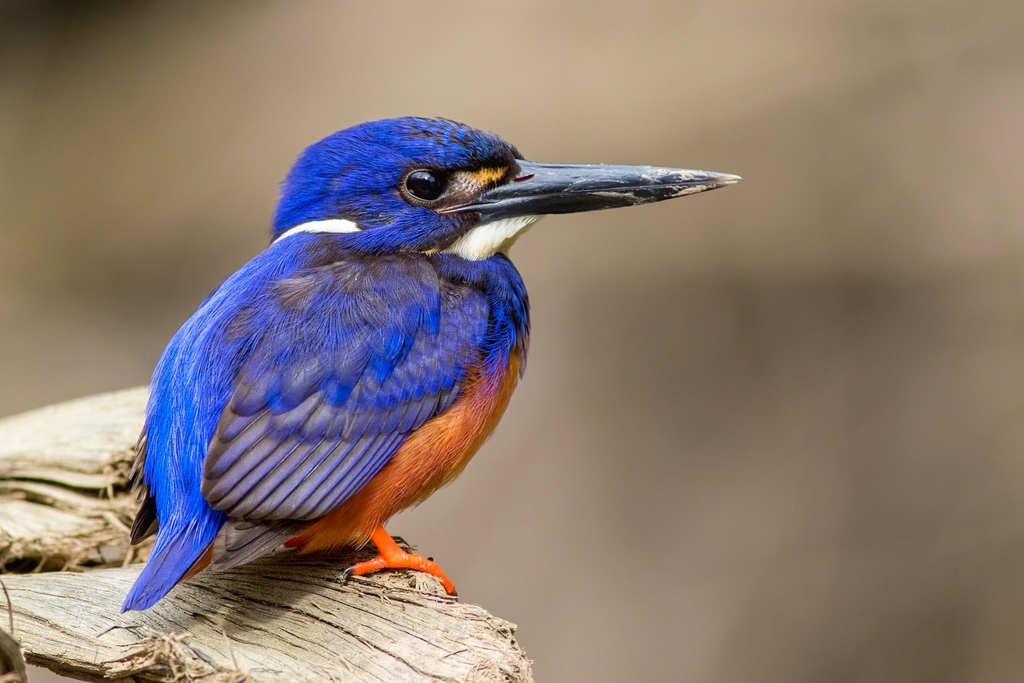
The azure kingfisher (Ceyx azureus) is a small kingfisher (17–19 centimetres (6.7–7.5 in)), in the river kingfisher subfamily, Alcedininae. It is found in Northern and Eastern Australia and Tasmania, as well as the lowlands of New Guinea and neighbouring islands, and out to North Maluku and Romang.
From the article Azure kingfisher on Wikipedia (CC BY-SA), quoted section by section
Description
The azure kingfisher measures 17–19 cm (6.7–7.5 in) in length, and the male weighs 29–32 g (1.0–1.1 oz) while the female is slightly heavier at 31–35 g (1.1–1.2 oz). It is a very colourful bird, with deep blue to azure back, a large white to buff spot on the side of the neck and throat, rufous-buff with some blue-violet streaks on the breast and flanks. The feet are red with only two forward toes. The lores (the region between the eye and the bill) are white and inconspicuous except in front view, where they stand out as two large white eye-like spots which may have a role in warding off potential predators.
Range & habitat
The azure kingfisher is found in northern and eastern Australia and Tasmania, as well as the lowlands of New Guinea and neighbouring islands, and out to North Maluku and Romang. The contact zone between the mainland Australian subspecies is along the east coast of Far North Queensland, between Cairns and Princess Charlotte Bay, and that of the New Guinea ones between Simbu Province and the northern Huon Peninsula, as well as south of Cenderawasih Bay. The habitat of the azure kingfisher includes the banks of vegetated creeks, lakes, swamps, tidal estuaries, and mangroves. It is common in the north of its range, tending to uncommon in the south. It is generally sedentary, although some seasonal migration may occur.
Wikipedia: “Distribution and habitat”
What it does
The azure kingfisher feeds on small fish, crustaceans (such as shrimps, amphipods and freshwater yabbies), water beetles, spiders, locusts, and small frogs or tadpoles. It is often difficult to see until it quickly darts from a perch above water.
Wikipedia: “Feeding”
Listen
Looking for field recordings…
Where it lives
Recorded sightings
—
geo-referenced records in GBIF, from museums, herbaria and field observers.
Drag the globe to turn it. Dots are where records exist, not a range map; darker means more records.
In the stacks
Searching the stacks…
Every page naming Ceyx azureus in the Biodiversity Heritage Library →
This page is assembled live from iNaturalist, GBIF, Wikipedia, the Source Library and the Internet Archive. It is not yet part of the hand-edited codex. iNaturalist taxon 144646.