- Animals
- ›Chordates
- ›Vertebrates
- ›Birds
- ›Shorebirds and Allies
- ›Gulls, Terns, and Skimmers
- ›True Terns
- ›Sternula
On eBird ↗
Damara Tern
Live sightings near you, the range map, bar charts of when it is seen, and Macaulay Library photos and recordings.
Damara Tern
Sternula balaenarum
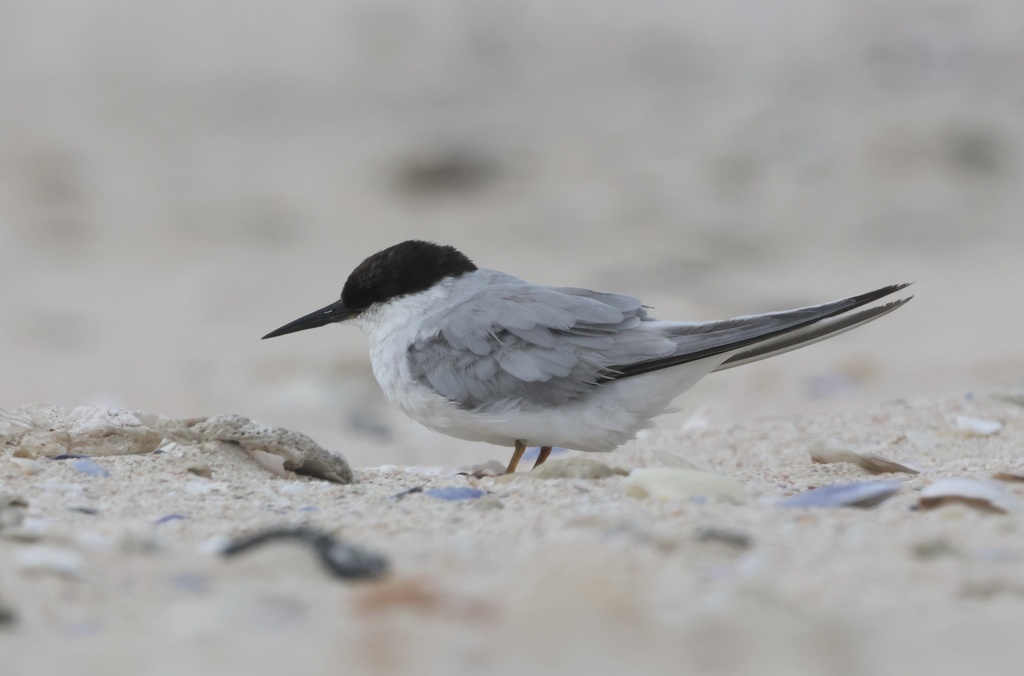
The Damara tern (Sternula balaenarum) is a species of small tern in the family Laridae which breeds in the southern summer in southern Africa and migrates to tropical African coasts to winter.
From the article Damara tern on Wikipedia (CC BY-SA), quoted section by section
Description
At 23 centimetres or 9.1 inches in length the Damara tern is a small, rather pale tern. In breeding plumage, the adult has a black cap extending from forehead onto the nape and a very pale grey back. In flight, it displays a black triangular wing tip which runs from the carpal joint to the tip of the wing. In non-breeding plumage the adult shows white on the forehead and crown, with a black mask around the eyes extending to the nape. Immature birds are marked with buff bars across the mantle.
Voice. The calls of the Damara tern are a high-pitched, sharp "tsit tsit" and quick, harsh "kid-ick".
Range & habitat
It breeds in western coastal Southern Africa from the Eastern Cape through the Western Cape and Northern Cape into Namibia and Angola; 98% of the population of 14,000 individuals nests in Namibia. The majority of non-breeding birds migrate north reaching Benin, Cameroon, Republic of the Congo, Democratic Republic of the Congo, Ivory Coast, Gabon, Ghana, Liberia, Nigeria, and Togo in the Atlantic, and a small number migrate northwards in the Indian Ocean to spend the non-breeding period in Mozambique. The Damara tern generally prefers shorelines in arid, desert regions particularly where there are sheltered bays, estuaries, lagoons and reefs. As breeding areas, it uses gravel plains between dunes and on salt pans.
Wikipedia: “Distribution and habitat”
Listen
Looking for field recordings…
Where it lives
Recorded sightings
—
geo-referenced records in GBIF, from museums, herbaria and field observers.
Drag the globe to turn it. Dots are where records exist, not a range map; darker means more records.
In the stacks
Searching the stacks…
Every page naming Sternula balaenarum in the Biodiversity Heritage Library →
This page is assembled live from iNaturalist, GBIF, Wikipedia, the Source Library and the Internet Archive. It is not yet part of the hand-edited codex. iNaturalist taxon 144535.