- Animals
- ›Chordates
- ›Vertebrates
- ›Birds
- ›Shorebirds and Allies
- ›Gulls, Terns, and Skimmers
- ›True Terns
- ›Sternula
On eBird ↗
Least Tern
Live sightings near you, the range map, bar charts of when it is seen, and Macaulay Library photos and recordings.
Least Tern
Sternula antillarum
The least tern (Sternula antillarum) is a species of tern that breeds in North America and locally in northern South America. It is closely related to, and was formerly often considered conspecific with, the little tern of the Old World. Other close relatives include the yellow-billed tern and Peruvian tern, both from South America.
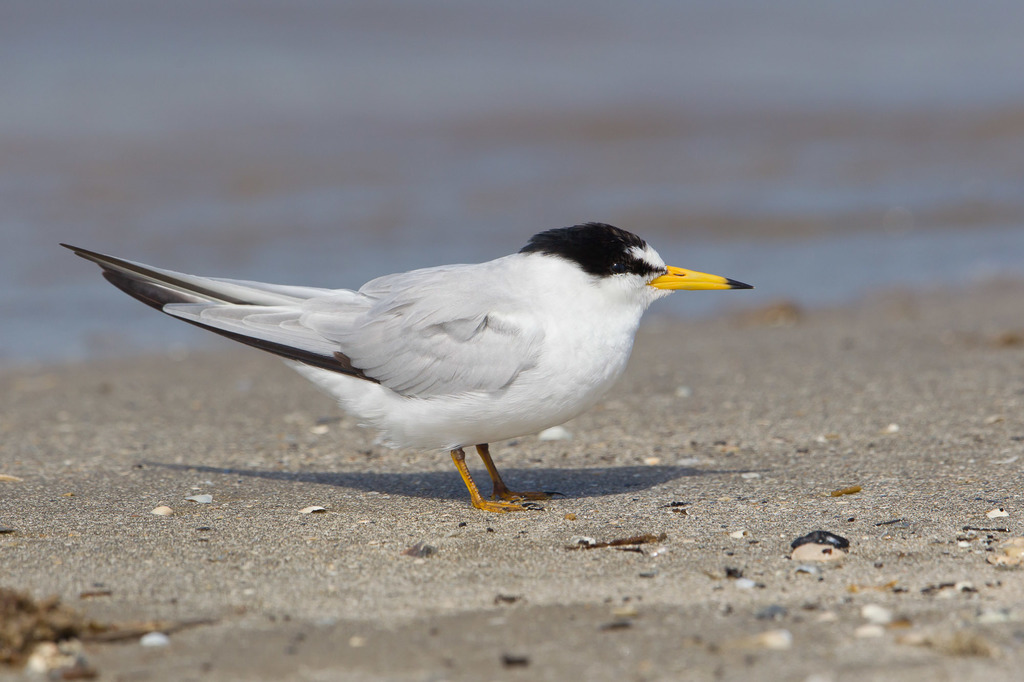
It is a small tern, 22–24 cm (8.7–9.4 in) long, with a wingspan of 50 cm (20 in), and weighing 39–52 g (1.4–1.8 oz). The upper parts are a fairly uniform pale gray, and the underparts white. The head is white, with a black cap and line through the eye to the base of the bill, and a small white forehead patch above the bill; in winter, the white forehead is more extensive, with a smaller and less sharply defined black cap. The bill is yellow with a small black tip in summer, all blackish in winter. The legs are yellowish. The wings are mostly pale gray, but with conspicuous black markings on their outermost primaries. It flies over water with fast, jerky wingbeats and a distinctive hunchback appearance, with the bill pointing slightly downward.
From the article Least tern on Wikipedia (CC BY-SA), quoted section by section
What it does
The least tern arrives at its breeding grounds in late April. The breeding colonies are not dense and may appear along either marine or estuarine shores, or on sandbar islands in large rivers, or in areas free from humans or predators. Courtship typically takes place removed from the nesting colony site, usually on an exposed tidal flat or beach. Only after courtship has confirmed mate selection does nesting begin by mid-May and is usually complete by mid-June. Courtship takes the form of either an aerial display in which the female follows the flight of the male or through courtship feeding. Nests are situated on barren to sparsely vegetated places near water, normally on sandy or gravelly substrates. In the southeastern United States, many breeding sites are on white gravel rooftops. In the San Francisco Bay region, breeding typically takes place on abandoned salt flats. Where the surface is hard, this species may use an artificial indentation (such as a deep dried footprint) to form the nest basin. The nest density may be as low as several per acre, but in San Diego County, densities of 200 nests per acre have been observed. Most commonly the clutch size is two or three, but it is not rare to consist of either one or four eggs. Adults are known to wet themselves and shake off the water over the eggs when arriving at the nest. …
Wikipedia: “Nesting and breeding behavior”
Listen
Looking for field recordings…
Where it lives
Recorded sightings
—
geo-referenced records in GBIF, from museums, herbaria and field observers.
Drag the globe to turn it. Dots are where records exist, not a range map; darker means more records.
In the stacks
Searching the stacks…
Every page naming Sternula antillarum in the Biodiversity Heritage Library →
This page is assembled live from iNaturalist, GBIF, Wikipedia, the Source Library and the Internet Archive. It is not yet part of the hand-edited codex. iNaturalist taxon 144530.