- Animals
- ›Chordates
- ›Vertebrates
- ›Birds
- ›Shorebirds and Allies
- ›Gulls, Terns, and Skimmers
- ›True Terns
- ›Sternula
On eBird ↗
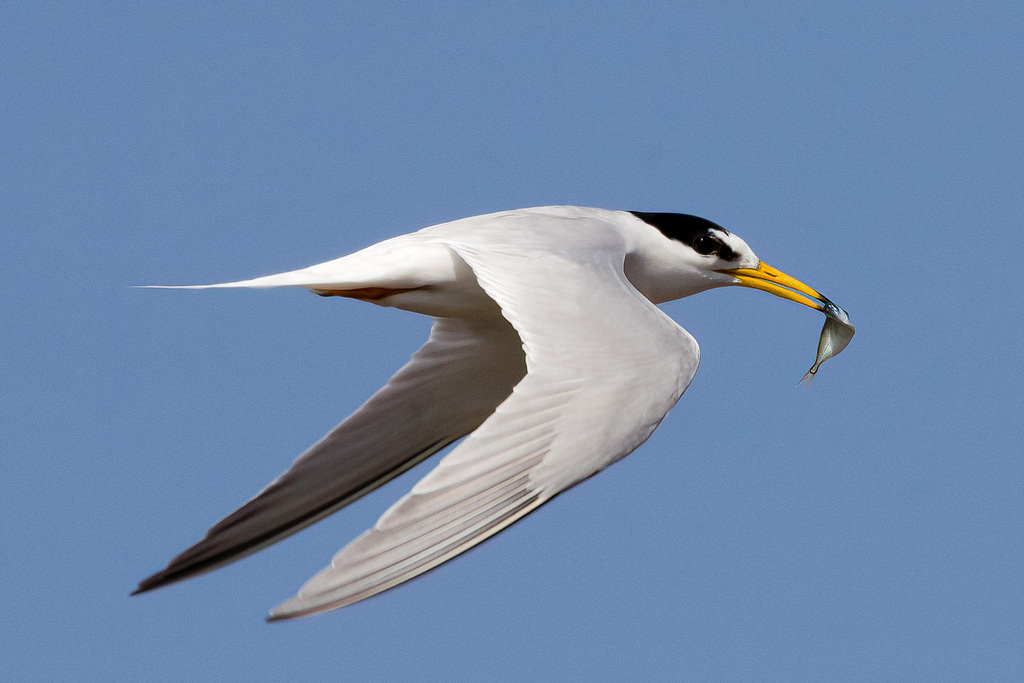
Little Tern
Live sightings near you, the range map, bar charts of when it is seen, and Macaulay Library photos and recordings.
Little Tern
Sternula albifrons
The little tern (Sternula albifrons) is a seabird of the family, Laridae. It was formerly placed into the genus Sterna, which now is restricted to the large white terns. The genus name is a diminutive of Sterna, "tern". The specific albifrons is from Latin albus, "white", and "frons", forehead. The former North American (S. a. antillarum) and Red Sea S. a. saundersi subspecies are now considered to be separate species, the least tern (Sternula antillarum) and...
From the article Little tern on Wikipedia (CC BY-SA), quoted section by section
Description
This is a small tern, 21–25 cm long with a 41–47 cm wingspan. It is not likely to be confused with other species, apart from fairy tern and Saunders's tern, because of its size and white forehead in breeding plumage. Its thin sharp bill is yellow with a black tip and its legs are also yellow. In winter, the forehead is more extensively white, the bill is black and the legs duller.
Range & habitat
This bird breeds on the coasts and inland waterways of temperate and tropical Europe, Asia, north and west Africa, and eastern Australia. Some populations are migratory, wintering in the subtropical and tropical oceans as far south as South Africa and New Zealand.
Wikipedia: “Distribution”
What it does
The little tern breeds in colonies on gravel or shingle coasts and islands. It lays two to four eggs on the ground. Like all white terns, it is defensive of its nest and young and will attack intruders. Like most other white terns, the little tern feeds by plunge-diving for fish, either in coastal saline environments, or inland, along larger rivers. The offering of fish by the male to the female is part of the courtship display. The call is a loud and distinctive creaking noise.
Wikipedia: “Habitat and behaviour”
Listen
Looking for field recordings…
Where it lives
Recorded sightings
—
geo-referenced records in GBIF, from museums, herbaria and field observers.
Drag the globe to turn it. Dots are where records exist, not a range map; darker means more records.
In the stacks
Searching the stacks…
Every page naming Sternula albifrons in the Biodiversity Heritage Library →
This page is assembled live from iNaturalist, GBIF, Wikipedia, the Source Library and the Internet Archive. It is not yet part of the hand-edited codex. iNaturalist taxon 144529.