- Animals
- ›Chordates
- ›Vertebrates
- ›Birds
- ›Shorebirds and Allies
- ›Gulls, Terns, and Skimmers
- ›True Terns
- ›Onychoprion
On eBird ↗
Sooty Tern
Live sightings near you, the range map, bar charts of when it is seen, and Macaulay Library photos and recordings.
Sooty Tern
Onychoprion fuscatus
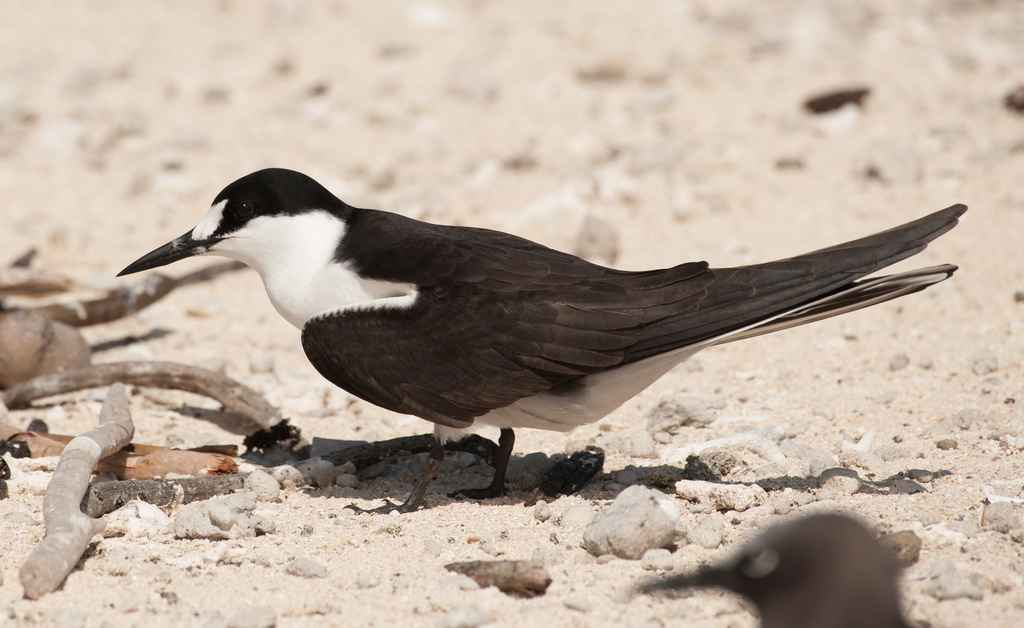
The sooty tern (Onychoprion fuscatus) is a tern in the family Laridae. It is a seabird of the tropical oceans and can fly for years at a time, skimming the sea surface for food, and returning to land only to breed, on islands throughout the equatorial zone.
From the article Sooty tern on Wikipedia (CC BY-SA), quoted section by section
Description
It is a medium-large tern, similar in size to the Sandwich tern (Thalasseus sandvicensis) at 36–45 cm (14–17.5 in) long with an 82–94 cm (32.5–37 in) wingspan. The wings and tail are long, and it has black to dark blackish-brown upperparts and white underparts, and a white forehead. The tail is moderately deeply forked (more deeply forked than in Thalasseus terns, but less deeply than most Sterna terns), black, with white outer edges. It has black legs and bill. The average life span is 32 years. Juvenile sooty terns are grey-black above and below with narrow pale fringes on the upperpart feathers giving a scaly appearance above, and whitish on only the lower belly. The sooty tern is unlikely to be confused with any tern apart from the similarly dark-backed but smaller bridled tern (O. anaethetus). It is darker-backed than that species, and has a broader white forehead and no pale neck collar. The call is a loud piercing 'wide-a-wake', also cited as ker-wack-a-wack; it also has a harsh alarm call kvaark.
What it does
Sooty terns breed in colonies on rocky or coral islands. It nests in a ground scrape or hole and lays a single egg, typically in the afternoon. Although "two-egg clutches" have been reported, they probably occur when an egg from one nest rolls into another. It feeds by picking fish from the surface in marine environments, often in large flocks, and rarely comes to land except to breed, and can stay out to sea for 3 to 10 years. Due to the lack of oil in its feathers, it cannot float, and spends that entire time on the wing. This bird is migratory and dispersive, wintering more widely through the tropical oceans. It has very marine habits compared to most terns; sooty terns are generally found inland only after severe storms. The Field Museum, for example, has a male specimen which was found exhausted on August 2, 1933 on the slopes of Mount Cameroon above Buea, about 1,000 m (3,300 ft) ASL, after foul weather had hit the Gulf of Guinea. This species is a rare vagrant to western Europe, although a bird was present at Cemlyn Bay, Wales for 11 days in July 2005. It is also not normally found on the Pacific coasts of the Americas due to its pelagic habits. …
Wikipedia: “Ecology”
In human culture
Colloquially, it is sometimes known as "wideawake" or "wideawake tern"; an onomatopoeic name derived from its call 'wide-a-wake', as is the Hawaiian name ʻewa ʻewa which roughly means "cacophony". In most of Polynesia its name is manutara or similar, literally "tern-bird", though it might be better rendered in English as "the tern" or "common tern". This refers to the fact that wherever Polynesian seafarers went on their long voyages, they usually would find these birds in astounding numbers. It is also known as kaveka in the Marquesas Islands, where dishes using its eggs are a delicacy. On Easter Island, this species and the spectacled tern (O. lunatus) are collectively known as manutara. The manutara played an important role in the tangata manu ("birdman") ritual: whichever hopu (champion) could retrieve the first manutara egg from Motu Nui islet would become that year's tangata manu; his clan would receive prime access to resources, especially seabird eggs.
Wikipedia: “In culture”
Listen
Looking for field recordings…
Where it lives
Recorded sightings
—
geo-referenced records in GBIF, from museums, herbaria and field observers.
Drag the globe to turn it. Dots are where records exist, not a range map; darker means more records.
In the stacks
Searching the stacks…
Every page naming Onychoprion fuscatus in the Biodiversity Heritage Library →
This page is assembled live from iNaturalist, GBIF, Wikipedia, the Source Library and the Internet Archive. It is not yet part of the hand-edited codex. iNaturalist taxon 144525.