On eBird ↗
Armenian Gull
Live sightings near you, the range map, bar charts of when it is seen, and Macaulay Library photos and recordings.
Armenian Gull
Larus armenicus
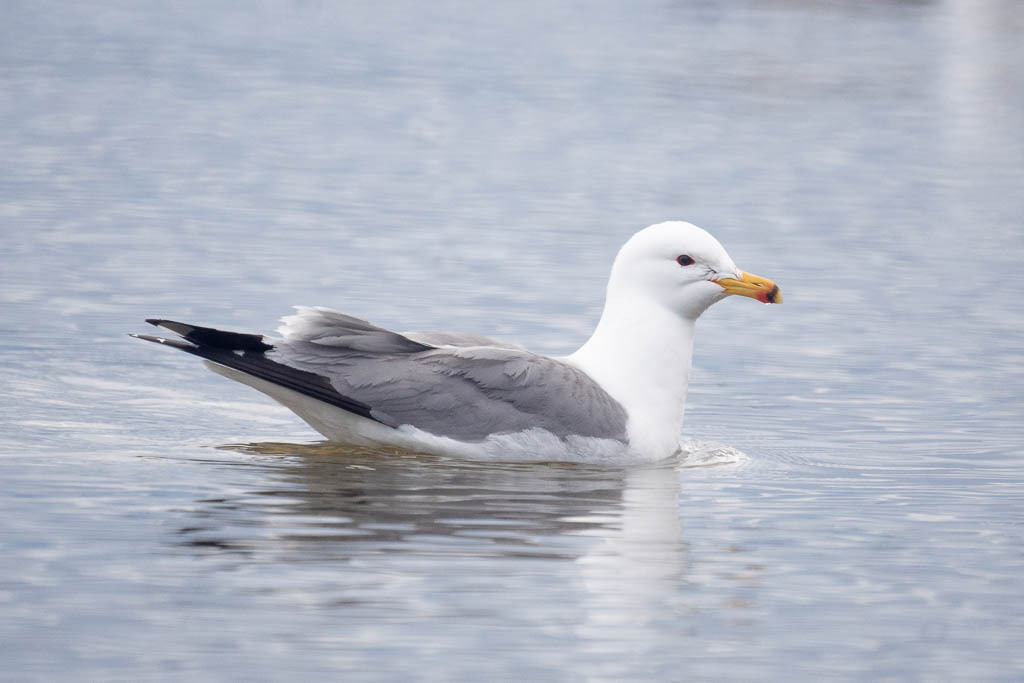
The Armenian gull (Larus armenicus) is a large gull found in the Caucasus and the Middle East. It was formerly classified as a subspecies of the European herring gull (L. argentatus), but is now generally considered to be a separate species, although BirdLife International lumps it with the yellow-legged gull (L. michahellis).
From the article Armenian gull on Wikipedia (CC BY-SA), quoted section by section
Description
The Armenian gull is a fairly large gull species, though it is on average the smallest of the "herring gull" complex. It can range from 52 to 62 cm (20 to 24 in), from 120 to 145 cm (47 to 57 in) across the wings, and weighs from 600 to 960 g (1.32 to 2.12 lb). Among standard measurements, its wing chord is 38.5 to 45.8 cm (15.2 to 18.0 in), its bill is 4.1 to 5.6 cm (1.6 to 2.2 in) and its tarsus is 5.7 to 6.4 cm (2.2 to 2.5 in). They are superficially similar to yellow-legged gulls but are slightly smaller with a slightly darker grey back and dark eyes. The area of black on the wingtips is more extensive with smaller white spots. The bill is short with a distinctive black band just before the tip. First-winter birds are mainly brown. They have a whitish rump, pale inner primary feathers, and a narrow, sharply defined black band on the tail. Although their ranges do not overlap, with its darkish mantle, both black and red near the tip of its bill and a dark eye, the Armenian gull bears a remarkable resemblance to the California gull (L. californicus) of North America.
Range & habitat
The Armenian gull nests beside mountain lakes in Georgia, Armenia, Turkey, and western Iran. The largest colonies are at Lake Sevan and Lake Arpi in Armenia. It is a partial migrant, with many birds wintering on the coasts of Turkey, Lebanon, and Israel. Smaller numbers reach Cyprus, Egypt, and the Persian Gulf.
Wikipedia: “Distribution and habitat”
Listen
Looking for field recordings…
Where it lives
Recorded sightings
—
geo-referenced records in GBIF, from museums, herbaria and field observers.
Drag the globe to turn it. Dots are where records exist, not a range map; darker means more records.
In the stacks
Searching the stacks…
Every page naming Larus armenicus in the Biodiversity Heritage Library →
This page is assembled live from iNaturalist, GBIF, Wikipedia, the Source Library and the Internet Archive. It is not yet part of the hand-edited codex. iNaturalist taxon 144523.