- Animals
- ›Chordates
- ›Vertebrates
- ›Birds
- ›Shorebirds and Allies
- ›Gulls, Terns, and Skimmers
- ›Gulls
- ›Hydrocoloeus
On eBird ↗
Little Gull
Live sightings near you, the range map, bar charts of when it is seen, and Macaulay Library photos and recordings.
Little Gull
Hydrocoloeus minutus
The little gull (Hydrocoloeus minutus) is a species of gull belonging to the family Laridae which is mainly found in the Palearctic with some small colonies in North America. It breeds on freshwater lakes and marshes, and spends winters at sea. It is the smallest species of gull in the world, and the only species in the monospecific genus Hydrocoloeus.
From the article Little gull on Wikipedia (CC BY-SA), quoted section by section
Description
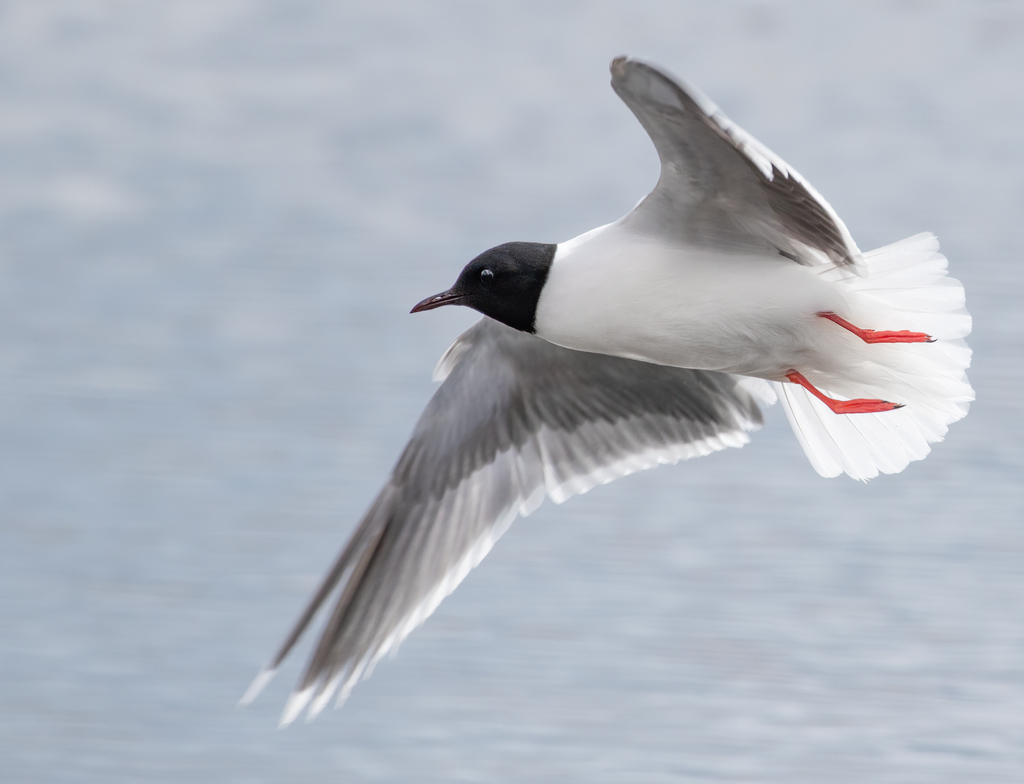
The little gull has a body length of 24 to 28 cm (9.4 to 11.0 in) and a wing span of 62 to 69 cm (24 to 27 in), making it the smallest gull species in the world. The adults in breeding plumage have a black hood, dark red bill, bright red legs, and sometimes a rosy flush to the underside. In non-breeding plumage the adults have a black cap and spot on the ear, white underparts, a black bill and the red on the legs is duller. In all plumages the adults have a pale grey back and upperwings with white primaries contrasting with very dark grey underwing. The juveniles have large areas of blackish colour on the back and head and in flight they have a dark "w" pattern on the upperwings with white underwings. By their first winter the head and body are similar to those of an adult but the upperwing pattern is retained. By their second year they have become very similar to the adults but have some black primary feathers.
Range & habitat
The little gull has a wide Palearctic distribution breeding from northern Scandinavia and the eastern Baltic Sea to eastern Siberia. They also breed in North America around the Great Lakes. It is a migratory species which winters along the coasts of Europe as far south as the Mediterranean, Black and Caspian Seas. They are uncommon in the western Pacific. In North America they winter along the Atlantic coasts in small numbers, as far south as the Carolinas. In the early 21st Century non-breeding birds have summered in western Europe in increasing numbers and in 2016 they successfully nested for the first time in Great Britain at the RSPB reserve at Loch of Strathbeg reserve in Aberdeenshire; they returned for a few days in May 2017, but did not breed again.
Wikipedia: “Distribution”
In human culture
The genus name Hydrocoloeus means "water jackdaw", from Ancient Greek hydro, water, and koloios, a jackdaw; Kaup, in naming the genus, compared the little gull to other gulls as he then went on to compare his new genus Coloeus for jackdaws to crows; Kaup had a personal theory of equivalence between members of different groups of birds based on their relative sizes. The specific minutus is Latin for "small".
Wikipedia: “Etymology”
Listen
Looking for field recordings…
Where it lives
Recorded sightings
—
geo-referenced records in GBIF, from museums, herbaria and field observers.
Drag the globe to turn it. Dots are where records exist, not a range map; darker means more records.
In the old herbals & bestiaries

In the stacks
Searching the stacks…
Every page naming Hydrocoloeus minutus in the Biodiversity Heritage Library →
This page is assembled live from iNaturalist, GBIF, Wikipedia, the Source Library and the Internet Archive. It is not yet part of the hand-edited codex. iNaturalist taxon 144512.