On eBird ↗
Common Scoter
Live sightings near you, the range map, bar charts of when it is seen, and Macaulay Library photos and recordings.
Common Scoter
Melanitta nigra
The common scoter (Melanitta nigra) is a large sea duck, 43–54 cm (17–21 in) in length, which breeds over the far north of Europe and Asia east to the Olenyok River. The genus name is derived from Ancient Greek melas, "black", and netta, "duck". The species name is from Latin niger "shining black". The black scoter (M. americana) of North America and eastern Siberia is sometimes considered a subspecies of M. nigra.
From the article Common scoter on Wikipedia (CC BY-SA), quoted section by section
Description
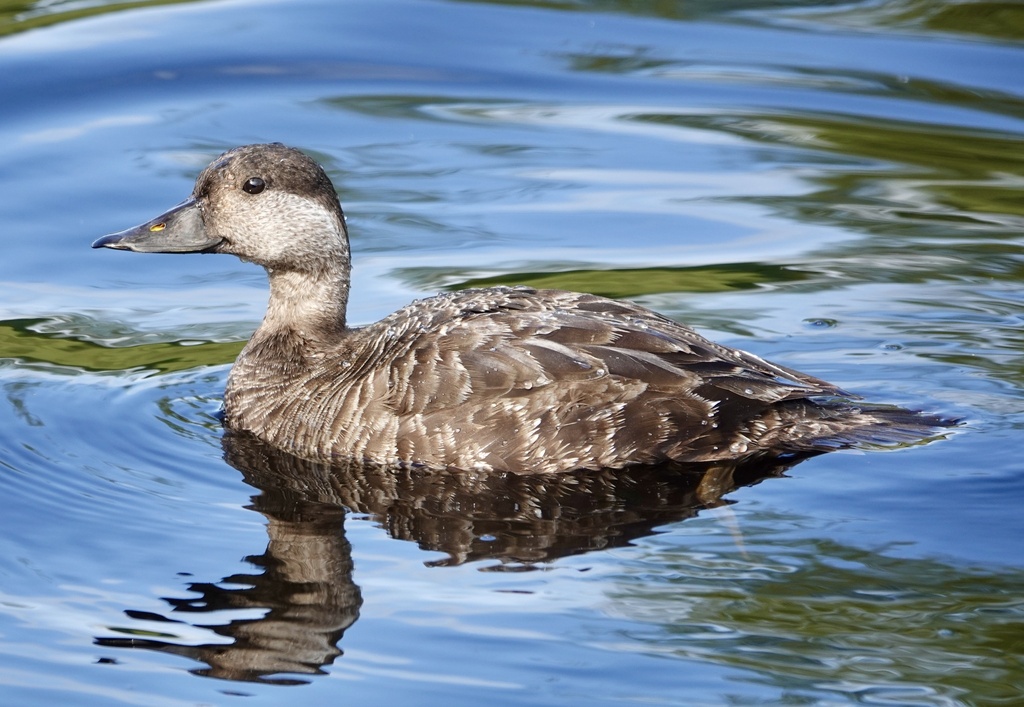
The common scoter is characterised by its bulky shape and large bill. The male is all black with a bulbous bill which shows some yellow coloration around the nostrils. The female is a brown bird with pale cheeks, very similar to female black scoter. This species can be distinguished from other scoters, apart from black scoter, by the lack of white anywhere on the drake and the more extensive pale areas on the female. The black scoter and common scoter have diagnosably distinct vocalisations.
What it does
It winters farther south in temperate zones, on the coasts of Europe as far south as Morocco. It forms large flocks on suitable coastal waters. These are tightly packed, and the birds tend to take off and dive together.
The lined nest is built on the ground close to the sea, lakes or rivers, in woodland or tundra. 6–8 eggs are laid. This species dives for crustaceans and molluscs; it also eats aquatic insects and small fish when on fresh water. The common scoter is one of the species to which the Agreement on the Conservation of African-Eurasian Migratory Waterbirds (AEWA) applies.
Wikipedia: “Behaviour and ecology”
Listen
Looking for field recordings…
Where it lives
Recorded sightings
—
geo-referenced records in GBIF, from museums, herbaria and field observers.
Drag the globe to turn it. Dots are where records exist, not a range map; darker means more records.
In the stacks
Searching the stacks…
Every page naming Melanitta nigra in the Biodiversity Heritage Library →
This page is assembled live from iNaturalist, GBIF, Wikipedia, the Source Library and the Internet Archive. It is not yet part of the hand-edited codex. iNaturalist taxon 144221.