On eBird ↗
Black-billed Magpie
Live sightings near you, the range map, bar charts of when it is seen, and Macaulay Library photos and recordings.
Black-billed Magpie
Pica hudsonia
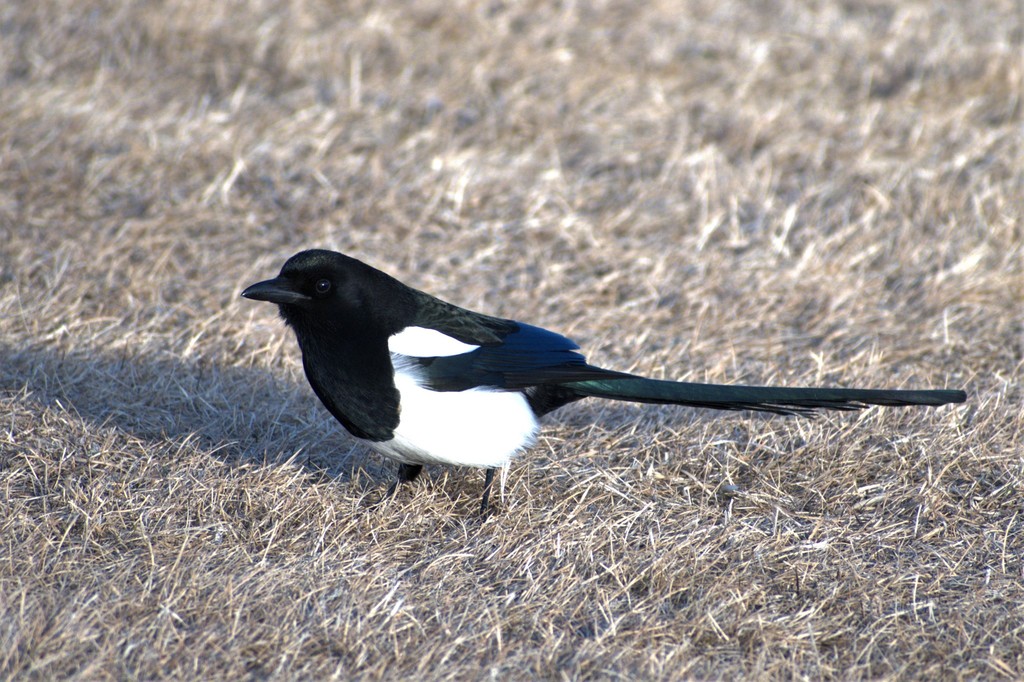
The black-billed magpie (Pica hudsonia), also known as the American magpie, is a bird in the corvid family found in the western half of North America. It is black and white, with the wings and tail showing black areas and iridescent hints of blue and blue-green. It was formerly treated as a subspecies of Pica pica (Eurasian magpie), but was separated as a species in its own in 2000 based on genetic studies.
This species prefers generally open habitats with clumps of trees, but can also commonly be found in farmlands and suburban areas. Historically associated with bison herds, it now lands on the backs of cattle to glean ticks and insects from them. Black-billed magpies commonly follow large predators, such as wolves, to scavenge from their kills. The species also walks or hops on the ground, where it obtains food items such as beetles, grasshoppers, worms, and small rodents.
From the article Black-billed magpie on Wikipedia (CC BY-SA), quoted section by section
Description
The black-billed magpie is an unmistakable bird within its range. It is a medium-sized bird that measures 45–60 cm (18–24 in) from tip to tail. It is largely black, with white scapulars, belly, and primaries, and the wings and tail are an iridescent blue-green. The tail is made up of long, layered feathers, the middle pair of which extend further than the rest. The beak is uniformly black, oblong, and weakly curved toward the tip. Adults also have black irises. Unlike most other members of the family Corvidae, the black-billed magpie is dimorphic in size and weight, though there can be overlap between the sexes. Males are, on average, 6–9% larger and 16–24% heavier than females, at 167–216 g (5.9–7.6 oz), an individual wing chord of 205–219 mm (8.1–8.6 in), and tail lengths of 230–320 mm (9.1–12.6 in). Females weigh between 141–179 g (5.0–6.3 oz), have individual wing chords of 175–210 mm (6.9–8.3 in), and tail lengths of 232–300 mm (9.1–11.8 in).
Juveniles have less iridescence on their wings and tail, buffier scapulars and belly, and they lack the distinctive long tail feathers. Their rectrices are typically rounder and narrower, and have more black on their wing-tips compared to mature adults. They also have pink mouth-linings and grey irises. …
Range & habitat
Black-billed magpies are generally non-migratory, however some winter movement does occur. While the exact reason for these movements is unknown, it is thought to be a result of postbreeding dispersal and a subsequent return to their nesting sites. This species ranges from coastal southern Alaska, southwest Yukon Territory, central British Columbia, Alberta, Saskatchewan, Manitoba, and northwestern Ontario in the north, through the Rocky Mountains down south to all the Rocky Mountain states including New Mexico, Colorado, Utah, Wyoming, Idaho, and some bordering states as well. The range can extend as far east as northern Minnesota and Iowa, with casual records in northern Wisconsin and upper Michigan, but is thought to be limited further east and south by high temperature and humidity. The species is absent in California west of the Cascades and Sierra Nevada ranges, where it is replaced by the yellow-billed magpie. During the breeding season the preferred habitat is riparian areas with thickets. The predilection for open habitats with clumps of trees means that the species lives in meadows and suburbs. Outside the breeding season, magpies can be found in their breeding habitat but also near feedlots, grain elevators, landfills, and around barns and houses.
Wikipedia: “Distribution and habitat”
What it does
The black-billed magpie is an opportunistic omnivore, eating whatever is readily available, including carrion, insects, seeds, berries, and nuts. When living near humans, they will also eat garbage and food from pets or livestock that are fed outside. They have been known to hunt rodents, reptiles, amphibians, small birds, and have also been seen eating eggs of other birds. Black-billed magpies primarily feed on animal matter during the summer, and in the winter switch to more vegetation. Chicks are fed animal matter almost exclusively. Magpies typically forage on the ground, scratching with their feet or beaks to turn over ground litter. They often follow large predators, such as wolves, to scavenge or steal from their kills. They sometimes land on large mammals, such as moose, cattle, or deer, to pick at the ticks that often plague these animals.
Black-billed magpies are also known to make food caches in the ground, in scatter-hoarding fashion. To make a cache, the bird pushes or hammers its bill into the ground (or snow), forming a small hole into which it deposits the food items it was holding in a small pouch under its tongue. It may, however, then move the food to another location, particularly if other magpies in the vicinity are watching. Cache robbing is fairly common, so a magpie often makes several false caches before a real one. …
Wikipedia: “Feeding”
Listen
Looking for field recordings…
Where it lives
Recorded sightings
—
geo-referenced records in GBIF, from museums, herbaria and field observers.
Drag the globe to turn it. Dots are where records exist, not a range map; darker means more records.
In the stacks
Searching the stacks…
Every page naming Pica hudsonia in the Biodiversity Heritage Library →
This page is assembled live from iNaturalist, GBIF, Wikipedia, the Source Library and the Internet Archive. It is not yet part of the hand-edited codex. iNaturalist taxon 143853.