On eBird ↗
Noisy Pitta
Live sightings near you, the range map, bar charts of when it is seen, and Macaulay Library photos and recordings.
Noisy Pitta
Pitta versicolor
The noisy pitta (Pitta versicolor) is a species of bird in the family Pittidae. The noisy pitta is found in eastern Australia and southern New Guinea. It eats earthworms, insects and snails. Its natural habitats are temperate forests, subtropical or tropical moist lowland forests, and subtropical or tropical moist montane forests.
From the article Noisy pitta on Wikipedia (CC BY-SA), quoted section by section
Description
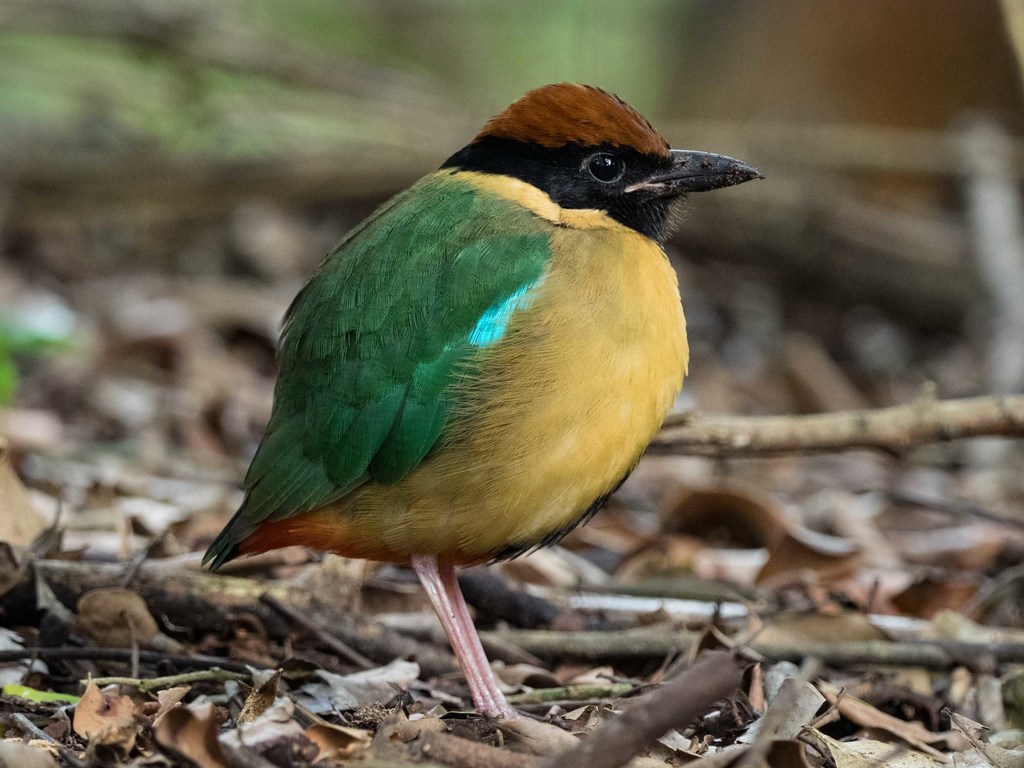
The noisy pitta is 19 to 21 cm (7.5–8.3 in) long. Males weigh 70–112 g (2.5–4.0 oz) and females 70–128 g (2.5–4.5 oz). It is a colourful bird. It has a black head and nape of neck with a chestnut crown. The wings are green with a turquoise front edge and the back is also green. The throat, breast and belly are lemon yellow. The tail is black and the under-tail coverts are orange-red. Juvenile birds resembled adults but are duller, with olive green on the wings and the buffy breast washed with grey, as is the throat and chin. The chestnut feathers of the crown are tipped with black and the lesser wing coverts lack any blue.
Range & habitat
The noisy pitta is found in forest habitats along the east coast of Australia. Its breeding range extends from the Torres Strait Islands and the northern tip of Cape York Peninsula southwards to the New South Wales/Victoria border. It occurs mainly in rainforest but is also sometimes found in drier woodland and scrub. Outside of Australia they may be found in southern New Guinea, where they are probably underreported and winter migrants. It has also been suggested that they breed in southern New Guinea.
Wikipedia: “Distribution and habitat”
What it does
The noisy pitta is a shy bird and its distinctive call is heard more often than the bird is seen. Because of this it has been suggested that the species is often overlooked when not calling.
Calls. Noisy pittas call most frequently in the morning with a secondary peak in calling around midday. Calling declines in the afternoon before spiking again at dusk. They also call at night. Seasonally, they call most frequently in the breeding season, with almost no calling between March and August. The call is usually repeated twice and consists of a sequence of three ascending notes, sometimes rendered as "walk-to-work".
Diet and feeding. The noisy pitta is a bird of the forest floor where it rummages through the leaf litter for the insects, woodlice, snails and other invertebrates on which it feeds. It bobs its head up and down and flicks its tail from side to side while it forages. Its diet includes some fruit and it cracks open the shells of molluscs such as the giant panda snail (Hedleyella falconeri) on an anvil, a stone or other hard surface habitually used for this purpose. Small lizards are also caught and bashed against hard surfaces before swallowing.
Breeding. Like other pittas this species nests in a concealed location on the ground. The breeding season peaks in late spring and early summer, although the timing varies by location. …
Wikipedia: “Behaviour”
Listen
Looking for field recordings…
Where it lives
Recorded sightings
—
geo-referenced records in GBIF, from museums, herbaria and field observers.
Drag the globe to turn it. Dots are where records exist, not a range map; darker means more records.
In the stacks
Searching the stacks…
Every page naming Pitta versicolor in the Biodiversity Heritage Library →
This page is assembled live from iNaturalist, GBIF, Wikipedia, the Source Library and the Internet Archive. It is not yet part of the hand-edited codex. iNaturalist taxon 14380.