- Animals
- ›Arthropods
- ›Hexapods
- ›Insects
- ›Winged and Once-winged Insects
- ›Butterflies and Moths
- ›Geometrid and Swallowtail Moths
- ›Geometer Moths
- ›Ennominae
- ›Boarmiini
- ›Biston
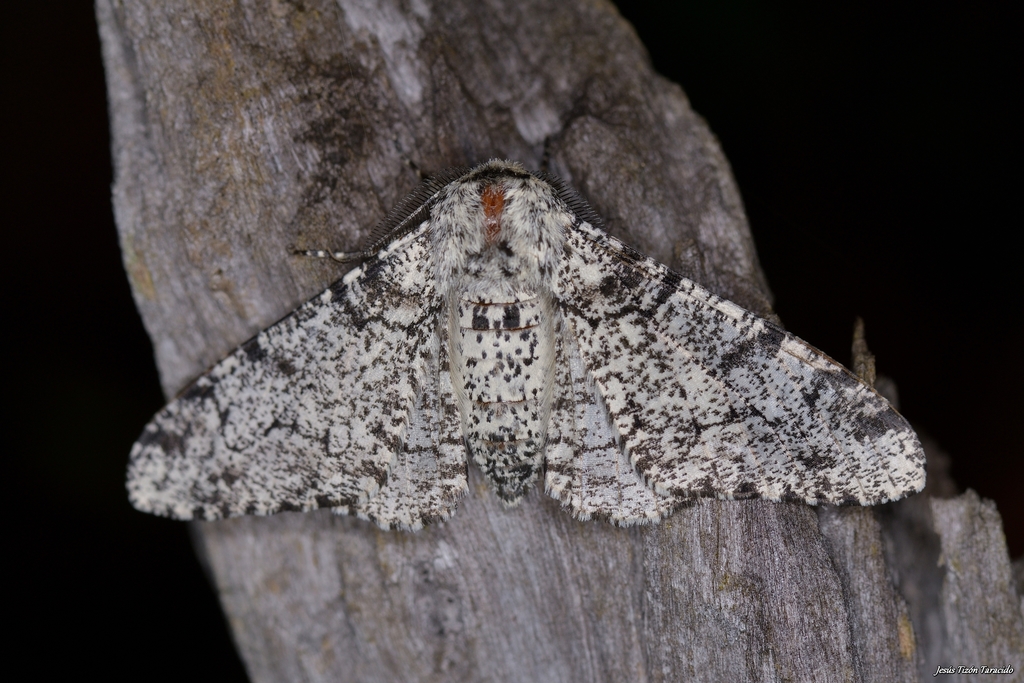
Peppered Moth
Biston betularia
The peppered moth (Biston betularia) is a moth of the family Geometridae. It is night flying, and found mainly in temperate regions of the northern hemisphere. Peppered moth evolution is an example of population genetics and natural selection.
The caterpillars of the peppered moth not only mimic the form but also the colour of a twig. Recent research indicates that the caterpillars can sense the twig's colour with their skin and match their body colour to the background to protect themselves from predators.
From the article Peppered moth on Wikipedia (CC BY-SA), quoted section by section
Description
The wingspan ranges from 45 to 62 mm (1.8 to 2.4 in) with a median of 55 mm (2.2 in). It is relatively stout-bodied, with forewings relatively narrow-elongate. The wings are white, "peppered" with black, and with more-or-less distinct cross lines, also black. These transverse wing lines and "peppered" maculation (spotting) can also, in rare instances, be grey or brown; the spotting pattern, in particularly very rare cases, is sometimes a combination of brown and black/grey. The black speckling varies in amount, in some examples it is almost absent, whilst in others it is so dense that the wings appear to be black sprinkled with white. The antennae of males are strongly bipectinate. Prout (1912–16) gives an account of the forms and congeners.
Range & habitat
Biston betularia is found in China (Heilongjiang, Jilin, Inner Mongolia, Beijing, Hebei, Shanxi, Shandong, Henan, Shaanxi, Ningxia, Gansu, Qinghai, Xinjiang, Fujian, Sichuan, Yunnan, Tibet), Russia, Mongolia, Japan, North Korea, South Korea, Nepal, Kazakhstan, Kyrgyzstan, Turkmenistan, Georgia, Azerbaijan, Armenia, Europe and North America.
Wikipedia: “Distribution”
What it does
In Great Britain and Ireland, the peppered moth is univoltine (i.e., it has one generation per year), whilst in south-eastern North America it is bivoltine (two generations per year). The lepidopteran life cycle consists of four stages: ova (eggs), several larval instars (caterpillars), pupae, which overwinter in the soil, and imagines (adults). During the day, the moths typically rest on trees, where they are preyed on by birds. The caterpillar is a twig mimic, varying in colour between green and brown. On a historical note, it was one of the first animals to be identified as being camouflaged with countershading to make it appear flat (shading being the main visual cue that makes things appear solid), in a paper by Edward Bagnall Poulton in 1887. Research indicates that the caterpillars can sense the twig's colour with their skin and match their body colour to the background to protect themselves from predators, an ability to camouflage themselves also found in cephalopods, chameleons and some fish, although this colour change is rather slower in the caterpillars. It goes into the soil late in the season, where it pupates in order to spend the winter. The imagines emerge from the pupae between late May and August, the males slightly before the females (this is common and expected from sexual selection). …
Wikipedia: “Ecology and life cycle”
Listen
Looking for field recordings…
Where it lives
Recorded sightings
—
geo-referenced records in GBIF, from museums, herbaria and field observers.
Drag the globe to turn it. Dots are where records exist, not a range map; darker means more records.
In the stacks
Searching the stacks…
Every page naming Biston betularia in the Biodiversity Heritage Library →
This page is assembled live from iNaturalist, GBIF, Wikipedia, the Source Library and the Internet Archive. It is not yet part of the hand-edited codex. iNaturalist taxon 143517.