- Animals
- ›Arthropods
- ›Hexapods
- ›Insects
- ›Winged and Once-winged Insects
- ›Butterflies and Moths
- ›Geometrid and Swallowtail Moths
- ›Geometer Moths
- ›Carpet Moths
- ›Xanthorhoini
- ›Xanthorhoe
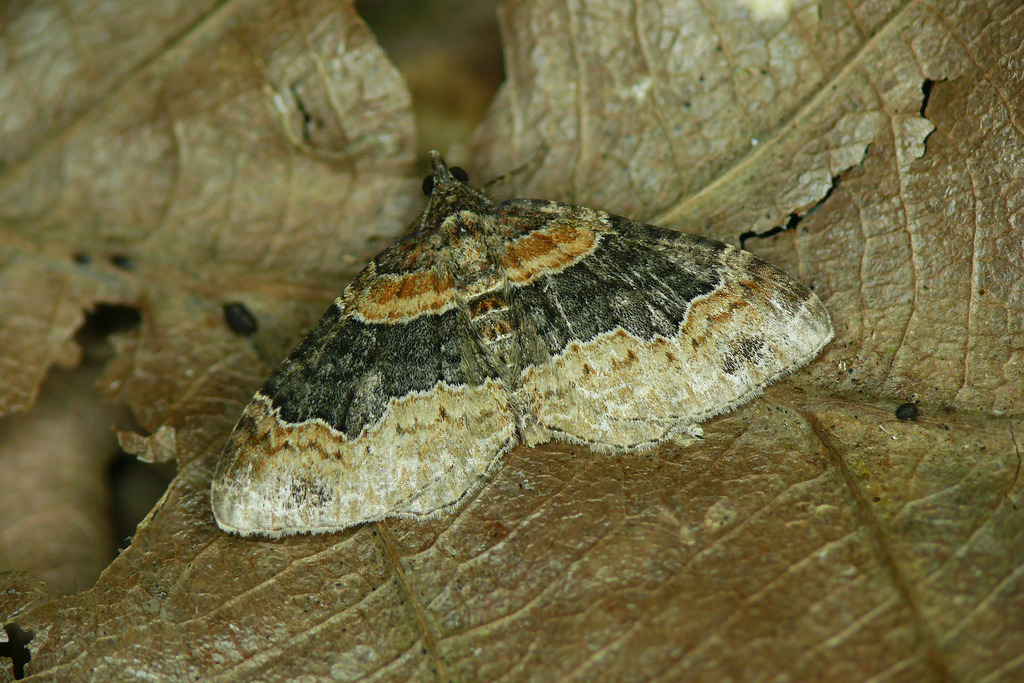
Dark-barred Twin-spot Carpet
Xanthorhoe ferrugata
Xanthorhoe ferrugata, the dark-barred twin-spot carpet, is a moth of the genus Xanthorhoe in the family Geometridae. It was first described by Carl Alexander Clerck in 1759 and has a Holarctic distribution.
From the article Xanthorhoe ferrugata on Wikipedia (CC BY-SA), quoted section by section
Description
The name-typical form of ferrugata as figured by Clerck and well described by Linné, has the median band reddish or purplish, the distal area very weakly marked (except the costal patch and two dark spots between the radials) often almost entirely white or whitish. An aberration, ab. unidentaria Haw. is a very common and very interesting aberration which has been proved, by my very extensive breeding experiments and those of Dr. Draudt, to be an almost perfect Mendelian "recessive". It differs in having the median band black, not reddish. — ab. coarctata Prout has the median band greatly narrowed, only 1–2 mm. in width; the rest of the markings often in part obsolete. - bilbainensis Fuchs, from Bilbao, said to be a local race, is described as smaller, narrower-winged, the distal edge of the median band more distinctly biangulate. I doubt its validity. — stupida Alph., from Issyk-kul, Tibet, W. Central China, etc., is rather larger, with whiter hindwing otherwise similar to ab. unidentaria. Xanthorhoe ferrugata is difficult to certainly distinguish from Xanthorhoe spadicearia (Denis & Schiffermüller, 1775). See Townsend et al. Xanthorhoe biriviata and Xanthorhoe vidanoi The larva is long and slender, naked except for a few short bristles and grey with some darker spots on the back.
Range & habitat
It is found in Europe and east to the Russian Far East, Siberia, Tibet and China, south to the Caucasus and Turkey. Also in North America (Alaska to Newfoundland and south to North Carolina and California).
Wikipedia: “Distribution”
Listen
Looking for field recordings…
Where it lives
Recorded sightings
—
geo-referenced records in GBIF, from museums, herbaria and field observers.
Drag the globe to turn it. Dots are where records exist, not a range map; darker means more records.
In the stacks
Searching the stacks…
Every page naming Xanthorhoe ferrugata in the Biodiversity Heritage Library →
This page is assembled live from iNaturalist, GBIF, Wikipedia, the Source Library and the Internet Archive. It is not yet part of the hand-edited codex. iNaturalist taxon 143485.