- Animals
- ›Arthropods
- ›Hexapods
- ›Insects
- ›Winged and Once-winged Insects
- ›Butterflies and Moths
- ›Geometrid and Swallowtail Moths
- ›Geometer Moths
- ›Ennominae
- ›Abraxini
- ›Ligdia
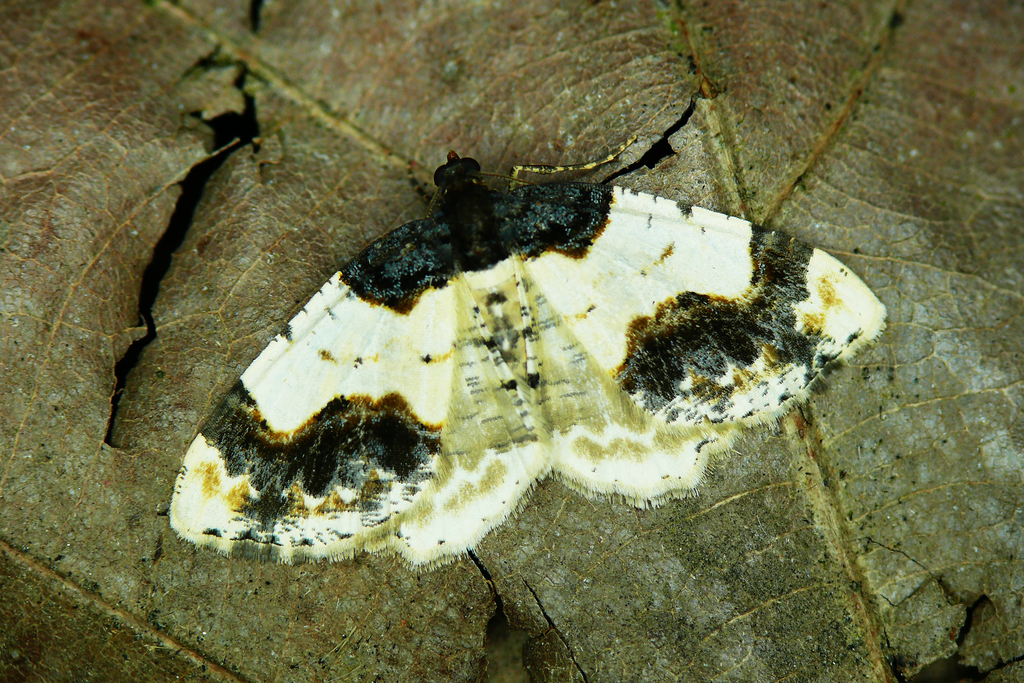
Scorched Carpet
Ligdia adustata
Ligdia adustata, the scorched carpet, is a moth of the family Geometridae.
From the article Ligdia adustata on Wikipedia (CC BY-SA), quoted section by section
Description
The wingspan is 25–30 mm. The basic color of the wings is glossy white, creamy white or light brownish. The basal area of the forewings is dark brown and can sometimes be slightly blue-grey. Across the forewings near the outer margin there is a blue-grey and brown wavy band. Hindwings are whitish with wavy pale brown lines on the slightly wavy outer edges. The underside of the wings is suffused with reddish brown.
Larvae are moderately stout, bright green with red dorsal spots, a red lateral blotch on the 1st—2nd abdominals and red marks on claspers; a rare variety is grey-brown. The pupae are red-brown with blackish wings. Ligdia adustata has two generations per year (bivoltine species). The adults fly in April–May, and later in July–August, but the flight season varies greatly, depending on the location within the distribution range. These moths are active from dusk onwards.
The larvae feed on spindle (Euonymus europaeus, Euonymus verrucosa) and on Berberis species. The species overwinters as a pupa.
Range & habitat
This moth is common in various environments, mainly in shrubs, deciduous forests, thickets, parks and gardens.
Wikipedia: “Habitat”
In human culture
The species Latin name adusta, meaning 'burnt', refers to the scorched appearance of the wings of these moths.
Wikipedia: “Etymology”
Listen
Looking for field recordings…
Where it lives
Recorded sightings
—
geo-referenced records in GBIF, from museums, herbaria and field observers.
Drag the globe to turn it. Dots are where records exist, not a range map; darker means more records.
In the stacks
Searching the stacks…
Every page naming Ligdia adustata in the Biodiversity Heritage Library →
This page is assembled live from iNaturalist, GBIF, Wikipedia, the Source Library and the Internet Archive. It is not yet part of the hand-edited codex. iNaturalist taxon 143432.