- Animals
- ›Arthropods
- ›Hexapods
- ›Insects
- ›Winged and Once-winged Insects
- ›Beetles
- ›Water, Rove, Scarab, Long-horned, Leaf, and Snout Beetles
- ›Cucujiform Beetles
- ›Darkling Beetles and Allies
- ›Blister Beetles
- ›Meloinae
- ›Epicautini
- ›Epicauta
- ›Epicauta
- ›Epicauta vittata
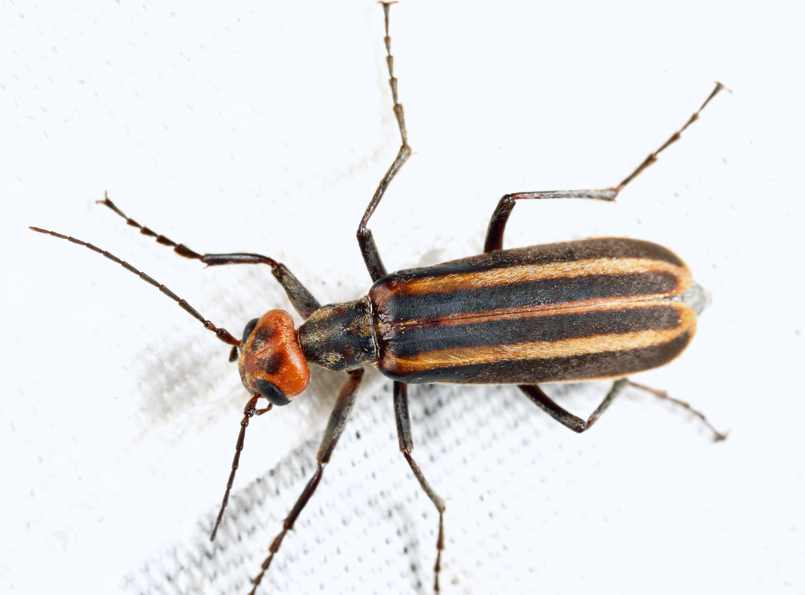
Striped Blister Beetle
Epicauta vittata
Epicauta vittata is a species of beetle in the family Meloidae, the blister beetles. It is native to eastern North America, including eastern Canada and the eastern United States. It is known commonly as the striped blister beetle and the old-fashioned potato beetle. It is known as an agricultural pest.
From the article Epicauta vittata on Wikipedia (CC BY-SA), quoted section by section
Description
The adult beetle is 9 to 17 millimeters long. It is long and slender, with a hairy, punctate body. The thorax is narrower than the head and abdomen. It is black and yellow, its color pattern varying across its geographical range. It has two black spots on the head, two black stripes on the thorax, and two or three black stripes on each elytron. Beetles from northern populations have two elytral stripes, and southern beetles have three. The larva, which is a triungulin, changes in appearance as it develops. The new larva is whitish and has long legs that allow it to be mobile. During this more mobile stage, it parasitizes a grasshopper egg case. From there, it becomes a sedentary grub. When it becomes a sedentary grub it darkens to a reddish-brown color with darker bands, and the legs shrink.
What it does
Many blister beetles have a complex developmental cycle in which the larva and pupa experience drastic changes in morphology between growth phases. There are one or two generations per year, with peak abundance of adults in the summer, or slightly earlier in more hospitable climate types. The adult female produces eggs about every 10 days. It deposits them in masses of 100 to 200 in a tubular chamber a few centimeters deep in the soil, then covers them. The eggs are whitish and about 2 millimeters long. They hatch within 16 days. The functional legs of the new larva allow it to seek its food, the egg of a grasshopper. As it feeds and develops at its food source, its legs become reduced. The striped blister beetle is associated with grasshopper species that produce large egg-pods, such as the two-striped grasshopper (Melanoplus bivittatus) and differential grasshopper (Melanoplus differentialis).
Wikipedia: “Life cycle”
Listen
Looking for field recordings…
Where it lives
Recorded sightings
—
geo-referenced records in GBIF, from museums, herbaria and field observers.
Drag the globe to turn it. Dots are where records exist, not a range map; darker means more records.
In the stacks
Searching the stacks…
Every page naming Epicauta vittata in the Biodiversity Heritage Library →
This page is assembled live from iNaturalist, GBIF, Wikipedia, the Source Library and the Internet Archive. It is not yet part of the hand-edited codex. iNaturalist taxon 143386.