On eBird ↗
Blue-capped Manakin
Live sightings near you, the range map, bar charts of when it is seen, and Macaulay Library photos and recordings.
Blue-capped Manakin
Lepidothrix coronata
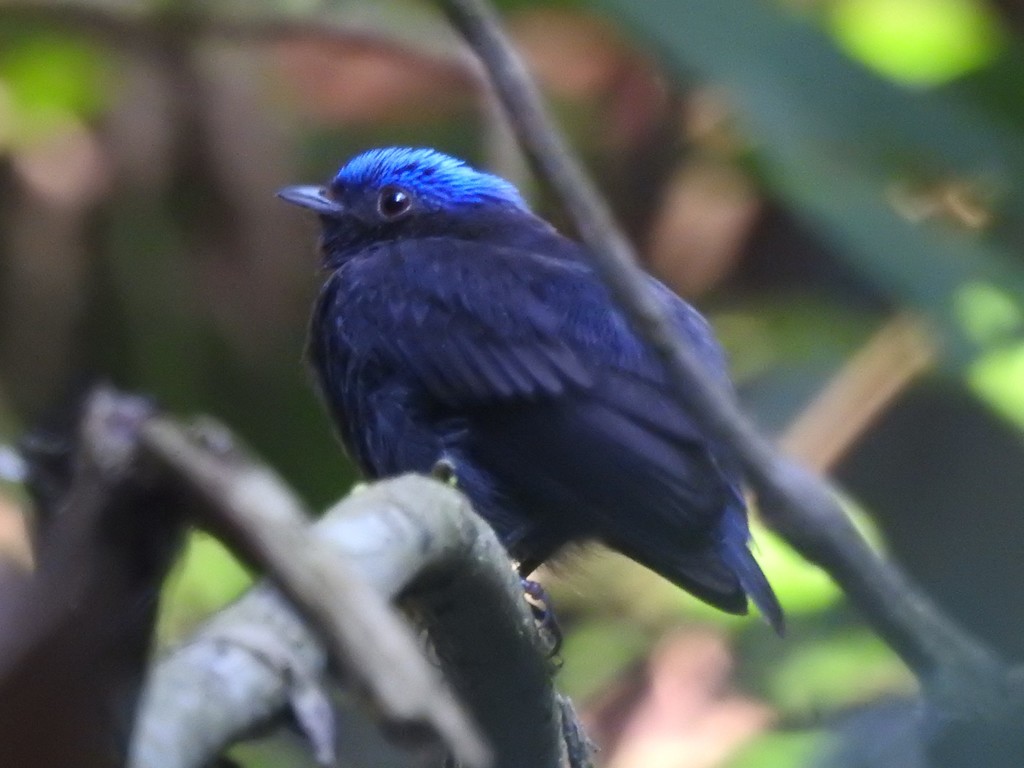
The blue-capped manakin (Lepidothrix coronata) is a species of bird in the family Pipridae. The males have a brilliant blue cap; some have black, others have green body plumage, but the relationship between the subspecies is not well understood.
It is found in Bolivia, Brazil, Colombia, Ecuador, Peru, and Venezuela. Its natural habitats are subtropical or tropical moist lowland forest and heavily degraded former forest.
From the article Blue-capped manakin on Wikipedia (CC BY-SA), quoted section by section
Description
Blue-capped manakins show sexual dimorphism in weight and wing chord length. Females are heavier at 9.8 g on average with a max weight of 11.5 g and a minimum weight of 8.5 g. Males are 8.5 g on average with a maximum weight of 9.5 g and a minimum weight of 7.5 g. Males have a wing chord length of 60.45 mm on average with a maximum length of 63 mm and a minimum length of 58 mm. Females have a wing chord length of 58.76 mm on average with a maximum length of 62 mm and a minimum length of 55 mm.
Males are sooty black with a bright blue crown while females are green. Juvenile plumage is similar to female plumage but is duller in color. Their first prebasic molt occurs within 2 months of leaving the nest and is a partial molt. Their second prebasic molt occurs at the end of the first breeding season or one year after their first prebasic molt. This molt is complete, so they lose their molt limits. At this stage, males gain signs of male plumage. The third prebasic molt occurs at the end of their third year and males gain full male plumage.
Vocalizations. The blue-capped manakin's contact call is a swee sound. It is used by blue-capped manakins of all ages and sex. Males will use it while perching on their song perch, while interacting with other blue-crowned manakins, and while performing some of their display behaviors. …
What it does
Blue-capped manakins are frugivores. Their diet includes fruit from Melastomataceae, Moraceae, Bromeliaceae, and Araceae. When feeding in a mixed flock, blue-capped manakins tend to flock with cinereus and dusty-throated antshrikes, and the white-flanked, Yasuni, long-winged, gray, and rufous-tailed stipplethroats. These flocks are typically only composed of one or two blue-capped manakins. When there are two blue-capped manakins in a flock, they forage independently from one another. Their behavior is never aggressive toward other species of birds in the flock. Both males and females forage in mixed flocks, but females spend more time on average in the flock. They forage in the understory between a height of 2–7 m. Their preferred food while in flocks are arthropods, including ants, flies, and other small insects. While catching arthropods, their hunting technique was often a sally-strike or sally-glean off of live foliage. Considering their normally frugivorous diet, it is speculated that the blue-capped manakins are taking advantage of the flock's ability to cause insects to scatter.
Wikipedia: “Food and feeding”
Listen
Looking for field recordings…
Where it lives
Recorded sightings
—
geo-referenced records in GBIF, from museums, herbaria and field observers.
Drag the globe to turn it. Dots are where records exist, not a range map; darker means more records.
In the stacks
Searching the stacks…
Every page naming Lepidothrix coronata in the Biodiversity Heritage Library →
This page is assembled live from iNaturalist, GBIF, Wikipedia, the Source Library and the Internet Archive. It is not yet part of the hand-edited codex. iNaturalist taxon 14328.