On eBird ↗
Lance-tailed Manakin
Live sightings near you, the range map, bar charts of when it is seen, and Macaulay Library photos and recordings.
Lance-tailed Manakin
Chiroxiphia lanceolata
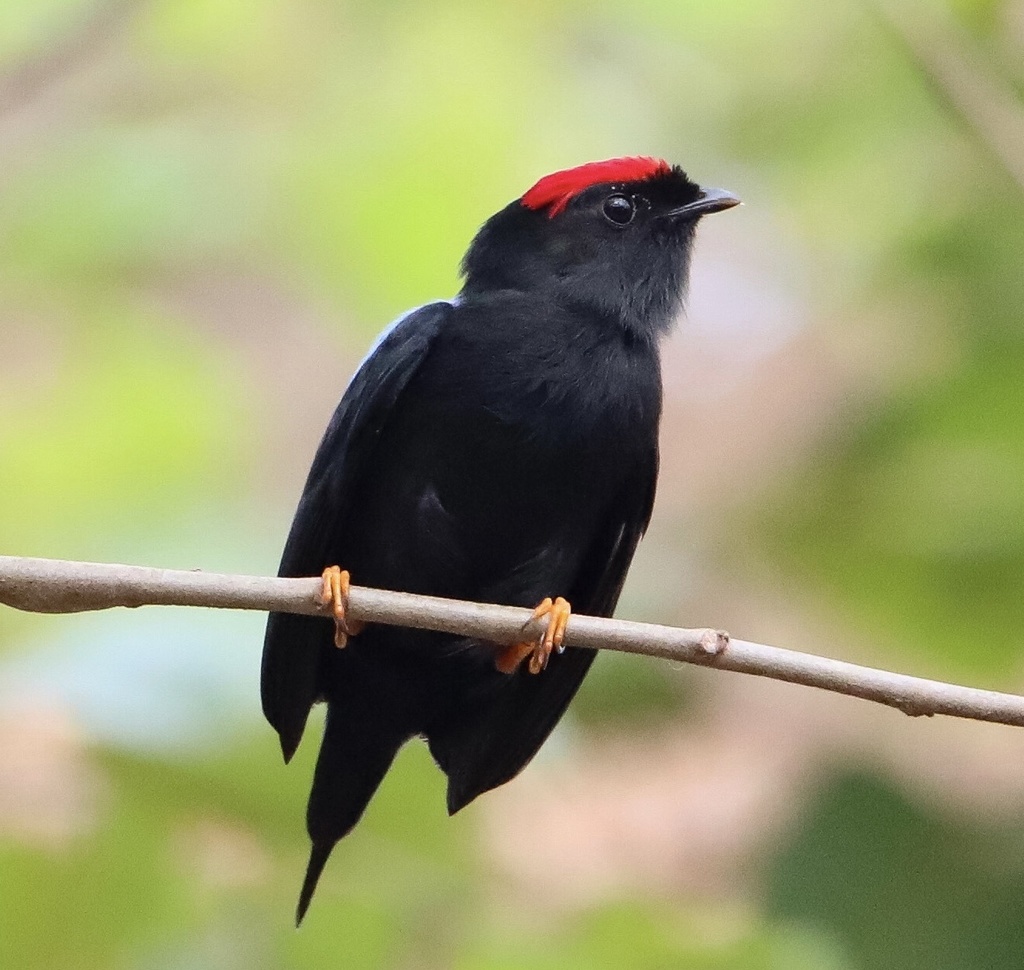
The lance-tailed manakin (Chiroxiphia lanceolata) is a small passerine bird which breeds in tropical Central and South America from Costa Rica to northern Venezuela. This manakin is a fairly common bird of dry and moist deciduous forests, but not rainforest. It is a small, compact bird about 13 centimetres (5 in) long and similar to the blue-backed manakin, but both sexes have the two central tail feathers elongated to form a spike. Males have black plumage with a blue back, a red crown and orange legs. Females and juveniles are olive-green with paler underparts. At breeding time, males are involved in a cooperative behaviour during which they jump up and down alternately. This is a fairly common species with a wide range, and the International Union for Conservation of Nature has rated its conservation status as being of "least concern".
From the article Lance-tailed manakin on Wikipedia (CC BY-SA), quoted section by section
Description
Like other manakins, the lance-tailed manakin is a compact, brightly coloured forest bird, typically 13.5 cm long and weighing 17.5 g. Both sexes have bring orange legs and two central tail feathers elongated to form a spike. Females are olive-green, with slightly paler underparts. Most females are solid green, however, a small portion have tawny or red caps. Adult males are mostly black, with a red cap and sky-blue back. Young males are olive but show a red cap and the start of a blue back as they mature. Male lance-tailed manakins do not reach their full adult plumage until approximately 26 months after hatching. This species is similar to blue-backed manakin, Chiroxiphia pareola, which breeds further south and east, but the latter lacks the spiky tail, and the male has a somewhat darker blue back.
What it does
The male lance-tailed manakin has an interesting breeding display, unusual in that it is cooperative rather than competitive. Two males perch next to each other on a bare stick and jump up and down alternately, sometimes giving short flights. Groups of birds may perform together, with a different stick for each pair of displaying males. The female builds a cup nest in a tree; two brown-mottled cream eggs are laid, and incubated entirely by the female for about 20 days. The lance-tailed manakin has a number of calls, including a Toe-LEE-do, a curry-ho, and a frog-like buzzing croak given by displaying males. These manakins eat fruit and some insects.
Wikipedia: “Ecology”
Listen
Looking for field recordings…
Where it lives
Recorded sightings
—
geo-referenced records in GBIF, from museums, herbaria and field observers.
Drag the globe to turn it. Dots are where records exist, not a range map; darker means more records.
In the stacks
Searching the stacks…
Every page naming Chiroxiphia lanceolata in the Biodiversity Heritage Library →
This page is assembled live from iNaturalist, GBIF, Wikipedia, the Source Library and the Internet Archive. It is not yet part of the hand-edited codex. iNaturalist taxon 14308.