On eBird ↗
African Woolly-necked Stork
Live sightings near you, the range map, bar charts of when it is seen, and Macaulay Library photos and recordings.
African Woolly-necked Stork
Ciconia microscelis
The African woolly-necked stork or African woollyneck (Ciconia microscelis) is a species of large wading bird in the stork family Ciconiidae. It breeds singly, or in small loose colonies. It is distributed in a wide variety of habitats including marshes in forests, agricultural areas, and freshwater wetlands across Africa.
From the article African woolly-necked stork on Wikipedia (CC BY-SA), quoted section by section
Description
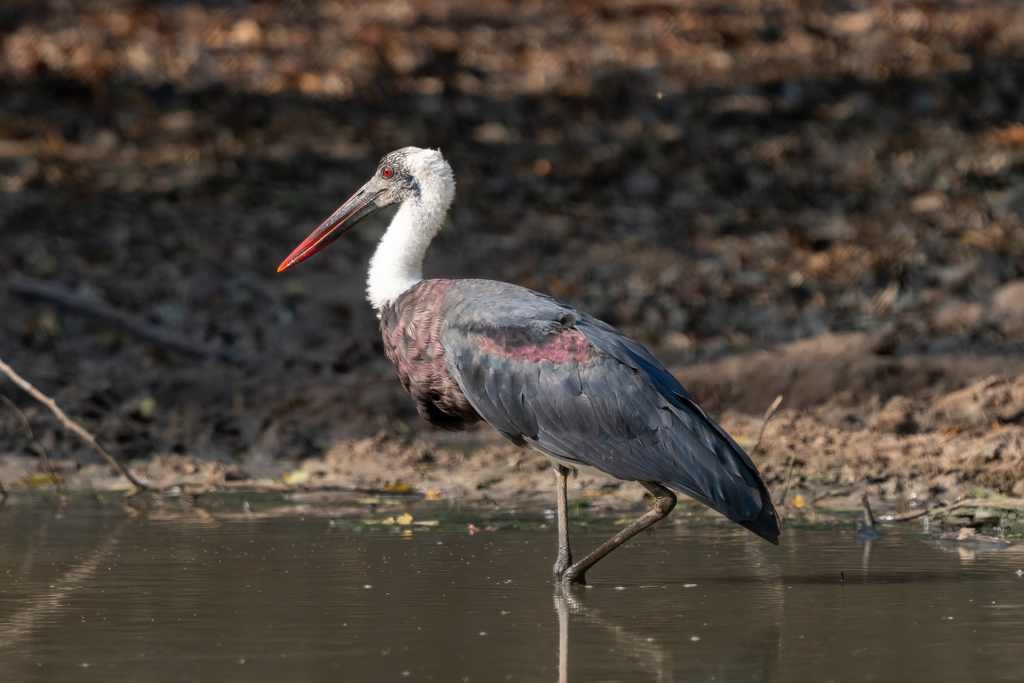
The African woolly-necked stork is a medium-sized stork at 75–92 cm tall. The iris is deep crimson or wine-red. The stork is glistening black overall with a black "skull cap", a downy white neck which gives it its name. The lower belly and under-tail coverts are white, standing out from the rest of the dark coloured plumage. Feathers on the fore-neck are iridescent with a coppery-purple tinge. These feathers are elongated and can be erected during displays. The tail is deeply forked and is white, usually covered by the black long under tail coverts. It has long red legs and a heavy, blackish bill, though some specimens have largely dark-red bills with only the basal one-third being black. Sexes are alike. Juvenile birds are duller versions of the adult with a feathered forehead that is sometimes streaked black-and-white. The African birds are described as having the edges of the black cap diffused or with a jagged border compared to a sharp and clean border in the Asian birds. Sexes are identical, though males are thought to be larger. When the wings are opened either during displays or for flight, a narrow band of very bright unfeathered skin is visible along the underside of the forearm. …
Range & habitat
It is a widespread tropical species which breeds across much of western, eastern and south-central Africa. It is a resident breeder building nests on trees located on agricultural fields or wetlands, on natural cliffs, and on cell phone towers. They use a variety of freshwater wetlands including seasonal and perennial reservoirs and marshes, crop lands, irrigation canals and rivers. They are attracted to fires in grasslands and crop fields where they capture insects trying to escape the fire. They use ponds and marshes inside forests in both Africa. They use coastal areas in Africa also, and birds on the Kenya coast foraging in coral reefs and mudflats. In KwaZulu Natal, South Africa, they are accustomed to people feeding them, and nest on exotic tree species in sub-urban areas.
Wikipedia: “Distribution and habitat”
What it does
Several calls by adult birds have been described including bisyllabic whistles given along with displays at the nest, and a fierce hissing sound when a bird was attacked by a trained falcon. The African woolly-necked stork is a broad winged soaring bird, which relies on moving between thermals of hot air for sustained long distance flight. Like all storks, it flies with its neck outstretched. It has also been observed to 'roll, tumble and dive at steep angles' in the air with the wind through its quills making a loud noise. Adult birds have also been observed diving from nests before flying away abruptly in a 'bat-like flight'. This species is largely seen as single birds, in pairs, or in small family groups of 4–5. While flocks are uncommon, they occur in all parts of the distribution range of the species and can be seen in all seasons. Flocking is affected by different factors in different areas. In more arid areas, most of the flocks occur in the summer when few wetlands are remaining, whereas in areas with more water, flocks occur largely in winter after chicks have fledged from nests.
Diet. The African woolly-necked stork walks slowly and steadily on the ground seeking its prey, which like that of most of its relatives, consists of amphibians, reptiles and insects. …
Wikipedia: “Behaviour”
Listen
Looking for field recordings…
Where it lives
Recorded sightings
—
geo-referenced records in GBIF, from museums, herbaria and field observers.
Drag the globe to turn it. Dots are where records exist, not a range map; darker means more records.
In the stacks
Searching the stacks…
Every page naming Ciconia microscelis in the Biodiversity Heritage Library →
This page is assembled live from iNaturalist, GBIF, Wikipedia, the Source Library and the Internet Archive. It is not yet part of the hand-edited codex. iNaturalist taxon 1429237.