On eBird ↗
Velvet Asity
Live sightings near you, the range map, bar charts of when it is seen, and Macaulay Library photos and recordings.
Velvet Asity
Philepitta castanea
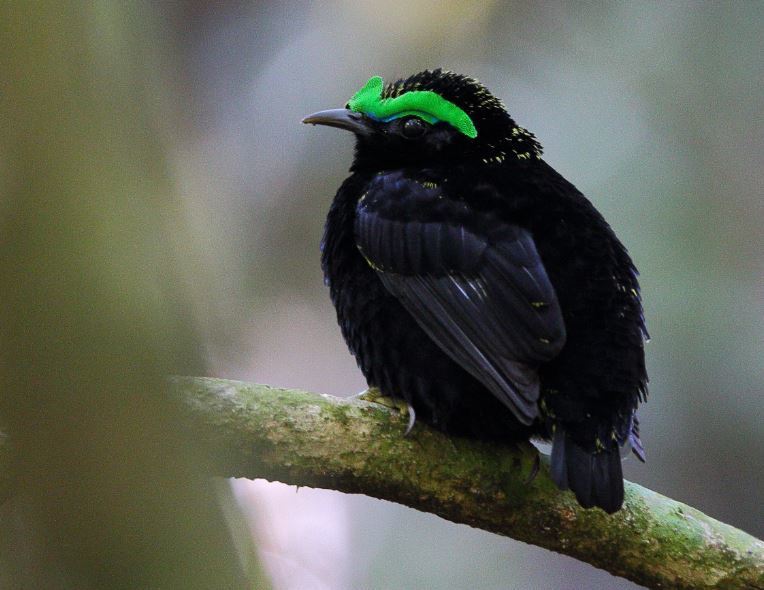
The velvet asity (Philepitta castanea) is a bird species in the family Philepittidae that is endemic to Madagascar. Its natural habitat is subtropical or tropical moist lowland forests. Non-breeding males have yellow-tipped feathers, while breeding males have a velvety black plumage with a pair of green fleshy supraorbital caruncles above the eyes. Adult females are greenish and have underparts striped with pale yellow-green longitudinal lines. Velvet asities eat berries and other fruits in the undergrowth. They build hanging nests with a little roof over the entrance. The species is listed as “Least Concern” on the IUCN Red List.
From the article Velvet asity on Wikipedia (CC BY-SA), quoted section by section
Description
The velvet asity has a minimum longevity of about 7 years. Its body is small and plump, measuring ~14–16.5 cm in length and weighing ~38.9 g. The tail (~42.5 mm) and wings (~82.1 mm) are rounded and short. The bill is slightly decurved and narrow, measuring ~18.1 mm in length and ~6.0 mm in width. The legs are relatively short.
The morphology of the velvet asity is not suited for strong or sustained flight because of its poor wing structure and chunky body. Instead, it is well adapted for perch foraging, where its short and narrow bill allows it to easily pick fruit from a perch.
Sexual dimorphism. The male and female velvet asity are both similar in size but strongly sexually dimorphic. The adult female has dull green upperparts with brown-olive wings and tail. Its underparts are dark olive and marked with pale yellow-green longitudinal stripes. The ear-coverts are dark olive green, with a creamy stripe that extends from the base of the bill. The bill is black and the eyes are dark brown. Juveniles are similar in appearance to adult females.
When newly molted, non-breeding males have a black throat, with most feathers tipped in olive-green, especially on the wings, breast, and belly. During the breeding season, the green tips disappear, and the feathers turn velvety black. …
Range & habitat
The velvet asity is endemic to Madagascar and is distributed along the eastern side and northwestern corner of the island, between sea level and altitudes of 1,800 m. It is commonly found in Ranomafana National Park (southeastern Madagascar) and the mountainous rainforests of Masoala National Park (northeastern Madagascar). Velvet asities live in subtropical or tropical moist lowland forests. More specifically, they inhabit primary and secondary rainforests, as well as forested areas bordering zones affected by human disturbance (adjacent degraded rainforests). The species tends to favor locations with an open understory, especially along valley sides and bottoms. It has been recorded at both low and mid-elevations, but is most commonly found between 600 and 1,400 m. It is uncommon below 400 m and above 1,600 m, and is absent from montane sclerophyllous forests.
Wikipedia: “Distribution and habitat”
What it does
The velvet asity is the only frugivorous bird species feeding in understory shrubs in Madagascar’s rainforests. It consumes small fleshy fruits (5–10 mm in diameter) that typically contain one or two seeds. Fruits eaten are mostly red and orange in colour, but they can also be yellow, white, dark blue, or black. The velvet asity picks fruit while perched or in mid-air during a brief hover.
Since the species eats a wide variety of fruiting plants, it is considered a generalist forager. Key plant families in its diet include Rubiaceae, Myrsinaceae, Euphorbiaceae, Piperaceae, and Melastomataceae. Plants belonging to the genera Oncostemum, Psychotria, Jasminum, Macaranga, Pittosporum, and Chassalia are also important food sources. Fruits brought to nestlings are mainly from Tambourissa spp. and Aphloia theiformis shrubs. Small seeds are defecated (1–2 mm in diameter) while larger seeds are usually regurgitated. This process contributes to the seed dispersal of shrubs, which is essential to support the regeneration of Madagascar's rainforests. Seasonally, the velvet asity feeds on nectar, particularly from terrestrial and shrub-layer plants such as Bakerella. It can also occasionally consume arthropods (spiders and caterpillars).
Wikipedia: “Diet”
Listen
Looking for field recordings…
Where it lives
Recorded sightings
—
geo-referenced records in GBIF, from museums, herbaria and field observers.
Drag the globe to turn it. Dots are where records exist, not a range map; darker means more records.
In the stacks
Searching the stacks…
Every page naming Philepitta castanea in the Biodiversity Heritage Library →
This page is assembled live from iNaturalist, GBIF, Wikipedia, the Source Library and the Internet Archive. It is not yet part of the hand-edited codex. iNaturalist taxon 14209.