On eBird ↗
White-eyed Robin
Live sightings near you, the range map, bar charts of when it is seen, and Macaulay Library photos and recordings.
White-eyed Robin
Pachycephalopsis poliosoma
The white-eyed robin (Pachycephalopsis poliosoma) is a medium-sized bird weighing between 35 and 42 grams and measuring around 15 to 16.5 centimeters in length. It is found in Indonesia and Papua New Guinea.
From the article White-eyed robin on Wikipedia (CC BY-SA), quoted section by section
Description
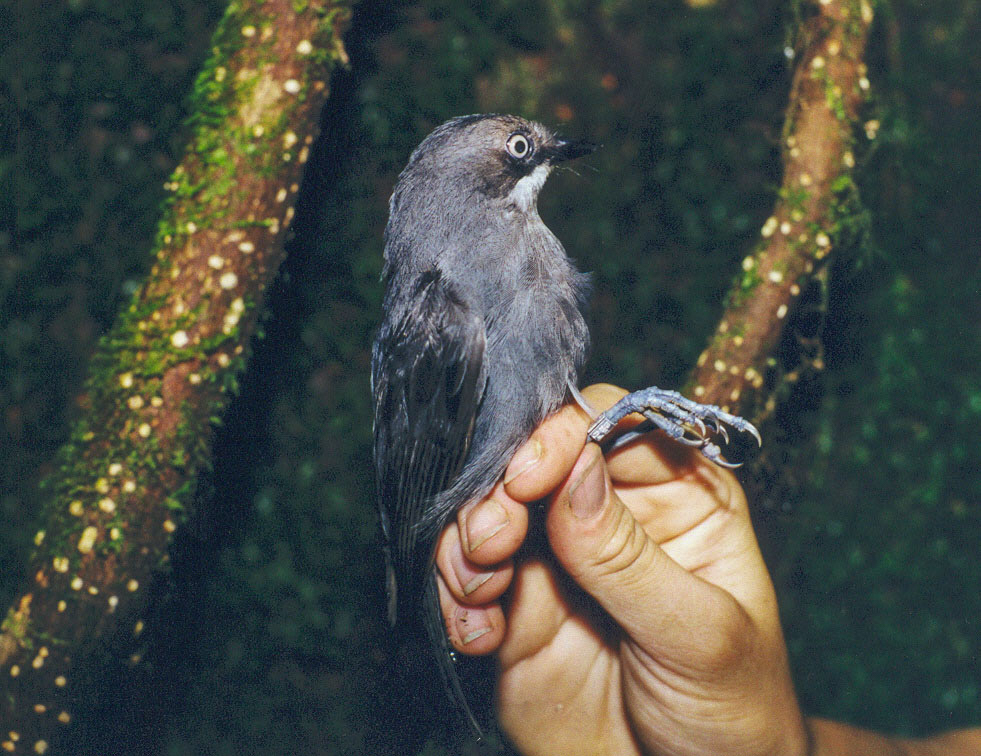
It is dark grey with a black eye-stripe, a brown tail and a white throat. Its bill is short and its eyes are brown. It has a strong, sturdy body with gray feathers that are slightly lighter on the belly. Its face and wings are darker, which makes its pale eyes stand out. Its eyes contrast against its dark facial features and gray throat, making it easy to recognize.
Range & habitat
Its natural habitat is subtropical or tropical moist montane forest. It lives in the hills and montane forests of New Guinea, where it prefers areas with lots of plants and trees. These spots provide good cover and plenty of food. The white-eyed robin often sits on low branches, where it monitors the ground, watching for prey. Its habitat is similar to that of other robins, such as the slaty (Melanodryas cyanus) and smoky robins (Peneothello cryptoleuca). Each tends to stick to a specific level within the forest, minimizing competition. The white-eyed robin shares its habitat with many other species, showing how adaptable it is. These forests vary greatly in temperature and elevation, requiring flexibility.
Wikipedia: “Habitat”
What it does
The white-eyed robin mainly eats insects, and it hunts using a "sit-and-wait" approach. It perches quietly on a low branch, watching for any movement that could mean food. When it has the chance, it eats eggs or nestlings.
The white-eyed robin is known best for its unique sound, which starts as a loud, raspy whistle. As it continues, the sounds become rougher and quicker, possibly reflecting excitement or agitation. Its loud whistle is used to call a mate or warn others to stay away from its territory. Its recognizable call helps the bird communicate within its environment and even alert others to danger.
Wikipedia: “Behavior”
Listen
Looking for field recordings…
Where it lives
Recorded sightings
—
geo-referenced records in GBIF, from museums, herbaria and field observers.
Drag the globe to turn it. Dots are where records exist, not a range map; darker means more records.
In the stacks
Searching the stacks…
Every page naming Pachycephalopsis poliosoma in the Biodiversity Heritage Library →
This page is assembled live from iNaturalist, GBIF, Wikipedia, the Source Library and the Internet Archive. It is not yet part of the hand-edited codex. iNaturalist taxon 14196.