On eBird ↗
Rosy-throated Longclaw
Live sightings near you, the range map, bar charts of when it is seen, and Macaulay Library photos and recordings.
Rosy-throated Longclaw
Macronyx ameliae
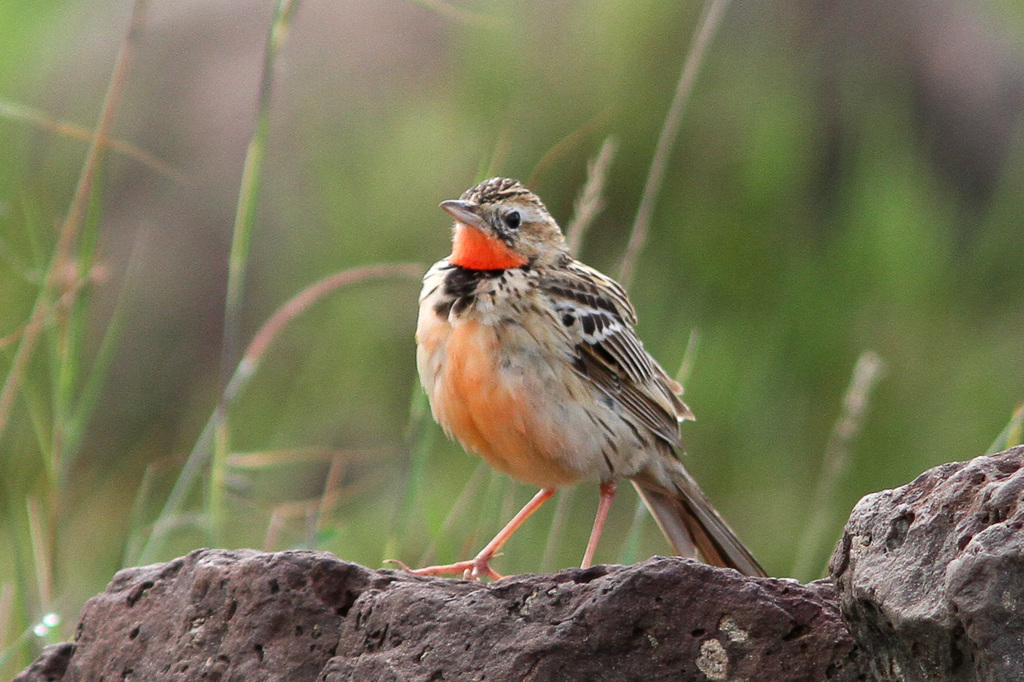
The rosy-throated longclaw, also known as the rosy-breasted longclaw (Macronyx ameliae) is a species of bird in the family Motacillidae. It is found in Angola, Botswana, Democratic Republic of the Congo, Kenya, Malawi, Mozambique, Namibia, South Africa, Tanzania, Zambia, and Zimbabwe. Its natural habitat is subtropical or tropical seasonally wet or flooded lowland grassland.
The Marquis Léonce de Tarragon described the species in 1845, its specific name honouring either his wife or mother who were both named Amélie. Richard Bowdler Sharpe named this species M. wintoni in 1891 after William Edward de Winton. Common names include rosy-throated longclaw, pink-throated longclaw and rosy-breasted longclaw.
From the article Rosy-throated longclaw on Wikipedia (CC BY-SA), quoted section by section
Description
Adult birds are 19–20 centimetres (7.5–7.9 in) long with greyish-brown scalloped upper parts. The male has a pink throat and breast crossed with a broad black band across the chest, which is not evident outside of breeding season. Female birds have pink underparts, but lack the black band. Immature birds have mainly black-streaked pale brown underparts with some pink-red colour centrally. It makes a chiteet call, resembling that of a pipit. The rosy-throated longclaw is found in wet grasslands and flood plains, often with lower grasses. Found across central and eastern Africa, it is more patchily distributed in the south of the continent. It is restricted to the Okavango Delta, Linyanti Marshes and Chobe floodplains in Botswana and Namibia, the Zimbabwe highveld in Zimbabwe and coastal areas in KwaZulu-Natal. Its occurrence in KwaZulu-Natal is threatened by coastal development. The rosy-throated longclaw breeds during the wet season from September to April.
Listen
Looking for field recordings…
Where it lives
Recorded sightings
—
geo-referenced records in GBIF, from museums, herbaria and field observers.
Drag the globe to turn it. Dots are where records exist, not a range map; darker means more records.
In the stacks
Searching the stacks…
Every page naming Macronyx ameliae in the Biodiversity Heritage Library →
This page is assembled live from iNaturalist, GBIF, Wikipedia, the Source Library and the Internet Archive. It is not yet part of the hand-edited codex. iNaturalist taxon 14103.