On eBird ↗
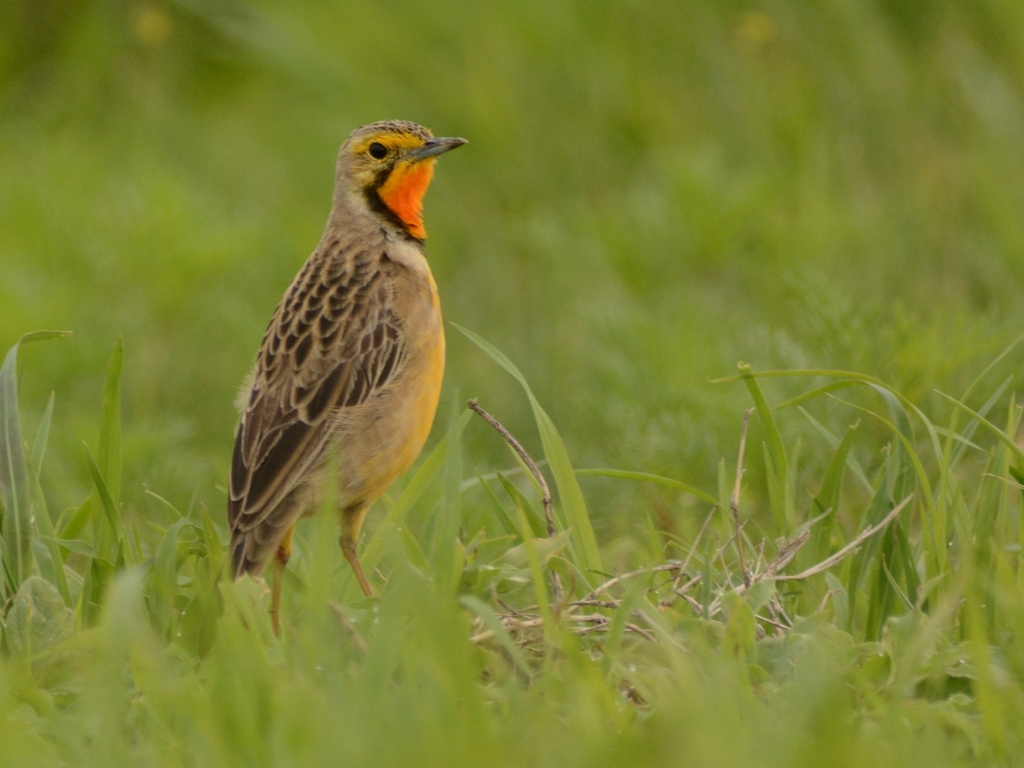
Orange-throated Longclaw
Live sightings near you, the range map, bar charts of when it is seen, and Macaulay Library photos and recordings.
Orange-throated Longclaw
Macronyx capensis
The Cape longclaw or orange-throated longclaw (Macronyx capensis) is a passerine bird in the family Motacillidae, which comprises the longclaws, pipits and wagtails. It occurs in Southern Africa in Zimbabwe and southern and eastern South Africa. This species is found in coastal and mountain grassland, often near water.
From the article Cape longclaw on Wikipedia (CC BY-SA), quoted section by section
Description
The Cape longclaw is a 19–20 cm long. The adult male has a grey head with a buff supercilium and a streaked blackish back. It has a bright orange gorget, black breast band and otherwise yellow underparts. The female is duller, having a yellow throat and much weaker breast band. The juvenile has a dirty yellow throat, indistinct breast band, and yellowish white underparts. The Cape longclaw is usually found in pairs throughout the year. It feeds on the ground on insects and some seeds. The song is a musical cheewit cheewit, the contact call is tsweet, and there is also a mewling alarm call. Typically not found in larger groups than two, a breeding pair or more often singly. Another behavioural characteristic is the tendency of birds to stand on top of stones, anthills or large grass clumps. While doing so birds stand upright with their breast extended. This species has a striking resemblance to the unrelated icterid meadowlarks, grassland birds of the Americas. This is presumably due to convergent evolution.
Listen
Looking for field recordings…
Where it lives
Recorded sightings
—
geo-referenced records in GBIF, from museums, herbaria and field observers.
Drag the globe to turn it. Dots are where records exist, not a range map; darker means more records.
In the stacks
Searching the stacks…
Every page naming Macronyx capensis in the Biodiversity Heritage Library →
This page is assembled live from iNaturalist, GBIF, Wikipedia, the Source Library and the Internet Archive. It is not yet part of the hand-edited codex. iNaturalist taxon 14098.