On eBird ↗
Green-faced Parrotfinch
Live sightings near you, the range map, bar charts of when it is seen, and Macaulay Library photos and recordings.
Green-faced Parrotfinch
Erythrura viridifacies
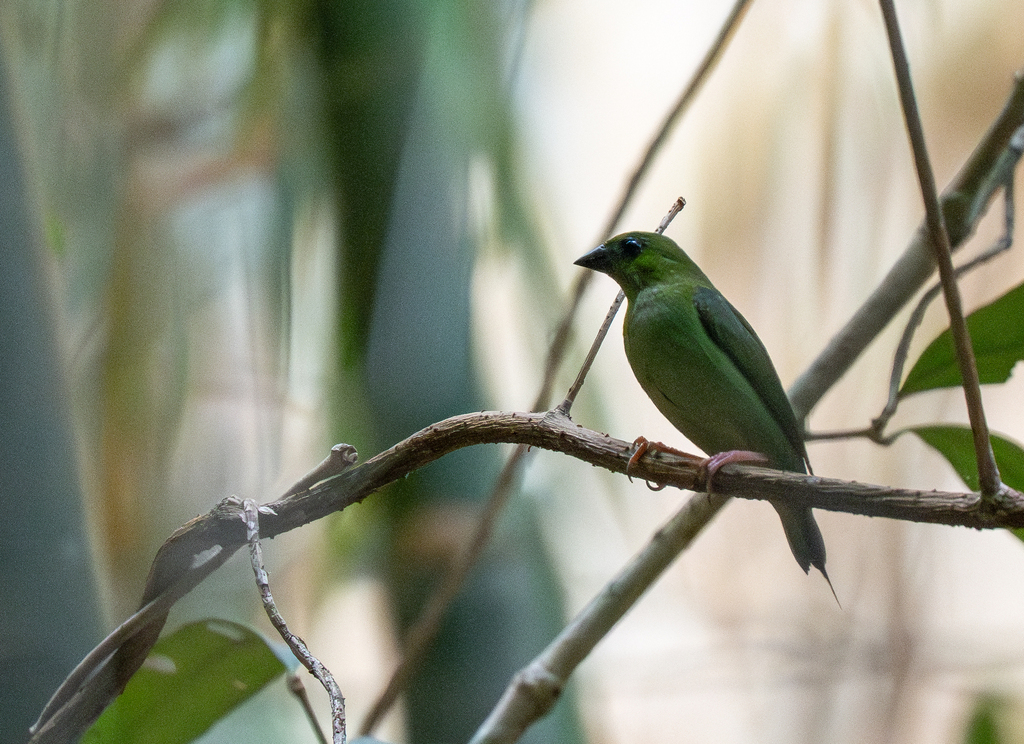
The green-faced parrotfinch (Erythrura viridifacies) is a rare species of estrildid finch found in northern Philippines, on Luzon, Mindoro, Panay, Negros and Cebu islands. It is an elusive and nomadic bird with mostly green plummage with a bright red vent and tail, rarely seen but large flocks of up to 1,000 birds have been reported feeding on bamboo flowers. Its local name is mayang-kawayan in Tagalog which roughly translates to bamboo sparrow due to its association with bamboo flowering.
From the article Green-faced parrotfinch on Wikipedia (CC BY-SA), quoted section by section
Description
The green-faced parrotfinch is approximately 12–13 centimetres (4.7–5.1 in) long. This species green plumage except for its bright red uppertail-coverts and tail and darker fringes to the primaries. It has a long pointed tail. The female is slightly shorter and shows buff on the lower belly and vent. Both sexes have a large, dark bill. The green-faced parrotfinch makes a short, high-pitched tsit tsit, chattering and grating notes.
Range & habitat
It inhabits tropical moist montane forest, forest edge and even savannah, often above 1,000 meters above sea level, but is occasionally found in the lowlands. It is usually found together with flowering or seeding bamboos, which are its food supply. Its true stronghold, if any, is unknown but most records have been in Luzon. As of 2025, this species was downlisted by the IUCN Red List to a Least-concern species with the population trend not known. This species was previously listed as a Vulnerable species, The cage-bird trade in the 1930s to the 1980s has also affected its population as large numbers of green-faced parrotfinch in many districts of Manila have been caught and exported to the United States. Despite a large number of birds entering the avicultural scene in the 1980s, no captive breeding has occurred. This species is currently conserved in two protected areas, the Northern Sierra Madre Natural Park and Bataan Natural Park/Subic Bay but actual enforcement is lax. Also, due to its nomadic habits, occurrence in protected areas does not necessarily confer continuous protection. Proposed conservation actions include more fieldwork and observations to properly understand its true range and disperasal habits. …
Wikipedia: “Habitat and Conservation Status”
What it does
It is irruptive, visiting flowering bamboos even in the lowlands and eating its seeds. During bamboo blooms, flocks as many as one thousand birds have been observed. It is believed to be nomadic. Otherwise, not much else is known about this bird, where it breeds, and its dispersive qualities and if they travel across islands. It was only discovered on Cebu in 2000 and then in Mindoro in 2013. In 2024, for multiple weeks, a small group of 8 birds was observed in Rizal picking up snails in streams and dipping them in the water. It is unknown if the parrotfinches used these snails to drink or if they fed on them.
Wikipedia: “Ecology and behavior”
Listen
Looking for field recordings…
Where it lives
Recorded sightings
—
geo-referenced records in GBIF, from museums, herbaria and field observers.
Drag the globe to turn it. Dots are where records exist, not a range map; darker means more records.
In the stacks
Searching the stacks…
Every page naming Erythrura viridifacies in the Biodiversity Heritage Library →
This page is assembled live from iNaturalist, GBIF, Wikipedia, the Source Library and the Internet Archive. It is not yet part of the hand-edited codex. iNaturalist taxon 13950.