On eBird ↗
Pink-billed Parrotfinch
Live sightings near you, the range map, bar charts of when it is seen, and Macaulay Library photos and recordings.
Pink-billed Parrotfinch
Erythrura kleinschmidti
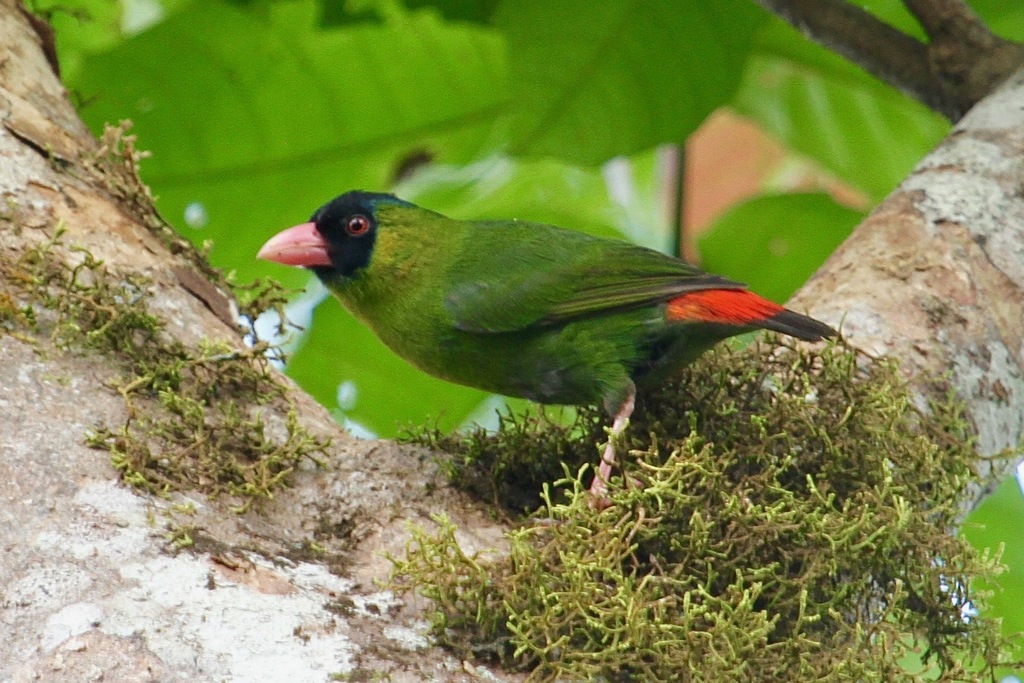
The pink-billed parrotfinch (Erythrura kleinschmidti) is a species of estrildid finch found on the island of Viti Levu, Fiji. Commonly found at undisturbed mature forest in the centre and east of Viti Levu, e.g. Joske's Thumb near Suva. This species is found at mid-height along tree-trunks and branches, usually alone or in pairs but also joining mixed-species flocks, feeding primarily on insects, but also on flower buds and fruits.
From the article Pink-billed parrotfinch on Wikipedia (CC BY-SA), quoted section by section
Description
This is a large and robust parrotfinch, 11 centimetres (4.3 in) in length, with a long pale pink bill much larger than that of other parrotfinches. The adult has mainly olive-green plumage, but it has a black face, blue crown and nape, and the bright red rump typical of the genus. Its eyes are brown or reddish-brown, and the legs and feet are pink or brownish-pink. The sexes are alike. The juvenile is like the adult, although its plumage is; slightly duller, and it has a pale orange bill with a dark tip. The call is a typical parrotfinch high pitched tsee tsee or cheee cheee cheee. A series of clicks may also be heard. A related species, the Fiji parrotfinch, E. pealii, also occurs on Viti Levu. This locally common bird is smaller, and adults have a red head and a much smaller, dark bill. Immatures have a pale bill, but are brighter green than their larger relative.
Range & habitat
The pink-billed parrotfinch is endemic to Fiji, thought to be only found in the wetter central and eastern parts of the largest island, Viti Levu but has also been observed on the Yasawa Islands to the north-west in 2012. This is a bird of undisturbed mature forest at any elevation, although it has been found to be common in one area of secondary forest, where it made a failed attempt to nest. It has disappeared from some previously occupied sites for reasons that are not known.
Wikipedia: “Distribution and habitat”
What it does
This bird is usually found alone, in pairs or in small family groups, and is less gregarious than other parrotfinches. It is normally sedentary, but outside the breeding season it may join mixed-species foraging flocks. The only known nest was similar in shape to that of the Fiji parrotfinch, domed with a side entrance. It was constructed of dead leaves, including those of bamboo, small twigs and lichens. This finch feeds mainly on insects, foraging on tree trunks and vines, and using its large bill to lever open likely hiding places, probe dead leaves, and crush twigs and tree fern stems. It will strip bark in a search for scale insects. It will also take flower buds, berries and fruit, but is not the specialised fig-eater it was once thought to be. Although it feeds mostly in trees, it will forage on the ground.
Wikipedia: “Behaviour”
Listen
Looking for field recordings…
Where it lives
Recorded sightings
—
geo-referenced records in GBIF, from museums, herbaria and field observers.
Drag the globe to turn it. Dots are where records exist, not a range map; darker means more records.
In the stacks
Searching the stacks…
Every page naming Erythrura kleinschmidti in the Biodiversity Heritage Library →
This page is assembled live from iNaturalist, GBIF, Wikipedia, the Source Library and the Internet Archive. It is not yet part of the hand-edited codex. iNaturalist taxon 13948.