- Plants
- ›Vascular Plants
- ›flowering plants
- ›Dicots
- ›Legumes, Milkworts, and Allies
- ›Legumes
- ›Faboideae
- ›Mirbelieae
- ›Jacksonia
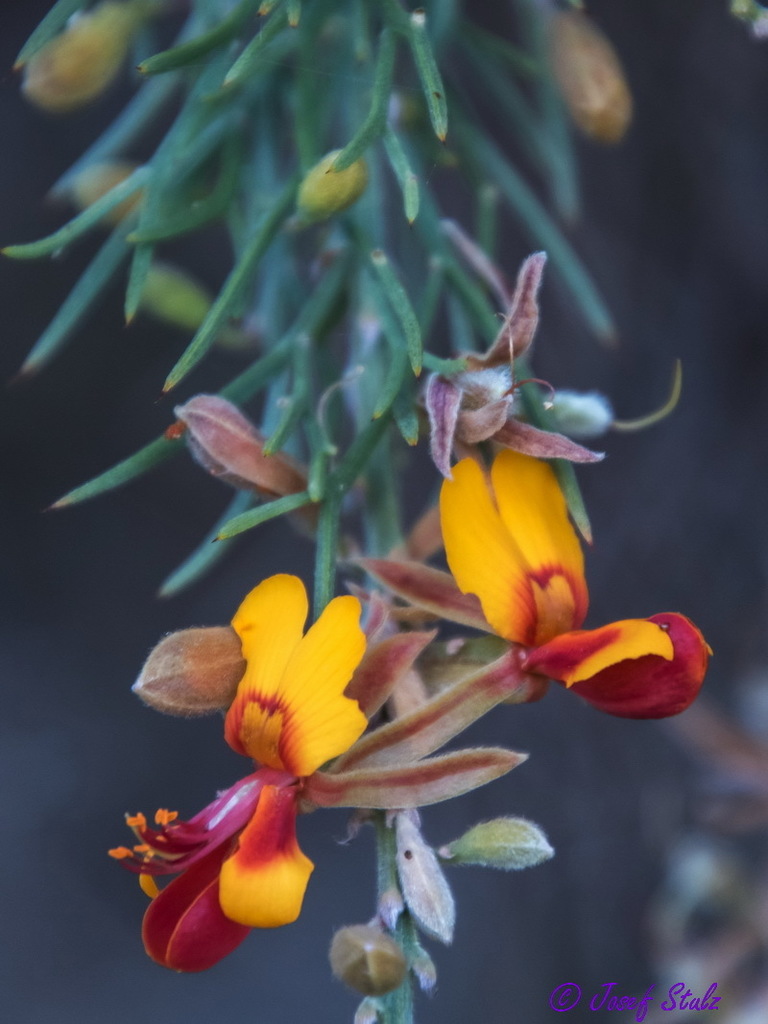
grey stinkwood
Jacksonia furcellata
Jacksonia furcellata, commonly known as grey stinkwood, is a species of leafless broom-like shrub or small tree that occurs in the south west of Western Australia. One of the most common plants of the Swan Coastal Plain, it is an excellent colonizer of newly cleared land. It is often seen growing where soil has recently been disturbed, such as alongside new roads.
From the article Jacksonia furcellata on Wikipedia (CC BY-SA), quoted section by section
Description
Jacksonia furcellata is prostrate to low-lying, or weeping, erect shrub, with sharply-pointed side branches that typically grows up to 0.4–6 m (1 ft 4 in – 19 ft 8 in) high and 1–3 m (3 ft 3 in – 9 ft 10 in) wide. It has greyish-green branches, the short end branches 2–15.8 mm (0.079–0.622 in) long, about 1.5 mm (0.059 in) wide and sharply-pointed. Its leaves are reduced to broadly egg-shaped scales with toothed edges, 1.2–3.9 mm (0.047–0.154 in) long and 0.6–1.8 mm (0.024–0.071 in) wide. The flowers are arranged on the ends of branches in raceme-like groups on a pedicel 2.3–4.7 mm (0.091–0.185 in) long. There are egg-shaped bracteoles 1.3–1.7 mm (0.051–0.067 in) long on the upper part of the pedicels. The floral tube is 1.0–1.4 mm (0.039–0.055 in) long and the sepals are membranous, with 7.5–12.3 mm (0.30–0.48 in) long and 1.6–2.4 mm (0.063–0.094 in) wide. The standard petal is yellowish-orange with red markings, 6.5–8.8 mm (0.26–0.35 in) long, the wings with a similar colour and 6.1–7.9 mm (0.24–0.31 in) long, and the keel is orange-red, 6.6–8.9 mm (0.26–0.35 in) long. The stamens have red filaments 5.2–11.9 mm (0.20–0.47 in) long. Flowering occurs throughout the year with a peak from October to December or January to March, and the fruit is a woody hairy, pod 7–8 mm (0.28–0.31 in) long and 3.5–4.0 mm (0.14–0.16 in) wide.
Range & habitat
Jacksonia furcellata grows in heath or woodland, often in winter-wet areas and is widespread between Dandaragan, the south-west corner of Western Australia, and east to the Lort River but absent for coastal areas between Augusta and Denmark, in the Avon Wheatbelt, Esperance Plains, Geraldton Sandplains, Jarrah Forest, Mallee, Swan Coastal Plain and Warren of south-western Western Australia.
== References ==
Wikipedia: “Distribution and habitat”
Where it lives
Recorded sightings
—
geo-referenced records in GBIF, from museums, herbaria and field observers.
Drag the globe to turn it. Dots are where records exist, not a range map; darker means more records.
In the stacks
Searching the stacks…
Every page naming Jacksonia furcellata in the Biodiversity Heritage Library →
This page is assembled live from iNaturalist, GBIF, Wikipedia, the Source Library and the Internet Archive. It is not yet part of the hand-edited codex. iNaturalist taxon 139043.