On eBird ↗
Scaly-breasted Munia
Live sightings near you, the range map, bar charts of when it is seen, and Macaulay Library photos and recordings.
Scaly-breasted Munia
Lonchura punctulata
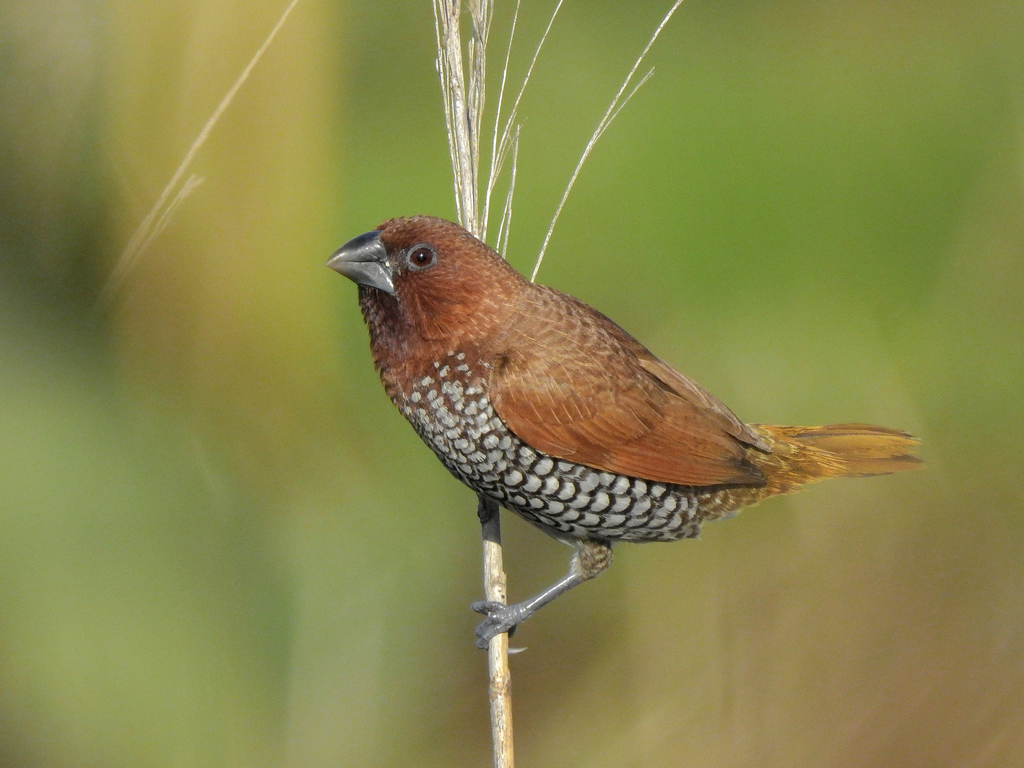
The scaly-breasted munia or spotted munia (Lonchura punctulata), known in the pet trade as nutmeg mannikin or spice finch, is a sparrow-sized estrildid finch native to tropical Asia. A species of the genus Lonchura, it was formally described and named by Carl Linnaeus in 1758. Its name is based on the distinct scale-like feather markings on the breast and belly. The adult is brown above and has a dark conical bill. The species has 11 subspecies across its range, which differ slightly in size and colour.
This munia eats mainly grass seeds apart from berries and small insects. They forage in flocks and communicate with soft calls and whistles. The species is highly social and may sometimes roost with other species of munias. This species is found in tropical plains and grasslands. Breeding pairs construct dome-shaped nests using grass or bamboo leaves.
From the article Scaly-breasted munia on Wikipedia (CC BY-SA), quoted section by section
Description
The scaly-breasted munia is about 11–12 centimetres (4.3–4.7 in) long and weighs 12–16 grams (0.026–0.035 lb). The adult has a stubby dark bill typical of grain eating birds, brown upperparts and a dark brown head. The underparts are white with dark scale markings. The sexes are similar, although males have darker markings on the underside and a darker throat than females. Immature birds have pale brown upperparts, lack the dark head found in adults, and have uniform buff underparts that can be confused with juveniles of other munia species such as the tricoloured munia (Lonchura malacca) across the Asian and island populations and the black-throated munia (Lonchura kelaarti) in parts of India or Sri Lanka.
Range & habitat
Scaly-breasted munias are found in a range of habitats but are usually close to water and grassland. In India, they are especially common in paddy fields where they are considered a minor pest on account of their feeding on grain. They are found mainly on the plains, but can be observed in the foothills of the Himalayas, in which they may be present at altitudes near 2,500 m (1.6 mi), and in the Nilgiris, where they are found at altitudes up to 2,100 m (6,900 ft) during the summer. In Pakistan, they are restricted to a narrow region from Swat in the west to Lahore, avoiding the desert zone, and then occurring again in India east of an area between Ludhiana and Mount Abu. The species has also been observed in Kashmir, though this is rare. Outside their native range, escaped birds frequently establish themselves in areas with a suitable climate and can then colonise new areas nearby. Escaped cagebirds established in the wild and such populations have been recorded in the West Indies (Puerto Rico since 1971), Hawaii (since 1883), Japan and southern United States, mainly in Florida and California. In Oahu, Hawaii, they compete for habitats with the tricoloured munia and tend to be rare where this competitor is present. The species has been introduced to other parts of the world due to its popularity as a cage bird and populations have established in the wild.
Wikipedia: “Distribution and habitat”
At the table
The scaly-breasted munia feeds mainly on grass seeds, small berries such as those of Lantana, and insects. Although the bill is suited for crushing small grains, they do not show lateral movements of the lower mandible that e.g. greenfinches show, which help in dehusking seeds. Like some other munias, they may also feed on algae, a rich protein source, prior to the breeding season. The ease of maintaining these birds in captivity has made them popular for studying behaviour and physiology. Feeding behaviour can be predicted by the optimal foraging theory, where animals minimise time and energy spent to maximise food intake. This theory has been tested by studying the strategies used by scaly-breasted munias to increase their feeding efficacy.
Flock size tradeoffs. Studies on foraging have examined the effect of group size in reducing time spent on predator vigilance, thereby increasing feeding efficiency. According to the "many-eyes" hypothesis, a reduction in the individual time spent on vigilance against threats in larger groups allows for more time to be spent on searching for food and feeding. Vigilance is greatest among solitary individuals and reduces as the group size increases to about four. …
Wikipedia: “Food and foraging”
Listen
Looking for field recordings…
Where it lives
Recorded sightings
—
geo-referenced records in GBIF, from museums, herbaria and field observers.
Drag the globe to turn it. Dots are where records exist, not a range map; darker means more records.
In the stacks
Searching the stacks…
Every page naming Lonchura punctulata in the Biodiversity Heritage Library →
This page is assembled live from iNaturalist, GBIF, Wikipedia, the Source Library and the Internet Archive. It is not yet part of the hand-edited codex. iNaturalist taxon 13893.