On eBird ↗
White-rumped Munia
Live sightings near you, the range map, bar charts of when it is seen, and Macaulay Library photos and recordings.
White-rumped Munia
Lonchura striata
The white-rumped munia (Lonchura striata) or white-rumped mannikin, sometimes called striated finch in aviculture, is a small passerine bird from the family of waxbill "finches" (Estrildidae). These are not close relatives of the true finches (Fringillidae) or true sparrows (Passeridae).
It is native to tropical continental Asia and some adjacent islands, and has been naturalized in some parts of Japan. Its domesticated descendant, the society finch or Bengalese finch, is found worldwide as a pet and a biological model organism.
From the article White-rumped munia on Wikipedia (CC BY-SA), quoted section by section
Description
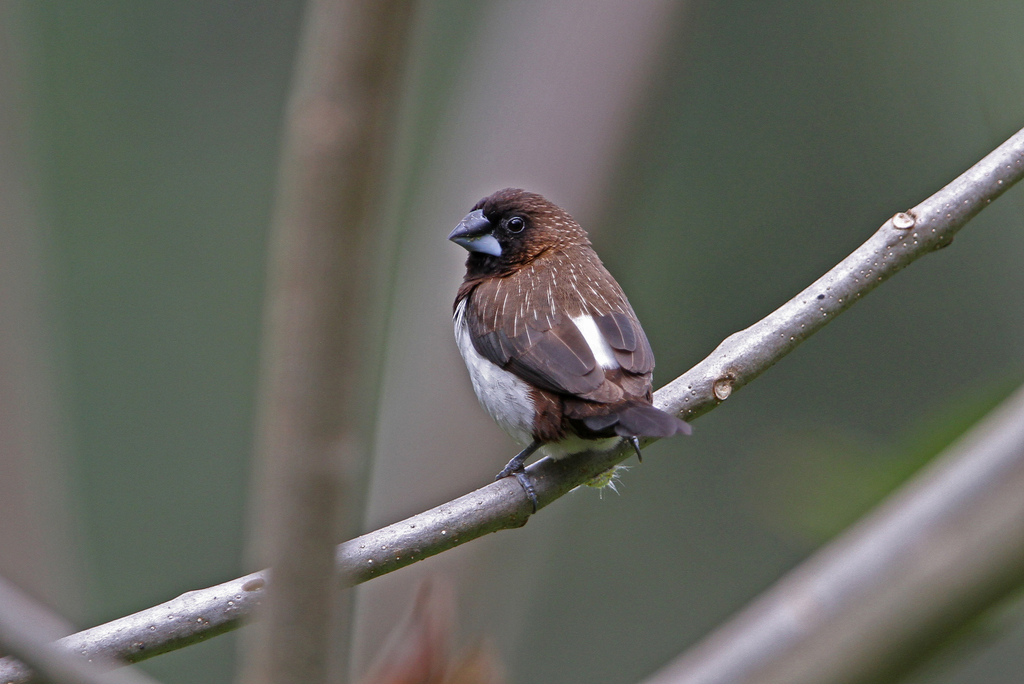
The white-rumped munia is approximately 10 to 11cm in length, with a stubby grey bill and a long black pointed tail. The adults are brown above and on the breast, and lighter below; the rump is white. There is some variation between the subspecies, but the sexes are almost impossible to distinguish in all subspecies; males have a more bulky head and bill.
Range & habitat
The white-rumped munia is a resident breeder ranging from the Indian subcontinent through Southeast Asia to southern China and Taiwan and to Sumatra; it frequents open woodland, grassland and scrub, and is well able to adapt to agricultural land use. It is a common and widespread bird across its large range, and is thus not considered a threatened species by the IUCN. It may locally become a nuisance pest of millets and similar grains. Even the Nicobar Islands subspecies with its limited range seems to be able to cope well with human settlement. As it is a drab-coloured and rather reclusive bird inhabiting dense undergrowth, the white-rumped munia is not necessarily conspicuous even where it occurs in considerable numbers.
Wikipedia: “Distribution and habitat”
What it does
The white-rumped munia is a gregarious bird which feeds mainly on seeds, moving through the undergrowth in groups and sometimes accompanying other birds such as puff-throated babblers (Pellorneum ruficeps). The nest is a large domed grass structure in a tree, bush or grass into which three to eight white eggs are laid. It has often been observed near water feeding on algae. It has been suggested that it obtains protein from algae of Spirogyra, which grows in paddy fields. The white-rumped munia uses abandoned nests of the Baya weaver.
Wikipedia: “Behaviour and ecology”
Listen
Looking for field recordings…
Where it lives
Recorded sightings
—
geo-referenced records in GBIF, from museums, herbaria and field observers.
Drag the globe to turn it. Dots are where records exist, not a range map; darker means more records.
In the stacks
Searching the stacks…
Every page naming Lonchura striata in the Biodiversity Heritage Library →
This page is assembled live from iNaturalist, GBIF, Wikipedia, the Source Library and the Internet Archive. It is not yet part of the hand-edited codex. iNaturalist taxon 13887.