On eBird ↗
Dusky Munia
Live sightings near you, the range map, bar charts of when it is seen, and Macaulay Library photos and recordings.
Dusky Munia
Lonchura fuscans
The dusky munia (Lonchura fuscans) is a species in the estrildid finch Family and is endemic to Borneo. It is also commonly referred to as the Dusky mannikin and the Bornean munia. It is in the genus Lonchura and is a monotypic species, so there are no subspecies.
From the article Dusky munia on Wikipedia (CC BY-SA), quoted section by section
Description
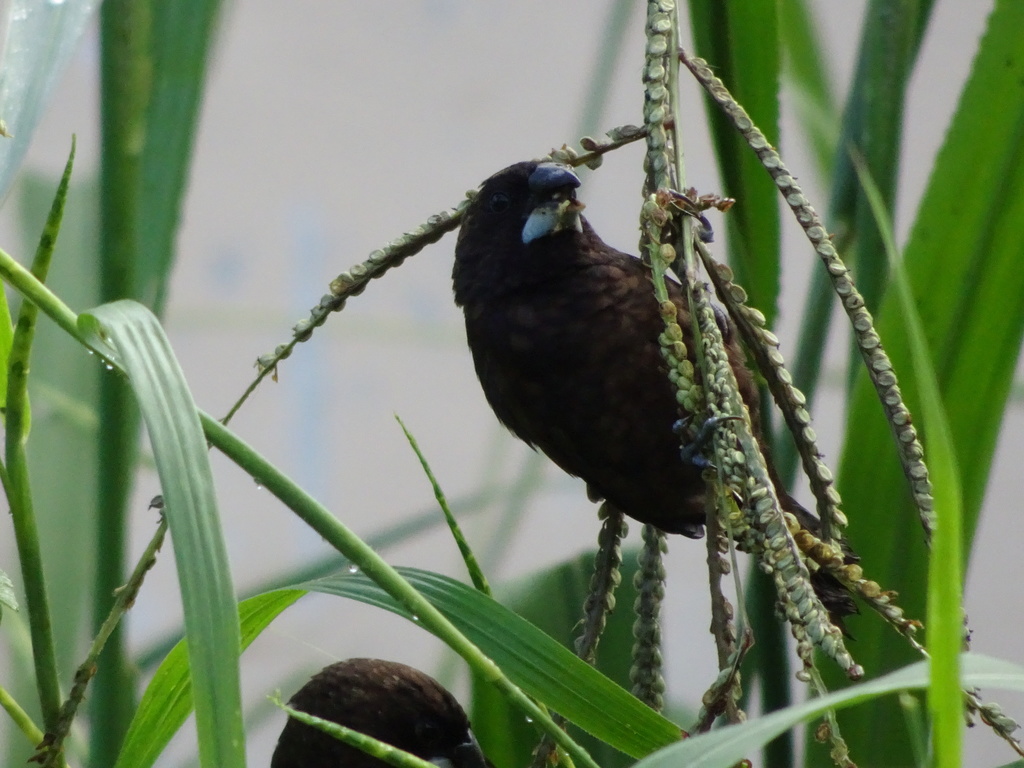
The dusky munia is a smaller perching bird, with adults growing to reach a body length of 10 to 11 centimeters long, and weighing in at 9.5 grams. Their plumage is a rich dark brown, with feathers of its crown streaked pale brown, and blue-gray legs. It has a gray ring around its eye, and is dark around the face, with a bill that has a black upper mandible, and a blue-gray lower mandible. There is no distinction in feather pattern between male or female.
Range & habitat
The status of the species is evaluated as Least Concern. It is most commonly spotted on the Island Borneo, but can be found in Brunei, Indonesia, Malaysia, and the Philippines. It is also an introduced species in Natuna, Banggi, Cagayan and Sulu Islands. While the population size of the species is unknown, the population growth is stable, and virtually unthreatened. It is found in subtropical/ tropical lowland shrubland, forest and grassland habitat. Its habitat can vary widely, with sightings being recorded in the foothills of the island Borneo, grasslands, and agricultural fields such as rice paddy fields. They also tend to reside along riverbanks, reed-beds, secondary scrub and cultivated areas, from sea-level all the way up to 500 meters above ground. They are not migrants, and do not venture outside of their habitat during seasonal changes like many other species of birds.
Wikipedia: “Distribution and habitat”
What it does
Its diet consists of grass seeds, seeds of weeds, rice grains, and insects. When searching for food, they mainly look through vegetation and on the ground. They also carefully pick out seeds from overturned clumps of earth and buffalo dung, as well as from seed heads and deep in the ground. Most Dusky Munia's feed primarily on seeds, with grass seed making up an important part of the diet for many species. In addition, snails, omnivores, figs, ants, insects, nectar, berries and algae are digested by a few species. They fly in flocks while communicating with gentle whistles. These species are exceedingly social and likely will mate and doze to sleep with other Munia species.
Wikipedia: “Diet”
Listen
Looking for field recordings…
Where it lives
Recorded sightings
—
geo-referenced records in GBIF, from museums, herbaria and field observers.
Drag the globe to turn it. Dots are where records exist, not a range map; darker means more records.
In the stacks
Searching the stacks…
Every page naming Lonchura fuscans in the Biodiversity Heritage Library →
This page is assembled live from iNaturalist, GBIF, Wikipedia, the Source Library and the Internet Archive. It is not yet part of the hand-edited codex. iNaturalist taxon 13882.