On eBird ↗
Saxaul Sparrow
Live sightings near you, the range map, bar charts of when it is seen, and Macaulay Library photos and recordings.
Saxaul Sparrow
Passer ammodendri
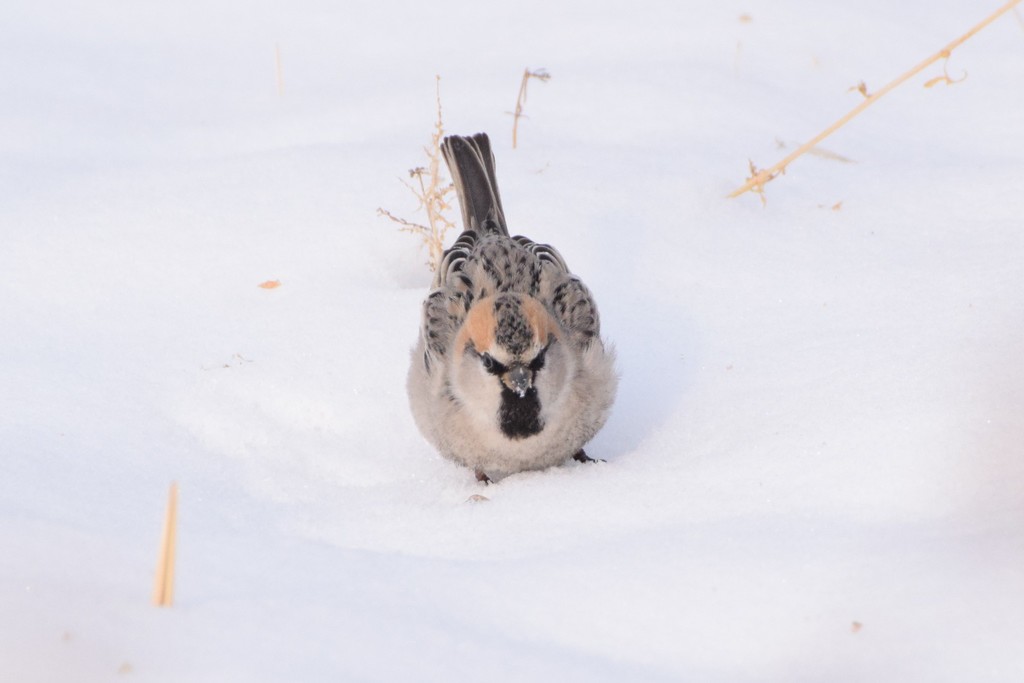
The saxaul sparrow (Passer ammodendri) is a passerine bird of the sparrow family (Passeridae), found in parts of Central Asia. At 14–16 centimetres (5.5–6.3 in) and 25–32 grams (0.88–1.13 oz), it is among the larger range of sparrows. Both sexes have plumage ranging from dull grey to sandy brown, and pale brown legs. Females have less boldly coloured plumage and bills, lacking the pattern of black stripes on the male's head. The head markings of both sexes make the saxaul sparrow distinctive and unlikely to be confused with any other bird. Vocalisations include a comparatively soft and musical chirping call, a song, and a flight call.
Three subspecies are recognised, differing in the overall tone of their plumage and in the head striping of the female. The subspecies ammodendri occurs in the west of the saxaul sparrow's range, while stoliczkae and nigricans occur in the east. This distribution falls into six probably disjunct areas across Central Asia, from central Turkmenistan to northern Gansu in China. A bird of deserts, the saxaul sparrow favours areas with shrubs such as the saxaul (Haloxylon), near rivers and oases. Though it has lost parts of its range to habitat destruction caused by agriculture, it is not seriously threatened by human activities.
From the article Saxaul sparrow on Wikipedia (CC BY-SA), quoted section by section
Description
The saxaul sparrow is one of the larger sparrows at 14–16 centimetres (5.5–6.3 in) and 25–32 grams (0.88–1.13 oz). Wing length varies from 7.1 to 8.1 centimetres (2.8 to 3.2 in), with males generally being larger. The tail is short at 6.3–6.95 centimetres (2.48–2.74 in). The saxaul sparrow's legs are pale or pinkish brown, with a tarsus length of 1.95 inches (50 mm). Its bill is 1.0–1.3 centimetres (0.39–0.51 in) long, pale grey on the juvenile, pale yellowish with a black tip on the breeding female, and black on the breeding male. Like all other sparrows, it flies swiftly and often at height. Distinctive markings, especially on its head, make the saxaul sparrow unlikely to be confused with any other bird. It is dull-coloured, with plumage ranging between dull grey and warm sandy brown, varying between and within subspecies. Birds of the subspecies ammodendri are a sandy grey, while nigricans birds are similar but darker, and stoliczkae birds are warm brown or russet. Birds of the subspecies stoliczkae and those from the southwest of the range of ammodendri also differ from usual ammodendri birds in their lack of streaking on the rump and upper tail coverts. Birds in Mongolia have a larger and deeper bill and broad bluish streaks on their chest. The male saxaul sparrow has bold markings, with a black stripe along the top of its head and another through its eye. …
Range & habitat
The saxaul sparrow is found in remote parts of Central Asia, where its distribution is believed to comprise six disjunct areas, though this is uncertain due to the scarcity of records. It is found in deserts, especially around rivers and oases. It is usually found around shrubs such as saxaul (Haloxylon), poplar (Populus), or tamarisk (Tamarix). Sometimes it occurs around settlements and grain fields, especially during the winter. It is not believed to be threatened, since it is reported as locally common across a wide range, and hence it is assessed as Least Concern on the IUCN Red List. However, it seems to have lost large parts of its range to the intensification of agriculture and desertification caused by overgrazing.
Wikipedia: “Habitat”
What it does
Little is known about the saxaul sparrow's behaviour due to its remote range. It is shy in many areas, and spends much time hidden in foliage, but breeding birds in Mongolia were reported to be "quite confiding". When not breeding, it is social, and can form flocks of up to fifty birds, sometimes associating with Eurasian tree, Spanish, and house sparrows. In some regions, it makes small local migrations. Towards the spring, saxaul sparrows form pairs within their flock, before dispersing in April. Seeds, especially those of the saxaul, are most of its diet, though it also eats insects, especially while breeding, most commonly weevils, grasshoppers, and caterpillars. It forages in trees and on the ground. In a study of insects fed to nestlings in the Ili River valley, it was found that beetles are predominant, with weevils and Coccinellidae comprising 60 and 30 percent of the diet of nestlings, respectively. Because of its desert habitat and scarcity, it is not a pest of agriculture. Where water is not available, the saxaul sparrow may fly several times each day over long distances to drink. The saxaul sparrow is less social than other sparrows while breeding, due to its dry habitat and its choices of nesting locations, holes in trees, and earth banks. …
Wikipedia: “Behaviour”
Listen
Looking for field recordings…
Where it lives
Recorded sightings
—
geo-referenced records in GBIF, from museums, herbaria and field observers.
Drag the globe to turn it. Dots are where records exist, not a range map; darker means more records.
In the stacks
Searching the stacks…
Every page naming Passer ammodendri in the Biodiversity Heritage Library →
This page is assembled live from iNaturalist, GBIF, Wikipedia, the Source Library and the Internet Archive. It is not yet part of the hand-edited codex. iNaturalist taxon 13866.