On eBird ↗
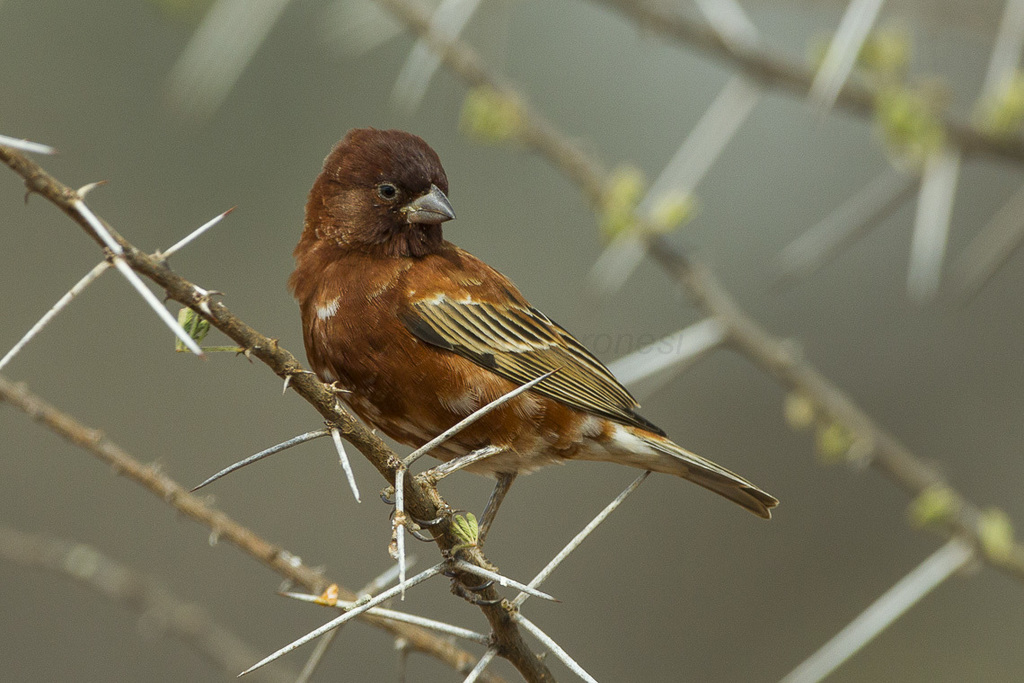
Chestnut Sparrow
Live sightings near you, the range map, bar charts of when it is seen, and Macaulay Library photos and recordings.
Chestnut Sparrow
Passer eminibey
The chestnut sparrow (Passer eminibey) is a species of passerine bird in the sparrow family Passeridae. It is the smallest member of the sparrow family, at about 11 cm (4.3 in) long. The breeding male has deep chestnut plumage and the female and juvenile are coloured a duller grey with some chestnut markings. Like its closest relatives in the genus Passer, the Arabian golden sparrow and the Sudan golden sparrow, it is gregarious and found in arid areas. Ranging through the east of Africa from Darfur in Sudan to Tanzania, it is found in dry savanna, papyrus swamps, and near human habitation. Adults and juveniles both feed mostly on grass seeds, and fly in flocks, often with other species of birds, to find food. It nests in trees, building its own domed nests, and also usurping the more elaborate nests of weavers.
From the article Chestnut sparrow on Wikipedia (CC BY-SA), quoted section by section
Description
Like the other members of the sparrow family, the chestnut sparrow is a small, chunky songbird with a thick bill suited to its diet of seeds. At 10.5 to 11.5 cm (4.1–4.5 in) in length, it is the smallest member of the sparrow family. It weighs between 12 grams (0.42 oz) and 17 grams (0.60 oz). Wing length ranges from 6.0 to 6.5 cm (2.4–2.6 in) in males and from 5.7 to 6.0 cm (2.2–2.4 in) in females. The tail, bill, and tarsus lengths are about 4 cm (1.6 in), 1 cm (0.39 in), and 1.5 cm (0.59 in) respectively. The plumage of the breeding male is mostly a deep shade of chestnut in colour with black colouration on the face, wings, and tail. The breeding male is not easily confused with any other birds except the chestnut weaver, which is substantially larger and has white on its wings. The breeding male's legs and feet are horn (pale grey) in colour. The non-breeding male chestnut sparrow has white flecking on the upperparts, and much of its plumage is buff or whitish with chestnut crescent markings, until the bright chestnut of the breeding plumage is exposed by wear. The non-breeding male's bill fades to a dusky-tipped horn, similar to that of females, but without dusky tones on the cutting edge of the mandible (lower portion of beak). Females have the same plumage pattern as males, though with somewhat duller colouration. …
Range & habitat
The chestnut sparrow is found in East Africa in mostly lower country from Darfur through Kordofan, South Sudan, Somalia, Uganda, and Kenya to north-central Tanzania. Its range also extends northeast into the southwest and Great Rift Valley of Ethiopia. Like the golden sparrows, it is sometimes nomadic when not breeding. Vagrants have been recorded as far from their breeding range as Dar es Salaam. It is found mostly in dry savanna and in fields and villages, but unlike its relations the golden sparrows, it is sometimes found in swamps of papyrus (certain Cyperus spp.). Its population has not been quantified, but it appears to be common across a very large range and it is assessed by the IUCN Red List as Least Concern for global extinction.
Wikipedia: “Distribution and habitat”
What it does
Chestnut sparrows are gregarious, and are only occasionally found away from flocks. They frequently associate with queleas and other weavers. Adults feed on grass seeds, and those near human habitations will also eat crumbs and other household scraps. Nestlings are fed mostly softer grass seeds, and small beetles are also recorded in their diet.
Breeding. The nesting behaviour of the chestnut sparrow chestnut sparrow has been the subject of confusion. Early reports described the chestnut sparrow's nest as being a typical sparrow nest built in a tree; later it was reported that chestnut sparrows had elaborate nests like those of weavers. In 1967, the ornithologist Robert B. Payne studied chestnut sparrows in a grey-capped social weaver colony in an acacia grove near Lake Magadi in southern Kenya, and in 1969 he reported his findings in the ornithological journal The Ibis. Payne found that chestnut sparrows only nested by usurping the nests of the social-weavers. After reporting this, and noting that the distribution of the chestnut sparrow closely coincides with that of the social-weavers of the genus Pseudonigrita, Payne suggested that the chestnut sparrow was an obligate nest parasite (not a brood parasite, like many Old World cuckoos and cowbirds). …
Wikipedia: “Behaviour and ecology”
Listen
Looking for field recordings…
Where it lives
Recorded sightings
—
geo-referenced records in GBIF, from museums, herbaria and field observers.
Drag the globe to turn it. Dots are where records exist, not a range map; darker means more records.
In the stacks
Searching the stacks…
Every page naming Passer eminibey in the Biodiversity Heritage Library →
This page is assembled live from iNaturalist, GBIF, Wikipedia, the Source Library and the Internet Archive. It is not yet part of the hand-edited codex. iNaturalist taxon 13861.