On eBird ↗
Nelicourvi Weaver
Live sightings near you, the range map, bar charts of when it is seen, and Macaulay Library photos and recordings.
Nelicourvi Weaver
Ploceus nelicourvi
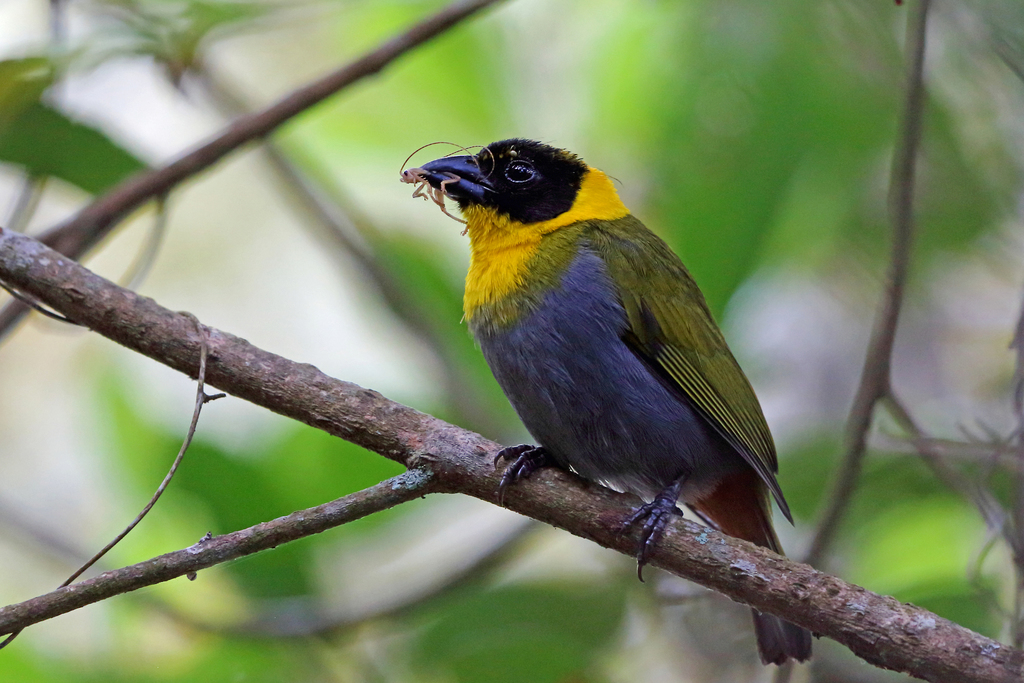
The nelicourvi weaver (Ploceus nelicourvi) is a species of bird in the family Ploceidae. It is endemic to Madagascar. Together with its closest relative, the sakalava weaver, it is sometimes placed in a separate genus Nelicurvius. A slender, sparrow-like bird, it is 15 cm (5.9 in) long and weighing 20–28 g (0.71–0.99 oz). Breeding males have a black bill and head, brown eyes, yellow collar, grey belly, chestnut-brown lower tail coverts, olive back, and blackish flight feathers edged greenish. Non-breeding males have mottled grey and green heads. In the breeding female the front of the head is yellow and the back olive green, with a broad yellow eyebrow. It builds solitary, roofed, retort-shaped nests, hanging by a rope from a branch, vine or bamboo stem, in an open space. It primarily feeds on insects, looking on its own or in very small groups, often together with long-billed bernieria. Its natural habitat is subtropical or tropical moist lowland and mountain forests. The conservation status of Nelicourvi weaver is least concern according to the IUCN Red List.
From the article Nelicourvi weaver on Wikipedia (CC BY-SA), quoted section by section
Description
The nelicourvi weaver is a slender sparrow-like bird of 15 cm (5.9 in) long and weighing 20–28 g (0.71–0.99 oz). During the breeding period, the male has a black beak, (reddish) brown eyes and blackish to brownish grey legs. His head is black, including the cheeks, around the ears, the forehead, crown and nape. The black is surrounded by a broad yellow collar, that includes chin, breast, side and back of the neck. The yellow collar is on the other side bordered by a vaguely defined olive-green band. The lower chest and belly are bluish-grey, the lower flanks grey with a greenish hue. The wing flight feathers are blackish, with those near the wing tips with narrow greenish yellow edges and those more to the base with broad olive-green edges. The alula and primary coverts are blackish, while all other coverts are bright olive green. The underside of the wing consists of light grey feathers with a yellowish tinge. The shoulders, and upper tailbase are also bright olive-green, the under tailbase chestnut-colored, while the tail flight feathers are blackish with wide olive-green. …
Range & habitat
The nelicourvi weaver is an endemic species of Madagascar. It occurs along the entire belt of rainforest that stretches from the Tsanatanana mountains in the North to the South-East. It also is present in the litoral forest of the eastern coast, almost but not quite reaching Tôlanaro (Fort-Dauphin of old) in the South-East. It can be found from sea level to mostly around 1,500 m (4,900 ft) altitude, but is also present up to 2,100 m (6,900 ft) high in Marojejy National Park. In the far North, an isolated population exists at the Amber Mountain National Park. It mostly lives in moist mountain and lowland forest, but is also present in sclerophyllous mountain forests, bushland and thickets.
Wikipedia: “Distribution and habitat”
What it does
Birds roam from the forest floor to the canopy, but particularly favour the middle story. They mostly operate alone, in pairs or groups of three, and can also be found mixing with long-billed bernierias. Larger flocks do not occur. The nelicourvi weaver is an agile, active species that generally makes a lot of noise. It searches for insects on leaves, and branches, while hanging from vines and twigs. It looks for animals in rolled leaves such as wild ginger Aframomum and along leaf litter, probing crevices, and opening dead stems. It also dismembers flowers to reach the nectar. Mostly, arthropods (beetles, bugs, butterflies, caterpillars, dragonflies, flies, grasshoppers, leafhoppers, stick insects, millipedes and spiders) are consumed, sometimes small vertebrates (lizards and chameleons), next to some nectar, fruit and probably seeds.
Reproduction. The species is apparently monogamous, having long-term relationships. Nests are built distanced from other nests. Although occasionally two nests are within a few meters, colonies do not occur. Males display during the breeding season, while seated on a horizontal branch, with fluttering wings helt low while calling loudly. Mating starts during the sixth day of nest building. The male chases away other birds from the nest, possibly to forestall the deposition of eggs by other couples or cuckoos. …
Wikipedia: “Ecology and behaviour”
Listen
Looking for field recordings…
Where it lives
Recorded sightings
—
geo-referenced records in GBIF, from museums, herbaria and field observers.
Drag the globe to turn it. Dots are where records exist, not a range map; darker means more records.
In the stacks
Searching the stacks…
Every page naming Ploceus nelicourvi in the Biodiversity Heritage Library →
This page is assembled live from iNaturalist, GBIF, Wikipedia, the Source Library and the Internet Archive. It is not yet part of the hand-edited codex. iNaturalist taxon 13846.