On eBird ↗
American Pipit
Live sightings near you, the range map, bar charts of when it is seen, and Macaulay Library photos and recordings.
American Pipit
Anthus rubescens
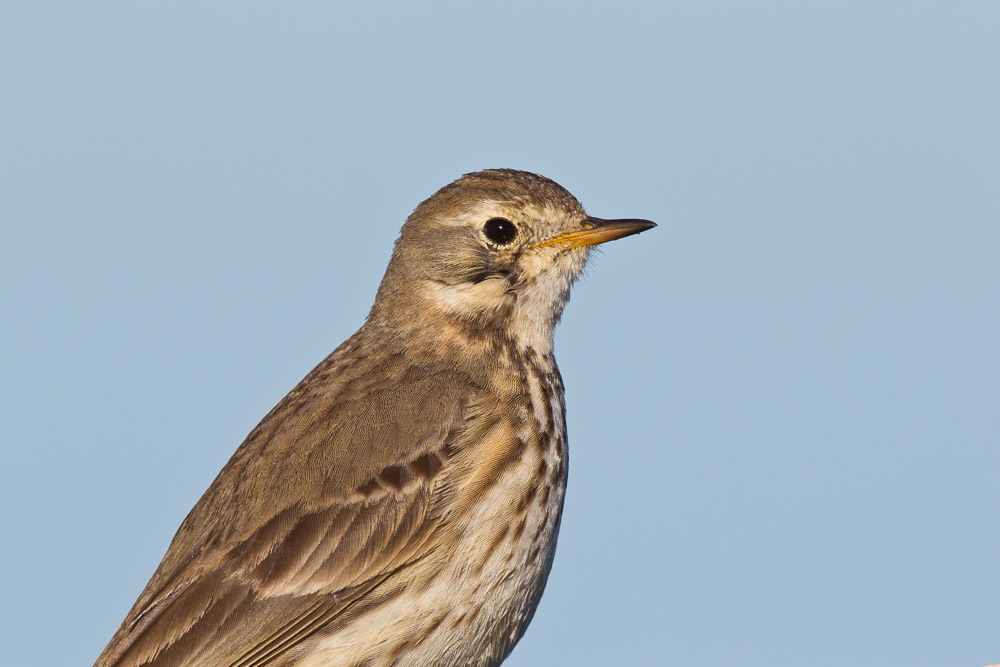
The American pipit (Anthus rubescens), formerly known as the buff-bellied pipit, is a small songbird native to North America. It was first described by Marmaduke Tunstall in his 1771 Ornithologia Britannica. It was formerly classified as a form of the water pipit. The former subspecies, Siberian pipit, is now considered a distinct species.
From the article American pipit on Wikipedia (CC BY-SA), quoted section by section
Description
Like most other pipits, the American pipit is an undistinguished-looking species which usually can be seen to run around on the ground. It has lightly streaked grey-brown upperparts and is diffusely streaked below on the buff breast and flanks. The belly is whitish, the bill and legs are dark. The related Siberian pipit is darker above and has bolder black streaking on its whiter underparts; its legs have a reddish hue. The call is a squeaky sip. Measurements:
Length: 16 cm Weight: 22 g Wingspan: 24 cm
What it does
All subspecies of the American pipit are migratory. The American pipit winters on the Pacific coast of North America, and on the Atlantic coast from the southern North America to Central America. At least regarding the American pipit, its wintering range seems to have expanded northwards in the 20th century and the birds seem to spend less time in winter quarters: in northern Ohio, for example, the species was recorded as "not common" during migration in May and September/October in the 1900s (decade), but today it is considered a "widespread migrant" in that region, found between March and May and from late September to November, with many birds actually wintering this far north. The American pipit is a rare vagrant to Western Europe. Like its relatives, this species is insectivorous. The breeding habitat of American pipit is tundra, but outside the breeding season it is found in open lightly vegetated areas, similar to those favoured by the water pipit (A. spinoletta).
Wikipedia: “Behavior”
Listen
Looking for field recordings…
Where it lives
Recorded sightings
—
geo-referenced records in GBIF, from museums, herbaria and field observers.
Drag the globe to turn it. Dots are where records exist, not a range map; darker means more records.
In the stacks
Searching the stacks…
Every page naming Anthus rubescens in the Biodiversity Heritage Library →
This page is assembled live from iNaturalist, GBIF, Wikipedia, the Source Library and the Internet Archive. It is not yet part of the hand-edited codex. iNaturalist taxon 13732.