On eBird ↗
Pechora Pipit
Live sightings near you, the range map, bar charts of when it is seen, and Macaulay Library photos and recordings.
Pechora Pipit
Anthus gustavi
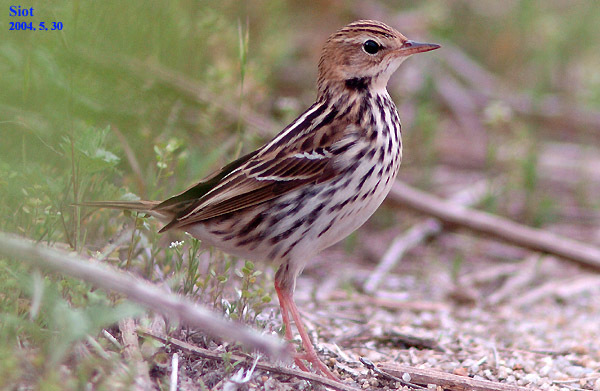
The Pechora pipit (Anthus gustavi) is a small passerine bird which breeds in the East Palearctic tundra and densely vegetated areas near river banks ranges from the Pechora River to the Chukchi Peninsula. It also breeds in Kamchatka and the Commander Islands, and with a disjunct population much further south in northeastern China and southeastern Siberia. It is a long-distance migrant, moving in winter to Indonesia. Rarely in September and October, the Pechora pipit may be observed in western Europe. The species was first described by Robert Swinhoe in 1863.
From the article Pechora pipit on Wikipedia (CC BY-SA), quoted section by section
Description
A. gustavi is a small pipit, which somewhat resembles non-breeding red-throated pipit in plumage. It is heavily streaked brown above, with whitish mantle stripes, and with black markings on a white belly and buff breast below. It can be distinguished from red-throated pipit by its heavier bill, whiter mantle stripes, and contrast between its buff breast and white belly. This species creeps in long grass, and is reluctant to fly even when disturbed. Its call is a distinctive electrical zip. Although the call is generally helpful when identifying pipits, this species calls far less than most. This, combined with its skulking habits, makes this a difficult species to find and identify away from its breeding grounds in the Arctic. The best place in western Europe to see Pechora pipit, where it is a rare vagrant, is Fair Isle, Shetland. The lack of cover on this small island makes skulking passerines easier to find. The breeding habitat is damp tundra, open forest or marshland. The nest is on the ground, with four or five eggs being laid. It is insectivorous, like its relatives.
In human culture
The genus name Anthus is from Latin and is the name for a small bird of grasslands. The specific gustavi commemorates the Dutch naturalist Gustaaf Schlegel. The English name is derived from the Pechora River in northwest Russia, where the first discovery of its breeding grounds was made by Henry Seebohm in 1875. The species was known earlier from its spring passage and wintering grounds, being discovered by Gustaaf Schlegel in Amoy (now Xiamen) in southeast China in the early 1860s.
Wikipedia: “Etymology”
Listen
Looking for field recordings…
Where it lives
Recorded sightings
—
geo-referenced records in GBIF, from museums, herbaria and field observers.
Drag the globe to turn it. Dots are where records exist, not a range map; darker means more records.
In the stacks
Searching the stacks…
Every page naming Anthus gustavi in the Biodiversity Heritage Library →
This page is assembled live from iNaturalist, GBIF, Wikipedia, the Source Library and the Internet Archive. It is not yet part of the hand-edited codex. iNaturalist taxon 13727.