On eBird ↗
Tree Pipit
Live sightings near you, the range map, bar charts of when it is seen, and Macaulay Library photos and recordings.
Tree Pipit
Anthus trivialis
The tree pipit (Anthus trivialis) is a small passerine bird that breeds throughout most of Europe and the Palearctic as far east as the East Siberian Mountains. It is a long-distance migrant, migrating in winter to Africa and southern Asia. The scientific name is from Latin: anthus is the name of a small bird of grasslands, and the specific trivialis means "common".
The breeding habitat is open woodland and scrub. The nest is placed on the ground and usually 4–6 eggs are laid. This species is insectivorous like its relatives, but will also eat seeds.
From the article Tree pipit on Wikipedia (CC BY-SA), quoted section by section
Description
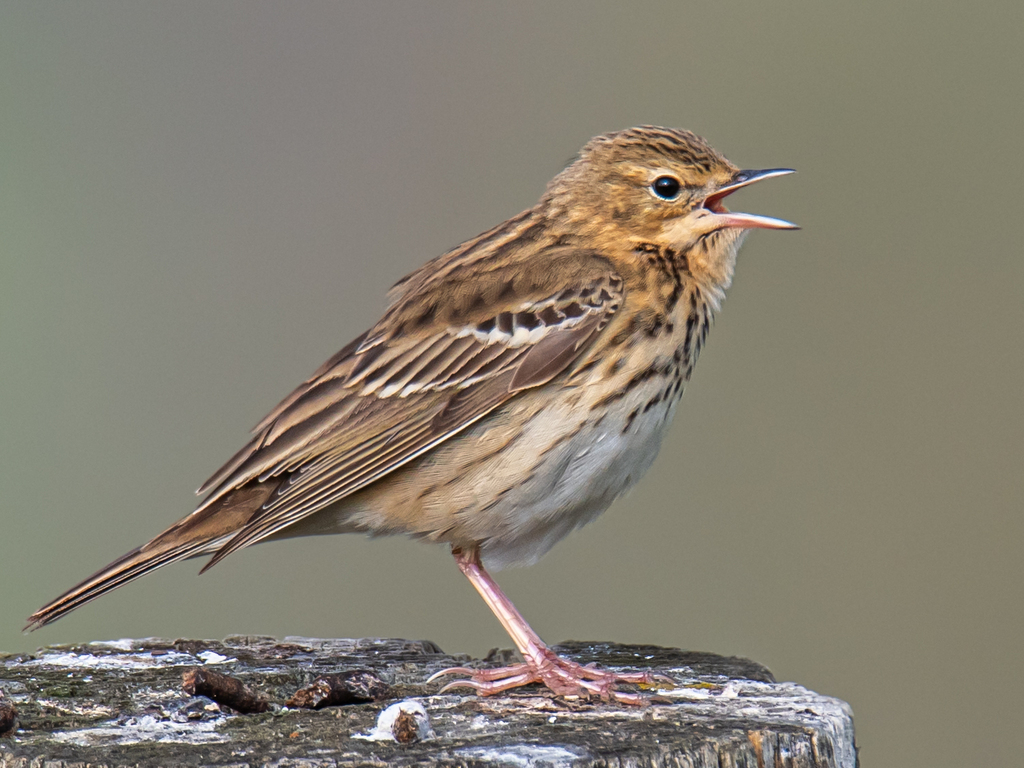
This is a small pipit that resembles the meadow pipit. It is an undistinguished looking species, with brown stripes above and with black markings on white underparts and buff breast below. It can be differentiated from the slightly smaller meadow pipit by its heavier bill and greater contrast between its buff breast and white belly. Tree pipits are more likely to perch in trees. The call is a strong spek, unlike the weak call of its relative. The song flight is unmistakable. The bird rises a short distance up from a tree, and then parachutes down on stiff wings, the song becoming more drawn out towards the end.
Range & habitat
The tree pipit breeds in habitats with a wooded component, including lowland heath and coppice. It is most common in open woodland bordering on moorland or in open structured oak woodland – hence the need for heavy thinning to create a gappy structure. It prefers medium-sized trees with a low canopy, where there is low-growing scrub and brambles less than 2 metres high, so that horizontal visibility is relatively good. It likes a mosaic of grass and bracken, but not heavily grazed short turf, so light to moderate grazing is preferred.
Wikipedia: “Distribution and habitat”
What it does
mid-September to mid-April: lives in sub Saharan Africa mid April to beginning of May: migrates and arrives in countries such as the United Kingdom beginning of May to August: breeding season, two broods August to mid September: flies back to Saharan Africas
Wikipedia: “Life cycle”
Listen
Looking for field recordings…
Where it lives
Recorded sightings
—
geo-referenced records in GBIF, from museums, herbaria and field observers.
Drag the globe to turn it. Dots are where records exist, not a range map; darker means more records.
In the stacks
Searching the stacks…
Every page naming Anthus trivialis in the Biodiversity Heritage Library →
This page is assembled live from iNaturalist, GBIF, Wikipedia, the Source Library and the Internet Archive. It is not yet part of the hand-edited codex. iNaturalist taxon 13711.