On eBird ↗
Sultan Tit
Live sightings near you, the range map, bar charts of when it is seen, and Macaulay Library photos and recordings.
Sultan Tit
Melanochlora sultanea
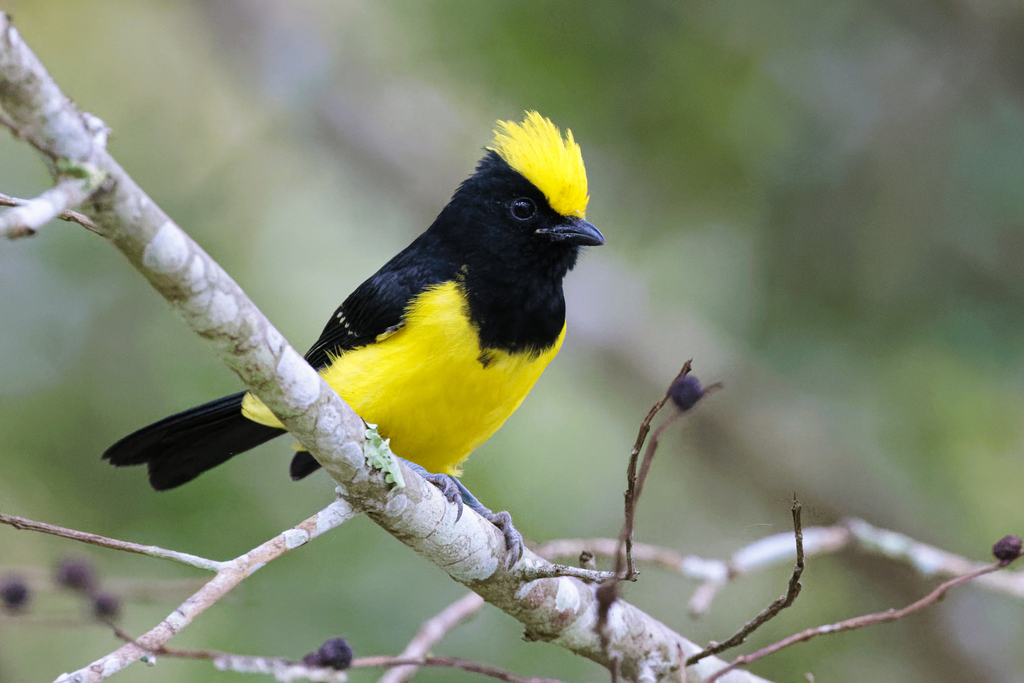
The sultan tit (Melanochlora sultanea) is an Asian forest bird with black upperparts plumage and yellow underparts, dark bill, and (depending on subspecies) a yellow or black crest. The sexes are similar, though the female has slightly duller plumage with greenish-black upperparts and throat. The young bird is duller than the adult and has a shorter crest. It is the only member of the monotypic genus Melanochlora, which is fairly distinct from other tits, third-basal in the family Paridae after Cephalopyrus and Sylviparus.
From the article Sultan tit on Wikipedia (CC BY-SA), quoted section by section
Description
The male has the forehead and crown with the crest brilliant yellow (except glossy black in one subspecies); the whole upper plumage, sides of the head and neck, chin, throat, and breast-deep black glossed with green, the edges of the feathers of the upper plumage with a metallic lustre, and the outermost tail-feathers tipped with white; lower plumage from the breast downwards deep yellow, the thighs barred or mottled with white. The recumbent crest is raised when the bird is alert or alarmed. The female has the yellow parts duller; the upper plumage and sides of the head dark greenish-brown; the chin and throat glossed dark olive-green; wings and tail dull black; the feathers of the upper plumage edged with metallic green. The young resemble the female, but in the youngest stage the bright edges to the plumage of the upper parts are absent, and the greater wing coverts are edged with white. They forage in the mid and upper canopy singly or in small groups mainly and feed mainly on insects but sometimes feed on figs. Their loud calls with short repeated and variable whistling notes have a tit-like quality. The flight is slow and fluttering. The bill is black; the mouth dark; the eyelids grey; the iris dark brown; the legs are grey; the claws dark horn. …
Range & habitat
There are four subspecies:
In 1890, Richard Bowdler Sharpe considered this species as a member of the former subfamily Liotrichinae within the Timaliidae. A 2005 study found that they appear to have distinctive mtDNA cytochrome b sequences, suggesting that they might not belong to the Paridae unless the penduline tits are included, but more recent, more detailed studies have clarified its placement in a near-basal position in the family Paridae and separate from the penduline tits.
Wikipedia: “Taxonomy and distribution”
What it does
The sultan tit forages mostly on invertebrates and larvae. The food sources are grasshoppers, mantises and web spiders, in addition to berries, other fruits and seeds. The search for food is mostly in the tree canopy, but sometimes also in higher undergrowth and bamboo areas.
Wikipedia: “Feeding”
Listen
Looking for field recordings…
Where it lives
Recorded sightings
—
geo-referenced records in GBIF, from museums, herbaria and field observers.
Drag the globe to turn it. Dots are where records exist, not a range map; darker means more records.
In the stacks
Searching the stacks…
Every page naming Melanochlora sultanea in the Biodiversity Heritage Library →
This page is assembled live from iNaturalist, GBIF, Wikipedia, the Source Library and the Internet Archive. It is not yet part of the hand-edited codex. iNaturalist taxon 13682.