- Plants
- ›Vascular Plants
- ›flowering plants
- ›Dicots
- ›Legumes, Milkworts, and Allies
- ›Legumes
- ›Peacock Flower Subfamily
- ›Cassieae
- ›Cassiinae
- ›Senna
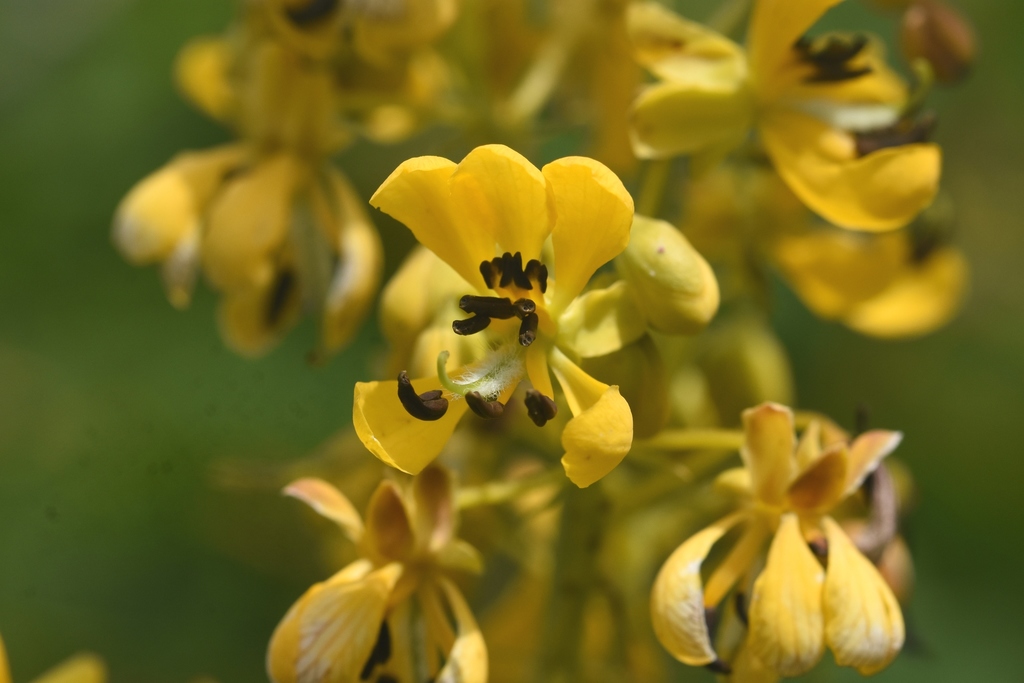
American senna
Senna hebecarpa
Senna hebecarpa, with the common names American senna and wild senna, is a species of legume native to eastern North America....
From the article Senna hebecarpa on Wikipedia (CC BY-SA), quoted section by section
Description
Senna hebecarpa grows as a sparsely branched perennial plant. It has alternate, compound leaves. Clusters of light yellow to orange flowers bloom from July to August in North America.
Range & habitat
The plant is found from the Great Lakes region and Maine southwards through the Eastern United States, in the Appalachian Mountains and Atlantic Plains, to Georgia. It is found in moist open woodlands, and in disturbed areas.
Wikipedia: “Distribution and habitat”
What it does
It is a larval host and nectar source for the Cloudless Giant Sulphur (Phoebis sennae) butterfly. It is also of special value to native bumble bees.
Wikipedia: “Ecology”
At the table
Senna hebecarpa is cultivated as an ornamental plant, for use as a perennial wildflower and flowering shrub in traditional and wildlife gardens, in natural landscaping projects, and for habitat restoration projects.
Native American ethnobotany. The Cherokee use an infusion of the plant for various purposes, including taking it for cramps, heart trouble, giving it to children and adults as a purgative and for fever, and taking it for 'blacks' (hands and eye sockets turn black). They also give an infusion of the root specifically to children for fever. They use a poultice of the root for sores, and they use a compound infusion for fainting spells. They also use a compound for pneumonia. The Haudenosaunee use the plant as a worm remedy and take a compound decoction as a laxative.
Wikipedia: “Uses”
Where it lives
Recorded sightings
—
geo-referenced records in GBIF, from museums, herbaria and field observers.
Drag the globe to turn it. Dots are where records exist, not a range map; darker means more records.
In the stacks
Searching the stacks…
Every page naming Senna hebecarpa in the Biodiversity Heritage Library →
This page is assembled live from iNaturalist, GBIF, Wikipedia, the Source Library and the Internet Archive. It is not yet part of the hand-edited codex. iNaturalist taxon 136373.