- Plants
- ›Vascular Plants
- ›flowering plants
- ›Dicots
- ›Sunflowers, Bellflowers, Fanflowers, and Allies
- ›Sunflowers, Daisies, Asters, and Allies
- ›Asteroideae
- ›paper daisies
- ›cudweeds, everlastings, and pussytoes
- ›Gnaphalium
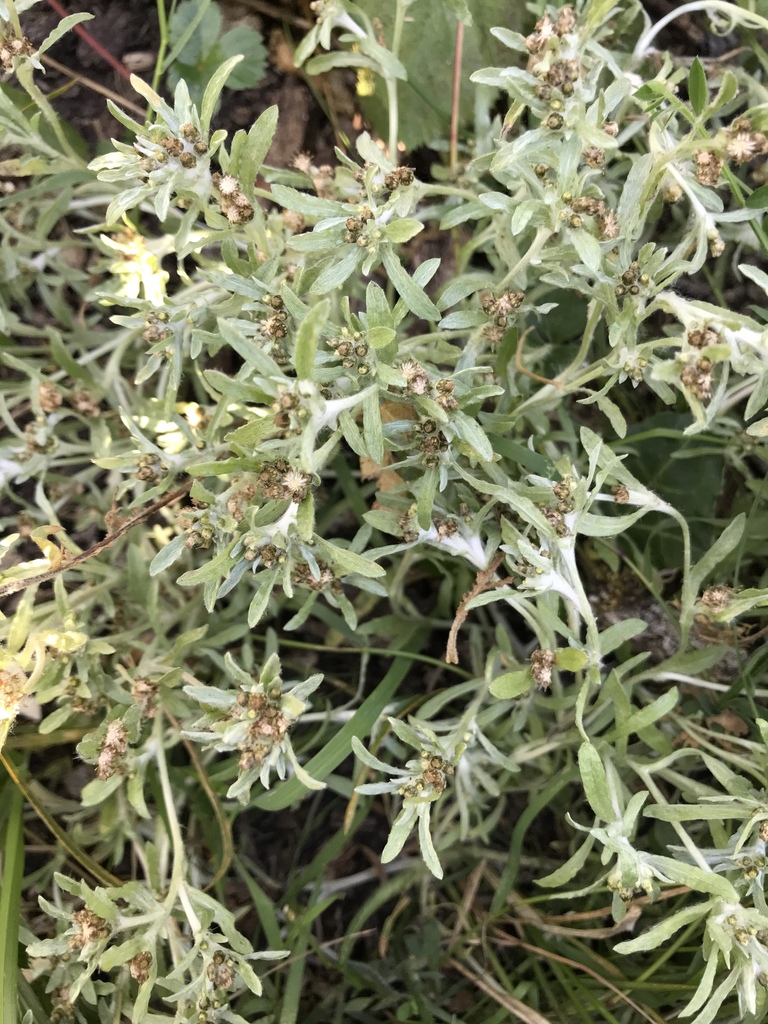
marsh cudweed
Gnaphalium uliginosum
Gnaphalium uliginosum, the marsh cudweed, is an annual plant found on damp, disturbed ground and tracks. It is very widespread across much of Europe, Asia, and North America. It is very common on damp, arable grasslands, paths, and on acid soils.
From the article Gnaphalium uliginosum on Wikipedia (CC BY-SA), quoted section by section
Description
It is a very woolly annual, growing 4–20 cm tall. The leaves are wooly on both sides. They are 1 to 5 cm long, narrow oblong shaped. The flower heads are 3 to 4 mm long. They are arranged in clusters of 3 to 10, surrounded by long leaves. The flower head bracts are wooly, and pale below, with dark chaffy hairless tips. The florets are brownish yellow. The stigmas are pale. It flowers from July until September.
Where it lives
Recorded sightings
—
geo-referenced records in GBIF, from museums, herbaria and field observers.
Drag the globe to turn it. Dots are where records exist, not a range map; darker means more records.
In the stacks
Searching the stacks…
Every page naming Gnaphalium uliginosum in the Biodiversity Heritage Library →
This page is assembled live from iNaturalist, GBIF, Wikipedia, the Source Library and the Internet Archive. It is not yet part of the hand-edited codex. iNaturalist taxon 136366.