- Animals
- ›Arthropods
- ›Hexapods
- ›Insects
- ›Winged and Once-winged Insects
- ›Butterflies and Moths
- ›Curved-horn Moths
- ›Timber Moths
- ›Pilostibes
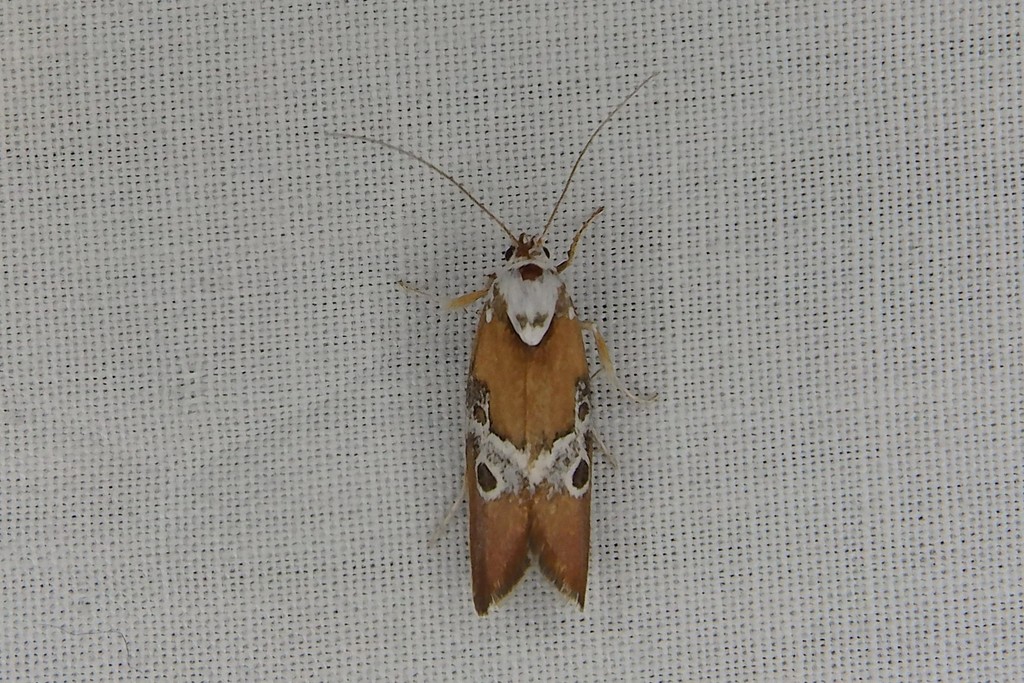
Pilostibes serpta
Pilostibes serpta is a moth in the family Xyloryctidae. It was described by Thomas Pennington Lucas in 1901. It is found in Australia, where it has been recorded from New South Wales, Queensland, South Australia and Western Australia.
The wingspan is about 27 mm. The forewings are light ochreous fuscous, with central and marginal diffusions of darker fuscous and black or white and dark fuscous markings. There is a subcostal black line from near the base to beyond half the costa, interrupted near the base and dotted with white dots throughout. A band of ground colour suffused with bluish white separates this costal line from a median fuscous diffusion. In this darker area are two circuitous white-lined rounded figures answering to discal and orbital, the outline gently undulating in and out and containing darker fuscous toward the costa. There are white dots scattered between the figures, and a winding white line anterior to the second figure, which turns sharply, circles obliquely to just before the anal angle of the inner margin. The central fascia is attenuated to a spear-like prominence beyond the second figure. The hindwings are light fuscous, lighter toward the inner margin.
Listen
Looking for field recordings…
Where it lives
Recorded sightings
—
geo-referenced records in GBIF, from museums, herbaria and field observers.
Drag the globe to turn it. Dots are where records exist, not a range map; darker means more records.
In the stacks
Searching the stacks…
Every page naming Pilostibes serpta in the Biodiversity Heritage Library →
This page is assembled live from iNaturalist, GBIF, Wikipedia, the Source Library and the Internet Archive. It is not yet part of the hand-edited codex. iNaturalist taxon 1354017.