On eBird ↗
Weebill
Live sightings near you, the range map, bar charts of when it is seen, and Macaulay Library photos and recordings.
Weebill
Smicrornis brevirostris
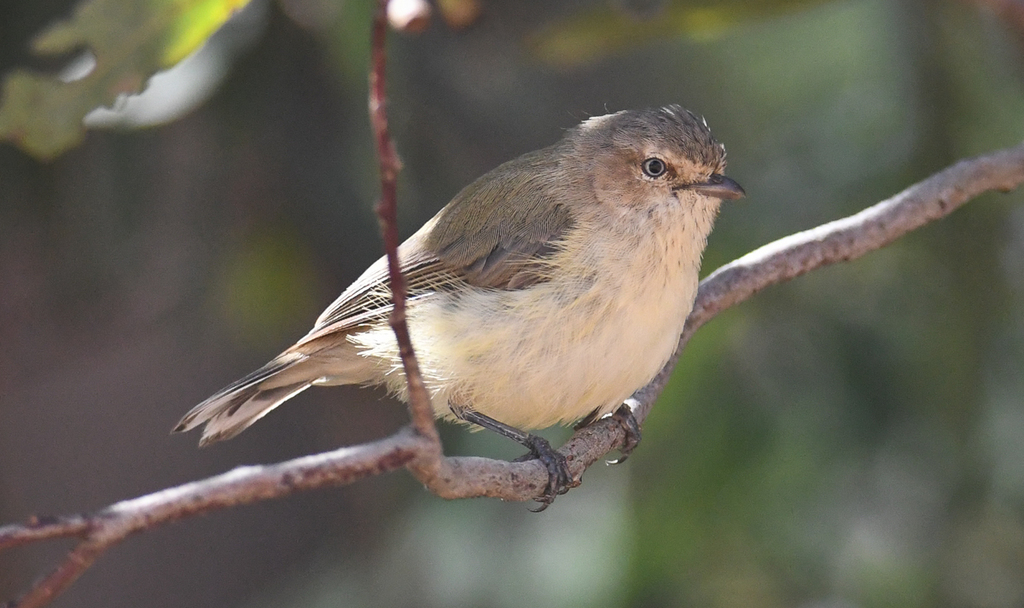
The weebill (Smicrornis brevirostris) is a species of bird in the family Acanthizidae. It is an insectivorous passerine that is found throughout mainland Australia. At 8 to 9 cm (3.1 to 3.5 in) long, it is Australia's smallest bird. It was originally described by John Gould in 1838, and four subspecies are recognised. The weebill's plumage is nondescript, with olive-grey upperparts and paler, more yellowish underparts. It grades from more brownish plumage in the southern regions of Australia to more yellow in tropical areas.
From the article Weebill on Wikipedia (CC BY-SA), quoted section by section
Description
The weebill is Australia's smallest bird at approximately 8 to 9 cm (3.1 to 3.5 in) long and weighing an average of 6 grams (adult bird). Wingspan is approximately 15 cm (5.9 in). Weebills have inconspicuously coloured plumage ranging from yellowish-grey (front) to olive-brownish-grey (back). The two main feather pigments involved in this variation are yellow (phaeomelanin) and olive-brown (eumelanin). There is geographical variation in plumage across the four subspecies. Adults have pale yellow eyes and a faint cream coloured supercilium. The throat feathers are grey, often with striation, and the flight feathers on the wings are pale brown. The tail feathers are brown with a black bar and white spot on the tip of all the rectrices, except the central pairs, which are completely dark. Both sexes are monomorphic in plumage colouration. The bill is short and pale grey. The stubby bill of the weebill assists in distinguishing it from thornbills. The legs and feet of the weebill are grey, and like all passerines, their toe arrangement is anisodactyl for perching. Juveniles have a similar plumage to adults, but can be identified by a brighter, yellow bill and greyer eye. Four subspecies of weebill are currently recognised and exhibit slight variation in feather pigmentation, dependent on distribution. …
Range & habitat
The weebill is found in woodlands and forests across most of mainland Australia, excluding Tasmania. All four subspecies of weebills are sedentary in their range, and numbers are regular throughout the year. They are most commonly found in the canopies of dry, open eucalyptus forests, woodlands and mallee, occasionally coming down to the midstory to feed primarily on small insects and their larvae. They display a preference for foraging in the canopy foliage of healthy eucalyptus trees, where they are more likely to retrieve insects. The weebill is widespread in all climates, although localised to watercourses in arid zones. They are somewhat gregarious with other small insectivorous passerines, such as thornbills, silvereyes, and pardalotes.
Wikipedia: “Distribution and habitat”
What it does
The diet consists mostly of insects, larvae, occasionally seeds and beetles . Arthropod prey items include spiders (Araneae), beetles (Coleoptera, including Curculionids), and flies (Diptera). Weebills forage busily in pairs, or small parties of up to 8, feeding mainly in trees, often hovering, they are active and noisy and cling to twigs while gleaning insects from the outer foliage of the canopy and midstory. Weebills assist in maintaining the health of trees, as they glean scale insects and eat a range of other insects, including psyllids and their protective covers (lerps).
Wikipedia: “Diet”
Listen
Looking for field recordings…
Where it lives
Recorded sightings
—
geo-referenced records in GBIF, from museums, herbaria and field observers.
Drag the globe to turn it. Dots are where records exist, not a range map; darker means more records.
In the stacks
Searching the stacks…
Every page naming Smicrornis brevirostris in the Biodiversity Heritage Library →
This page is assembled live from iNaturalist, GBIF, Wikipedia, the Source Library and the Internet Archive. It is not yet part of the hand-edited codex. iNaturalist taxon 13540.