On eBird ↗
Pilotbird
Live sightings near you, the range map, bar charts of when it is seen, and Macaulay Library photos and recordings.
Pilotbird
Pycnoptilus floccosus
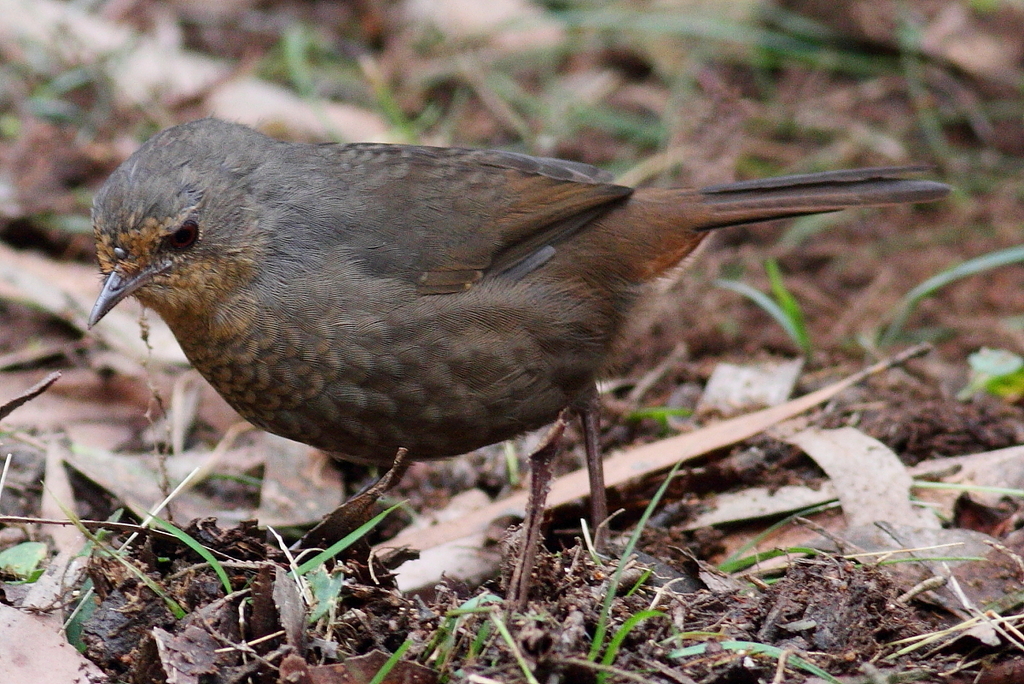
The pilotbird (Pycnoptilus floccosus) is a species of bird in the family Acanthizidae. It is monotypic within the genus Pycnoptilus. The species is endemic to south-east New South Wales and eastern Victoria in Australia. Its natural habitat is temperate wet sclerophyll forests and occasionally temperate rainforest. There are two subspecies Pycnoptilus floccosus floccosus lives in alpine areas of New South Wales such as the Snowy Mountains and Pycnoptilus floccosus sandfordi lives in lowland forest from Newcastle...
From the article Pilotbird on Wikipedia (CC BY-SA), quoted section by section
Description
The pilotbird is a large, plump species of acanthizid, measuring around 18 centimetres (7.1 in) in length and weighing 27 grams (0.95 oz). The plumage of the underparts is reddish-brown with scalloping on the chest and the centre of the belly speckled dull white. The upperparts are chocolate-brown. The bill is short and finely pointed. Its tail is broad and semi-erect, and flicked up and down when feeding.
Range & habitat
The pilotbird is found from the Wollemi National Park and Blue Mountains National Park in New South Wales through to the Dandenong Ranges, near Melbourne in Victoria. Its natural habitat is temperate wet sclerophyll forests and occasionally temperate rainforest, where there is dense undergrowth with abundant debris. It is sedentary and common.
Wikipedia: “Distribution and habitat”
What it does
Its name comes from its supposed habit of following lyrebirds, taking prey that they flush, and also from its call guiding bushmen seeking for lyrebirds. This habit is well known but seldom observed. The pilotbird is highly terrestrial, feeding on or near the ground and when disturbed it runs swiftly on strong legs. Its call has been described as "piercing and sweet". The male makes a far-carrying call of wit-wit-weet-WHEER to which the female may respond with a softer wit-a-wit-ee.
Breeding. The breeding season for the pilotbird is from August to December. The globular nest is built with a side-entrance and hidden amongst the accumulated debris on the forest floor. It is an untidy construction of bark, ferns, dead leaves and rootlets. A clutch of usually two eggs, each measuring 27 by 20 mm (1.06 by 0.79 in) and varying in colour from grey-green to purple-brown, is incubated by the female for 20–22 days. During the nestling period, which lasts 14–17 days, the male will often feed the female or help with the care of the nestlings, if the female has a subsequent brood. The nests are sometimes parasitised by the fan-tailed cuckoo (Cacomantis flabelliformis).
Wikipedia: “Behaviour”
Listen
Looking for field recordings…
Where it lives
Recorded sightings
—
geo-referenced records in GBIF, from museums, herbaria and field observers.
Drag the globe to turn it. Dots are where records exist, not a range map; darker means more records.
In the stacks
Searching the stacks…
Every page naming Pycnoptilus floccosus in the Biodiversity Heritage Library →
This page is assembled live from iNaturalist, GBIF, Wikipedia, the Source Library and the Internet Archive. It is not yet part of the hand-edited codex. iNaturalist taxon 13534.