On eBird ↗
Spotted Pardalote
Live sightings near you, the range map, bar charts of when it is seen, and Macaulay Library photos and recordings.
Spotted Pardalote
Pardalotus punctatus
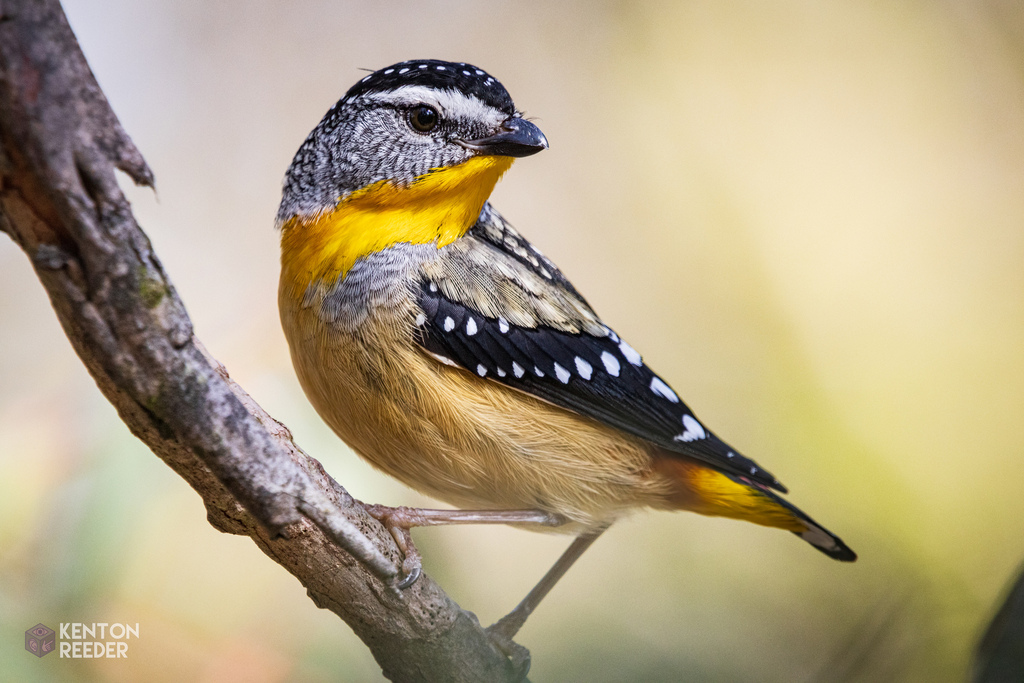
The spotted pardalote (Pardalotus punctatus) is a small passerine bird native to eastern and southern Australia, at elevations of up to 2,000 metres (6,600 ft). It is part of the pardalote family, Pardalotidae. One of the smallest of all Australian birds at 8 to 10 centimetres (3.1 to 3.9 in) in length, and one of the most colourful; it is sometimes known as the diamondbird. Although moderately common in all of the reasonably fertile parts of Australia (the east coast, the south-east, and the south-west corner) it is seldom seen closely enough to enable identification.
Three subspecies are recognised. The wet tropics spotted pardalote (subspecies militaris) is found in northeastern Queensland, while the distinctive subspecies, the yellow-rumped pardalote (subspecies xanthopyge), is mostly found in drier inland regions of southern Australia, particularly in semi-arid Mallee woodlands. Also occasionally found nesting in burrows in semi-rainforest areas inland from the coast in Mid North Coast NSW.
From the article Spotted pardalote on Wikipedia (CC BY-SA), quoted section by section
Description
Weighing around 6 grams (0.21 oz), the spotted pardalote is 8 to 10 cm (3.1 to 3.9 in) long. The adult male of the nominate subspecies has grey-brown upperparts with numerous paler buff spots, a black crown, wings and tail all with white spots, white eyebrows and reddish rump. The underparts are pale-buff-cinnamon, darkening to a more ochre at the breast, with a demarcated yellow throat and vent. The female is duller overall. The yellow-rumped subspecies is larger overall with a relatively smaller bill. The adult male has finer, white spots on its back, a bright yellow rump, and a cream breast. The adult female has finer spots than the adult female of the nominate subspecies. The Wet Tropics subspecies is smaller with a relatively larger bill. The adult male has a reddish rump and pale- to cinnamon-buff underparts.
Range & habitat
George Caley reported that it was not common around Sydney even in early settlement days. Spotted pardalote numbers appear to be declining, especially in urban areas, but the species is not considered endangered at this time.
Wikipedia: “Distribution and habitat”
Listen
Looking for field recordings…
Where it lives
Recorded sightings
—
geo-referenced records in GBIF, from museums, herbaria and field observers.
Drag the globe to turn it. Dots are where records exist, not a range map; darker means more records.
In the stacks
Searching the stacks…
Every page naming Pardalotus punctatus in the Biodiversity Heritage Library →
This page is assembled live from iNaturalist, GBIF, Wikipedia, the Source Library and the Internet Archive. It is not yet part of the hand-edited codex. iNaturalist taxon 13531.