- Animals
- ›Chordates
- ›Vertebrates
- ›Ray-finned Fishes
- ›Spiny-rayed fishes
- ›Butterflyfishes, Angelfishes, and Allies
- ›Grunts
- ›Sweetlips
- ›Plectorhinchus
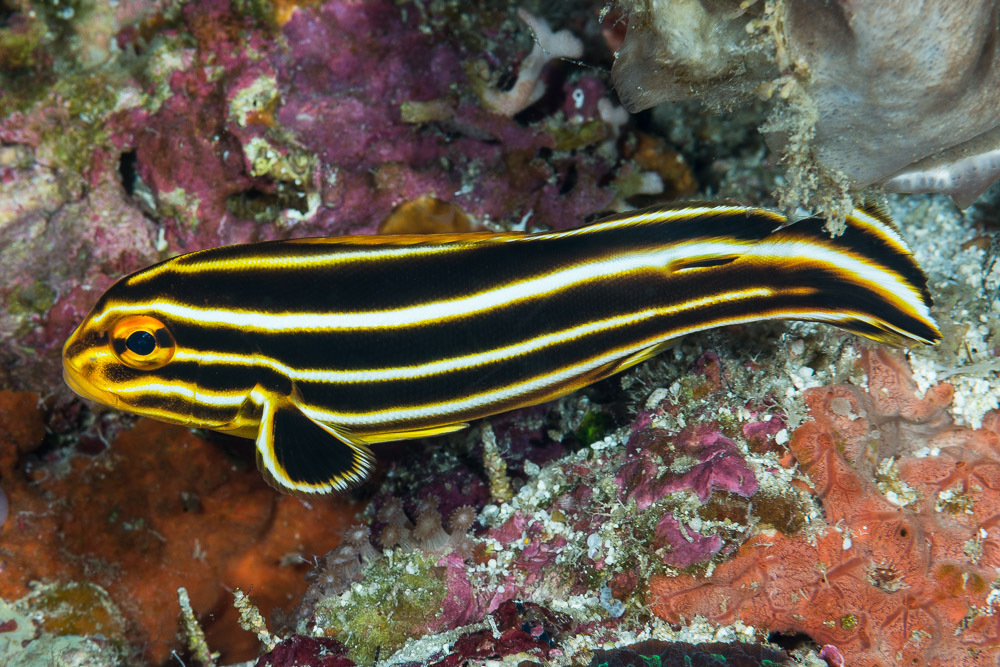
Ribbon Sweetlips
Plectorhinchus polytaenia
Plectorhinchus polytaenia, the ribboned sweetlips, also known as Tesone di mare or yellow-ribbon sweetlips, is a species of marine ray-finned fish, a sweetlips belonging to the subfamily Plectorhinchinae, one of two subfamilies in the family Haemulidae, the grunts. It is native to the Indian Ocean and the western Pacific Ocean.
From the article Ribboned sweetlips on Wikipedia (CC BY-SA), quoted section by section
Description
The ribboned sweetlips has fleshy lips which become moderately swollen as the fish ages. There are 6 pores on its chin bit there is no median pit. The dorsal fin contains 12-13 spines and 19-22 soft rays while the anal fin has 3 spines and 7-8 soft rays. They have a background colour which is brown to yellowish grey broken by 5 to 9 quite thin grey or white horizontal stripes edged with dark brown on the body and extending around the snout, The fins are yellow with darker stripes on the soft-rayed part of the dorsal fin, the caudal fin and the pectoral fin, these fade with age and in the oldest fish that are absent. The eyes and the lips are yellowish while the inside of the mouth is bright red and the chin is white. The juveniles less stripes on their orange-brown bodies, the most obvious being a central black band. This species attains a maximum total length of 50 cm (20 in).
Range & habitat
The ribboned sweetlips is found in the Indo-Pacific region. Its range extends from the west coast of India to the Malay Archipelago, the Philippines, New Guinea and east as far as the Solomon Islands south to north-western Australia.
Wikipedia: “Distribution”
Where it lives
Recorded sightings
—
geo-referenced records in GBIF, from museums, herbaria and field observers.
Drag the globe to turn it. Dots are where records exist, not a range map; darker means more records.
In the stacks
Searching the stacks…
Every page naming Plectorhinchus polytaenia in the Biodiversity Heritage Library →
This page is assembled live from iNaturalist, GBIF, Wikipedia, the Source Library and the Internet Archive. It is not yet part of the hand-edited codex. iNaturalist taxon 135279.