On eBird ↗
Gray Gerygone
Live sightings near you, the range map, bar charts of when it is seen, and Macaulay Library photos and recordings.
Grey Gerygone
Gerygone igata
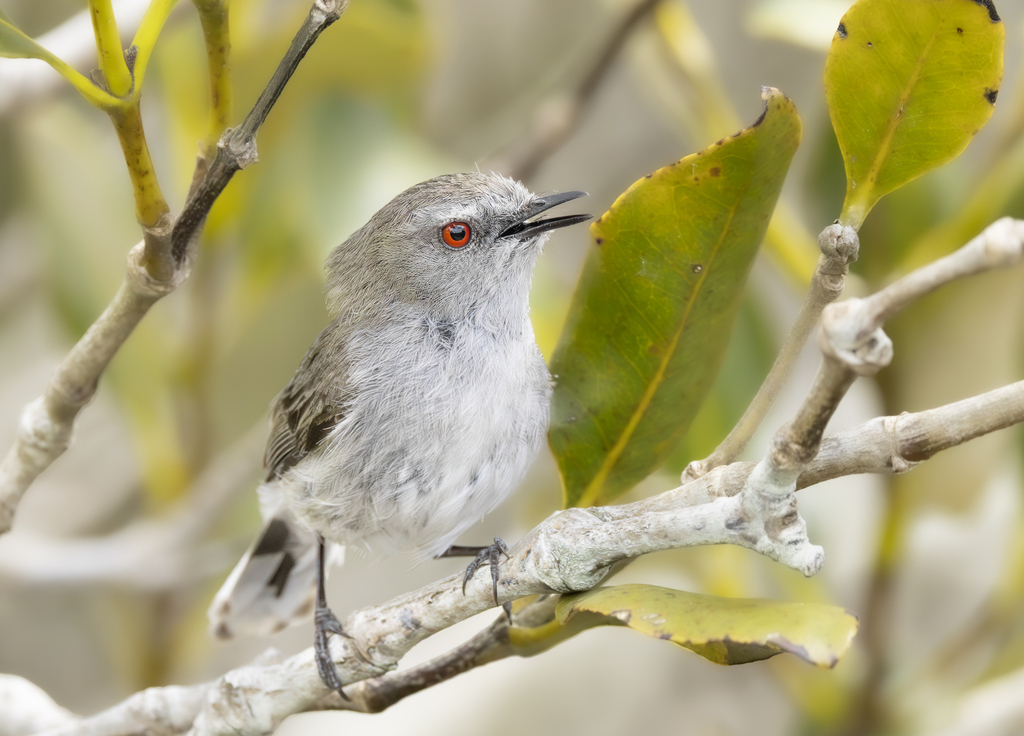
The grey warbler (Gerygone igata), also known by its Māori name riroriro, is an insectivorous bird in the family Acanthizidae endemic to New Zealand. Internationally, ornithologists usually refer to it as the grey gerygone or New Zealand gerygone to avoid confusion with unrelated birds also known as warblers. It is also sometimes known as the rainbird. The specific name igata was given by French naturalists Jean René Constant Quoy and Joseph Paul Gaimard, who claimed that this was the local name among the Māori inhabitants of Tasman Bay; this was likely a misunderstanding as no iwi are known to have a name resembling "igata" for the bird. Its natural habitat is forests, but also tends to occupy lower vegetation habitats. These insectivorous birds feed on insects living in shrubs, and often feed on the wing. They are found throughout New Zealand, as well as offshore islands where shrub exists. They also flourish in suburban areas where there is vegetation present.
From the article Grey warbler on Wikipedia (CC BY-SA), quoted section by section
Description
The grey warbler has a long tail that is darker than its grey-brown body, with white tail end markings as well as a white tail underside. There is little sexual dimorphism between males and females, aside from females usually being smaller than males. Warblers are especially small; weighing around 6.5g with an average length of only around 10cm. Adults have a signature ruby red eye, while juveniles have a brown eye, as well as yellowish feathers around the face and underbody. Its nest is especially unique among birds, with a pear shaped, dome like hanging nest that has a circular side entrance hole.
Song. The male's song often starts with a series of three squeaks and builds into a distinctive long plaintive wavering trill that rises and falls. Only the male warblers sing year-round, to attract mates and defend territory. Male songs are particularly loud during summer and spring, which lines up with the warblers breeding season. The warbler's song is a pleasant, soft warble and varies between different populations. In fact, studies looking at temporal aspects of warbler song found that the song shifted to a higher frequency over a period of 7 years. It was hypothesised that this was due to the reintroduction of native species to the warbler's habitat. …
Range & habitat
Grey warblers are common throughout New Zealand's main islands and many off-shore islands, but are absent from open country and alpine areas. At home in native and exotic forests it may be found almost anywhere there is some tree or shrub cover.
Wikipedia: “Distribution and habitat”
What it does
The grey warbler is a predominantly insectivorous bird, feeding on organisms such as spiders, beetles, and flies. They do this by hovering around shrubs, and picking invertebrates off leaves. However, they have been seen to occasionally eat fruits, perhaps to make up for limiting nutrients that are low in invertebrates, or due to their very high energy method of feeding.
Wikipedia: “Feeding”
In human culture
The direction in which a grey warbler would build its nest served as an indicator of forthcoming weather conditions to Māori – in this respect, the bird was known as a manu tohu tau. The tradition states that a grey warbler will build the nest entrance in the opposite direction to the prevailing wind. As such, an eastern-facing entrance would indicate a poorly season brought on by western winds; in contrast, a northern-facing entrance would suggest a pleasant season ahead. In spring, the song of the grey warbler is said to be a signal for Māori to begin planting their crops. As such, those who 'ignore' the call of the grey warbler and do not help out with the planting of crops (and later seek to reap the harvest for themselves) are rebuked with the following whakataukī (proverb):
I whea koe i te tangihanga o te riroriro, ka mahi kai māu? Where were you when the riroriro was singing, that you didn't work to get yourself food?
Wikipedia: “In Māori culture”
Listen
Looking for field recordings…
Where it lives
Recorded sightings
—
geo-referenced records in GBIF, from museums, herbaria and field observers.
Drag the globe to turn it. Dots are where records exist, not a range map; darker means more records.
In the stacks
Searching the stacks…
Every page naming Gerygone igata in the Biodiversity Heritage Library →
This page is assembled live from iNaturalist, GBIF, Wikipedia, the Source Library and the Internet Archive. It is not yet part of the hand-edited codex. iNaturalist taxon 13494.