On eBird ↗
Western Gerygone
Live sightings near you, the range map, bar charts of when it is seen, and Macaulay Library photos and recordings.
Western Gerygone
Gerygone fusca
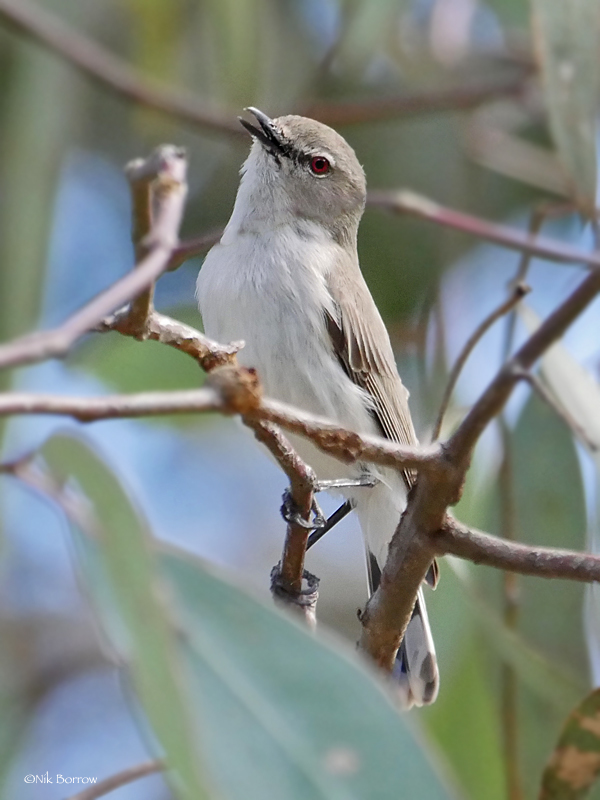
The western gerygone (Gerygone fusca) is a small, brownish-grey species of passerine bird, which is found in inland and south-west Australia. It is an arboreal, insectivore of open forest, woodland and dry shrubland. It is not currently threatened with extinction (IUCN: Least Concern).
From the article Western gerygone on Wikipedia (CC BY-SA), quoted section by section
Description
The western gerygone has plain, brownish-grey upperparts, with no prominent wing markings. The underparts are whitish, with variable amounts of grey on the throat and breast. The outer tail-feathers are conspicuously marked, with large, white patches at the base, a broad, blackish, subterminal tail band and white tips. It is usually found singly or in pairs, in the mid to upper storey of trees and shrubs and is often located by its characteristic, persistent song. It can be very active when foraging. The western gerygone is similar in appearance to several other Australian gerygones, which don't usually share its habitat. Its plumage can be distinguished from these species by the diagnostic large, white patches at base of its outer tail feathers.
Range & habitat
The western gerygone is the most widespread gerygone species and is endemic to Australia. Its three subspecies show subtle differences in plumage and form geographically separate populations:
Subspecies fusca is found in south-west Western Australia. Subspecies exsul is found in eastern Australia; from the Carpentarian Basin, through central and western Queensland, New South Wales and Victoria, and eastern South Australia. An isolated, resident population from the Eyre Peninsula in South Australia is usually ascribed to this subspecies. Subspecies mungi is found in central Australia; in the interior of Western Australia, the Northern Territory and South Australia. Nomadic individuals may travel far beyond this species' regular geographic limits. Gerygone species are largely allopatric. They are usually separated from each other by their geographic distribution, or by their preference for different habitats. As it is the only gerygone of the Australian interior, the western gerygone does not overlap geographically with other gerygones throughout most of its range. There are two island populations. Both are near Perth in Western Australia. Rottnest Island was colonized by the western gerygone in the 1950s. It was first observed on the island in 1955 and rapidly spread into all suitable habitat. …
Wikipedia: “Distribution”
What it does
Breeding usually occurs between September and January, but has been recorded from August to March. Courtship involves intricate chases between pairs. Territories are maintained throughout the breeding season and territorial disputes involve agitated calls. Males display by intensely fluttering their wings and tail, with their bodies tilted horizontally. The nest is a long, oval-shaped, pendent structure, with a hooded entrance near the top and a 'tail' at the bottom. Both sexes build the nest. The clutch size is 2 or 3 eggs, (rarely 4). The incubation period lasts 10–12 days, and only the female incubates. The nestling period lasts 10–13 days, and both parents feed the nestlings. Fledglings are fed by their parents for up to 15 days, until independence.
Wikipedia: “Reproduction”
Listen
Looking for field recordings…
Where it lives
Recorded sightings
—
geo-referenced records in GBIF, from museums, herbaria and field observers.
Drag the globe to turn it. Dots are where records exist, not a range map; darker means more records.
In the stacks
Searching the stacks…
Every page naming Gerygone fusca in the Biodiversity Heritage Library →
This page is assembled live from iNaturalist, GBIF, Wikipedia, the Source Library and the Internet Archive. It is not yet part of the hand-edited codex. iNaturalist taxon 13491.