On eBird ↗
Rufous Bristlebird
Live sightings near you, the range map, bar charts of when it is seen, and Macaulay Library photos and recordings.
Rufous Bristlebird
Dasyornis broadbenti
The rufous bristlebird (Dasyornis broadbenti) is one of three extant species of bristlebirds. It is endemic to Australia and three subspecies have been described, from coastal south-western Western Australia, south-eastern South Australia and south-western Victoria. Its natural habitat is coastal shrublands and heathlands. It is threatened by habitat destruction.
From the article Rufous bristlebird on Wikipedia (CC BY-SA), quoted section by section
Description
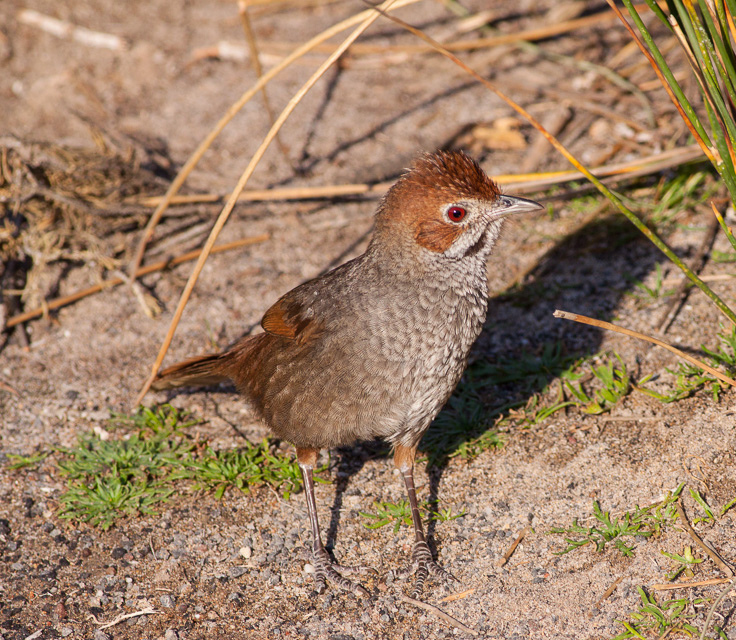
The rufous bristlebird is a medium-sized bird (approximately 77g) that is predominantly brown, with a long tail and short rounded wings. It has a rich rufous coloured head and ear coverts. The mantle, back and neck are dark brown with a faint reddish wash and a red-brown rump. A light grey marking surrounds the bird's eye and extends to the bill. The eyes of the rufous bristlebird are a reddish colour. Their legs and feet are a dark brown or grey-brown colour. It has a whitish throat with dark scalloping and a grey-brown breast also with scalloping. Compared to the east where the scalloping is dark, in the western part of the bird's range the scalloping is white. The rufous bristlebird is a similar size to the blackbird yet is unique due to its distinct features including its long tail, acoustic signals and rufous colour.
Range & habitat
Rufous bristlebirds are predominately found and distributed across Australia and its states. Formerly, they also ranged within southern Western Australia, however, now they only reside across coastal regions of western Victoria and south-eastern South Australia. Well-known locations are near the Murray River mouth in South Australia, and Portland and Port Fairy in Victoria. The rufous bristlebird was found to have a slow recolonization rate. They have also been located in heathlands, on coastal clifftops and in low-lying forested valleys in the Otway Ranges of south-western Victoria. The first records of the rufous bristlebird within the heath were in 1985 and the next one in 1981. Prior to these dates, there had been wildfires that swept through this region in South Australia. The first records were located at Salt Creek, which was one of the few lightly-burnt areas in this region that could have provided a safe shelter and supportive habitat. Their preferred habitat is in dense shrubland and heathlands amongst a diverse range of plant species. They are also commonly found within forests where there is an understory of bracken and/or shrubs. The bird can be detected running or flying short distances, darting in and out of the relatively dense understory in which it shelters and feeds. The rufous bristlebird also lives near thick and natural vegetation. …
Wikipedia: “Habitat and distribution”
What it does
The rufous bristlebird predominately feeds off seeds and small ground-dwelling invertebrates. Usually, they search for food off the ground; however, they also forage amongst leaf litter or in short shrubs whilst collecting insects or grubs. These are easy to catch and provide nutrition. The rufous bristlebird has also been found eating terrestrial snails.
Wikipedia: “Feeding”
Listen
Looking for field recordings…
Where it lives
Recorded sightings
—
geo-referenced records in GBIF, from museums, herbaria and field observers.
Drag the globe to turn it. Dots are where records exist, not a range map; darker means more records.
In the stacks
Searching the stacks…
Every page naming Dasyornis broadbenti in the Biodiversity Heritage Library →
This page is assembled live from iNaturalist, GBIF, Wikipedia, the Source Library and the Internet Archive. It is not yet part of the hand-edited codex. iNaturalist taxon 13481.