On eBird ↗
Chestnut-rumped Thornbill
Live sightings near you, the range map, bar charts of when it is seen, and Macaulay Library photos and recordings.
Chestnut-rumped Thornbill
Acanthiza uropygialis
The chestnut-rumped thornbill (Acanthiza uropygialis) is a small passerine bird in the family Acanthizidae, endemic to Australia.
Specially named for its pale-chestnut rump from mediaeval Latin uropygium, the rump.
From the article Chestnut-rumped thornbill on Wikipedia (CC BY-SA), quoted section by section
Description
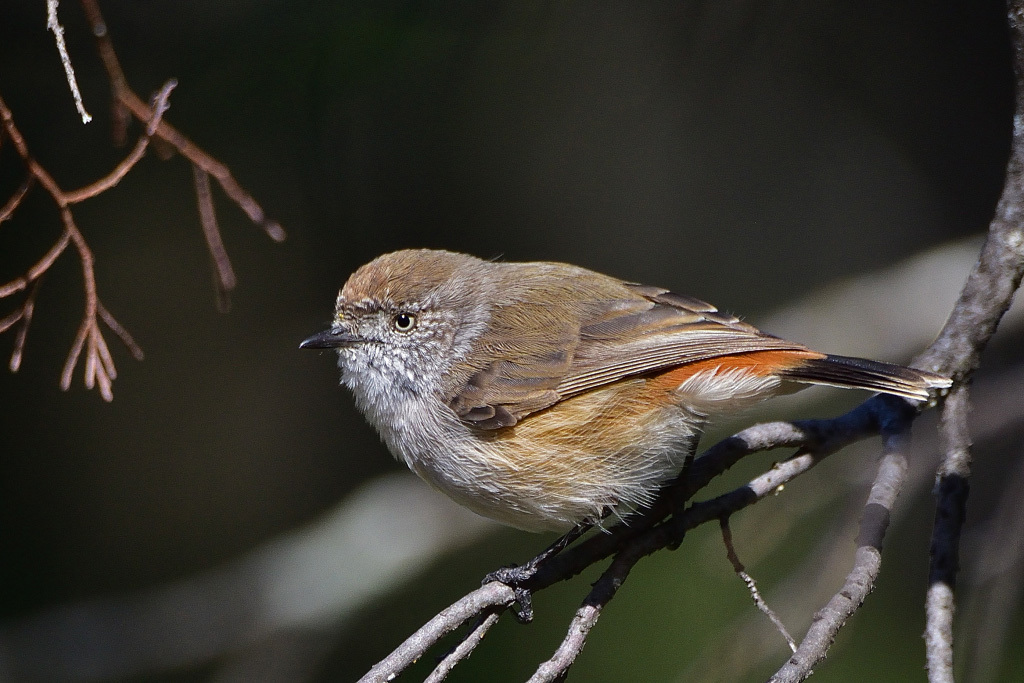
Length: 9.8 cm (9-11); wing span 15.5 cm (14-16.5); weight: 6 g. Mid-sized thornbill similar in size and shape to inland thornbill (A. apicalis) and slaty-backed thornbill (A. robustirostris). Pale and plain with pale iris similar to buff-rumped (Acanthiza reguloides), western (A.inornata), slender-billed (A. iredalei) and yellow-rumped thornbills (A. chrysorrhoa). Pale grey-brown upper, rich chestnut rump and mostly black tail with pale tips, pale mottled ear-coverts and rufous suffusion on forehead and crown. Plain whitish underbody. The sexes are alike, with no seasonal variation. Slight geographic variations, birds of the more arid inland are paler and greyer above, with a slightly paler rump patch and cleaner white below than those in coastal and subcoastal regions. May be confused with other thornbills having a rufous-brown rump patch such as brown thornbill (A. pusilla), inland thornbill (A. apicalis) and slaty-backed thornbills (A. robustirostris). The chestnut-rumped thornbill is gregarious, usually in small flocks, twos or threes and sometimes with other thornbills and small passerines. Active and restless, the chestnut-rumped thornbill forages in shrubs and trees, searching briskly, flitting and hopping in foliage and low branches, probing into crevices and bark. …
Range & habitat
Endemic to mainland Australia. Qld: Widespread in S, to W of Great Divide, in South Western, South Central and W. South-Eastern Regions. Generally S of 23° S. NSW & ACT: Widespread W of Great Divide, including w. slopes of Northern Tablelands and southern Tablelands, Canberra. Vic: Widespread in Mallee, Wimmera and North Districts N of 37°S. SA: Widespread in many regions, but generally absent from SE (though a few records exist). WA: Generally absent from Nullarbor Plain. Farther west largely absent from south coast, widespread in areas W of 123°E from 32°S North to 22°S in Pilbara region. Widespread in Gibson Desert, and scattered sites in Great Victoria Desert.
Movements. Chestnut-rumped thornbills are resident or sedentary, but some movement occurs. No large-scale movements are known, though some individuals occasionally move long distances. Non-breeding flocks disperse before breeding.
Habitat. They are found in dry woodlands and shrublands, mainly of mulga and malleeeucalypts. Also in thickets, saltbush, bluebush, lignum, open pastoral country, among dead trees and stumps. They occur in arid and semi-arid zones extending to temperate and subtropical zones, in a wide variety of land forms including sand dunes, flood plains, rocky hillsides, plateaux and gorges.
Wikipedia: “Distribution and population”
What it does
Chestnut-rumped thornbills are mainly insectivores but occasionally eat seeds. Studies on stomach contents show spiders, insects, plants, seeds and buds. They mostly forage in foliage and from branches of shrubs and low trees but also regularly on the ground, by gleaning 81.8% (leaves, twigs, branches, ground), sallying 4.4% and 13.9% by probing into bark. The young are fed tiny insects and small white grubs. They are gregarious and rarely seen singly. Feeding flocks are usually small parties of up to ten, and less often up to 20 birds, associating with brown thornbill (A. pusilla), yellow-rumped thornbill (A. chrysorrhoa), southern whiteface (Aphelocephala leucopsis), white-browed scrubwrens (Sericornis frontalis) or redthroats (Pyrrholaemus brunneus), and occasionally joined by silvereyes (Zosterops lateralis). In South Australia during winter, they may congregate in mixed feeding groups with yellow (A. nana), yellow-rumped (A. chrysorrhoa) and buff-rumped thornbills (A. reguloides), with up to 100 or more birds in groups.
Wikipedia: “Feeding”
Listen
Looking for field recordings…
Where it lives
Recorded sightings
—
geo-referenced records in GBIF, from museums, herbaria and field observers.
Drag the globe to turn it. Dots are where records exist, not a range map; darker means more records.
In the stacks
Searching the stacks…
Every page naming Acanthiza uropygialis in the Biodiversity Heritage Library →
This page is assembled live from iNaturalist, GBIF, Wikipedia, the Source Library and the Internet Archive. It is not yet part of the hand-edited codex. iNaturalist taxon 13464.