On eBird ↗
Whitehead's Spiderhunter
Live sightings near you, the range map, bar charts of when it is seen, and Macaulay Library photos and recordings.
Whitehead's Spiderhunter
Arachnothera juliae
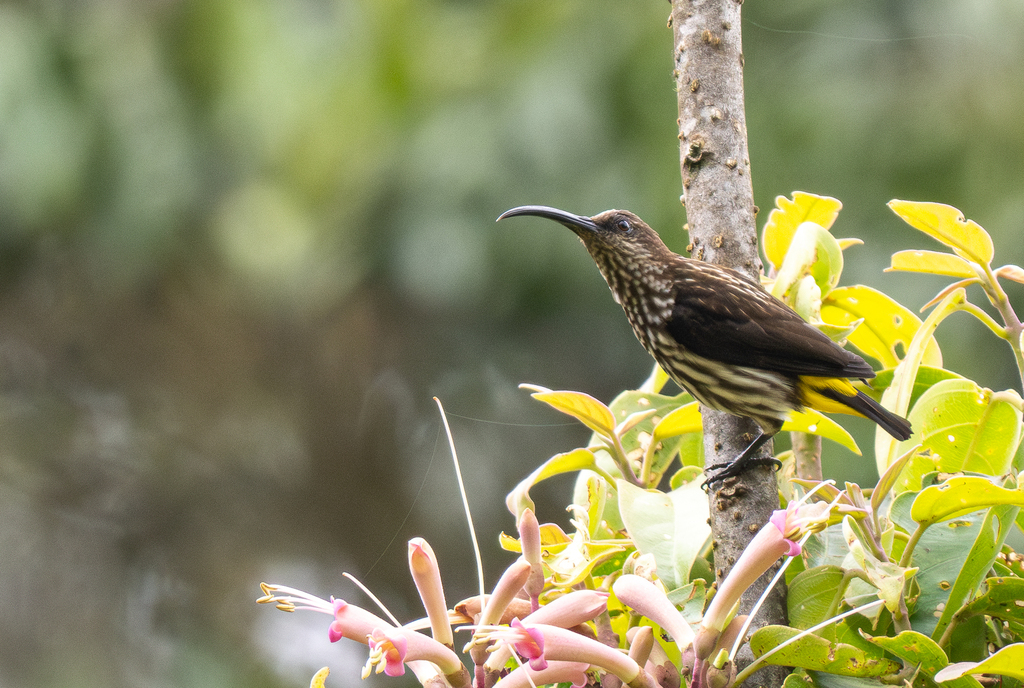
Whitehead's spiderhunter (Arachnothera juliae) is a species of spiderhunter in the sunbird and spiderhunter family Nectariniidae. It is endemic to Borneo, where it is found in the mountain ranges in the north-central part of the island. It inhabits hill dipterocarp forest, primary and secondary montane forest, and forest edge at elevations of 930–3,000 m (3,050–9,840 ft). A large and distinctive spiderhunter, the species is mostly brown with profuse whitish streaking all over the body and bright yellow vents and uppertail coverts. Both sexes are similar in appearance, but males are larger, with a length of 16.5–18 cm (6.5–7.1 in) compared to a length of 15.5–16.5 cm (6.1–6.5 in) for females. The juvenile plumage is unknown.
The species feeds on small arthropods, berries, and nectar, foraging alone, in pairs, or in small flocks of up to five birds. It breeds from March to at least August, making bark-lined nests in hollows it excavates in naturally occurring clumps of moss, vegetation, and roots. This nest is unique within its genus and is shared only with the closely related yellow-eared and naked-faced spiderhunters. Clutches consist of two chicks, which are fed berries and arthropods. It is listed as being of least concern by the International Union for Conservation of Nature, but is experiencing a population decline caused by habitat destruction.
From the article Whitehead's spiderhunter on Wikipedia (CC BY-SA), quoted section by section
Description
The species is a large, distinctive spiderhunter, with males having a length of 16.5–18 cm (6.5–7.1 in) and females having a length of 15.5–16.5 cm (6.1–6.5 in). It is mainly brown with profuse streaking on the head and body, buffy white streaking on the top of the head, narrow white streaks on the neck and back, fine brownish-white streaking on the throat, and broad white streaking on the rest of the underparts. The vent and uppertail coverts are bright yellow. The iris is brown, while the legs and bill are black. Both sexes look similar, while the juvenile plumage is unknown. Whitehead's spiderhunters have very distinctive vocalisations, with a high-pitched, squeaky song. Their calls include a wheezy wee-chit, with the first note rising and second note falling in pitch, a complex series of nasal and wheezy wit-wit-wit-wt'wt'wt'weehee twitters and trills, and a teeh-teeh-wee, with the wee rising in pitch. Other calls are a see-wee see-wee, a swee-eee-eee, a tee-tee-swee-ee, prolonged twittering, and loud shrieks made in flight or while perched.
Range & habitat
Endemic to Borneo, Whitehead's spiderhunter is found in mountain ranges in the north-central part of the island, from Mount Kinabalu to the Dulit Range and Kayan Mentarang. It inhabits hill dipterocarp forest, primary and secondary montane forest, and forest edge at elevations of 930–3,000 m (3,050–9,840 ft).
Wikipedia: “Distribution and habitat”
What it does
Whitehead's spiderhunter feeds on small arthropods, berries, and nectar. It feeds alone, in pairs, or in groups of up to five birds, occasionally joining mixed-species foraging flocks. Foraging is usually conducted in the canopy, but the species will sometimes lower down at forest edges. It searches for food in foliage, particularly within clumps of epiphytes high up in the forest, and has been observed probing Rhododendron flowers.
Wikipedia: “Feeding”
Listen
Looking for field recordings…
Where it lives
Recorded sightings
—
geo-referenced records in GBIF, from museums, herbaria and field observers.
Drag the globe to turn it. Dots are where records exist, not a range map; darker means more records.
In the stacks
Searching the stacks…
Every page naming Arachnothera juliae in the Biodiversity Heritage Library →
This page is assembled live from iNaturalist, GBIF, Wikipedia, the Source Library and the Internet Archive. It is not yet part of the hand-edited codex. iNaturalist taxon 13439.