On eBird ↗
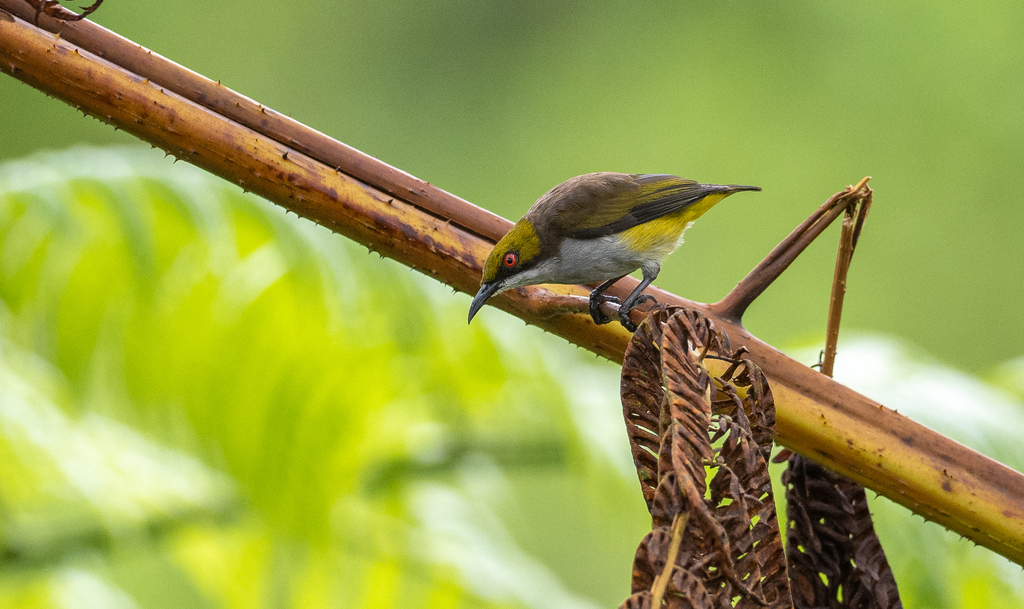
Olive-capped Flowerpecker
Live sightings near you, the range map, bar charts of when it is seen, and Macaulay Library photos and recordings.
Olive-capped Flowerpecker
Dicaeum nigrilore
The olive-capped flowerpecker (Dicaeum nigrilore) is a species of bird in the family Dicaeidae. It is endemic to the island of Mindanao in the Philippines.Its natural habitat is tropical moist montane forest.
From the article Olive-capped flowerpecker on Wikipedia (CC BY-SA), quoted section by section
Range & habitat
It inhabits tropic moist sub-montane and montane forest above 900 masl. IUCN has assessed this bird as a least-concern species. Despite a limited range, it is said to be locally common in its range. As it occurs in rugged and inaccessible mountains, this has allowed a large portion of its habitat to remain intact. However, there it is still affected by habitat loss through deforestation, mining, land conversion and slash-and-burn - just not to the same extent as lowland forest.
== References ==
Wikipedia: “Habitat and conservation status”
What it does
Feeds on small fruits, the nectar of mistletoes and flowers. Found singly, in pairs or mixed species flocks with other flowerpeckers and small birds. Often observed near fruiting and flowering trees especially kamang-kamang (Heptapleurum ovoideum) Nesting has been recorded from May to September. Nest is made out of moss and other dried plant material and suspended by fibers from small twigs. Nest in September contained 2 chicks although average clutch size has yet to be quantified.
Wikipedia: “Ecology and behavior”
Listen
Looking for field recordings…
Where it lives
Recorded sightings
—
geo-referenced records in GBIF, from museums, herbaria and field observers.
Drag the globe to turn it. Dots are where records exist, not a range map; darker means more records.
In the stacks
Searching the stacks…
Every page naming Dicaeum nigrilore in the Biodiversity Heritage Library →
This page is assembled live from iNaturalist, GBIF, Wikipedia, the Source Library and the Internet Archive. It is not yet part of the hand-edited codex. iNaturalist taxon 13406.