On eBird ↗
Cebu Flowerpecker
Live sightings near you, the range map, bar charts of when it is seen, and Macaulay Library photos and recordings.
Cebu Flowerpecker
Dicaeum quadricolor
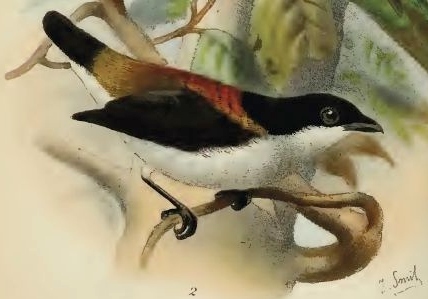
The Cebu flowerpecker (Dicaeum quadricolor) is a small passerine bird. It is endemic to Cebu Island in the Philippines. Feared to have become extinct early in the 20th century, it was rediscovered in 1992 in a small patch of limestone forest in the Central Cebu Protected Landscape. It has since been found at three other sites, namely the Nug-as forest of Alcoy, Mount Lantoy of Argao and the forests of Dalaguete. While sightings until the 2000s were frequent, this species became rarer and rarer and some now believe that this species is now extinct.
This four-colored bird normally grows to 11 or 12 centimeters. The male is characterized by a large, triangular, scarlet to vermilion coat stain. In the female, the top is brown. The Cebu flowerpecker consumes small fruits and mistletoe plants and is generally active in the mornings to avoid competition with more aggressive birds. Despite attempts to protect its habitat it remains critically endangered due to illegal logging.
From the article Cebu flowerpecker on Wikipedia (CC BY-SA), quoted section by section
Description
This four-colored bird normally grows to 11 or 12 centimeters (4.3 or 4.7 in). The male is characterized by a large, triangular, scarlet to vermilion coat stain. The lower back is ochre with green approach. Back, neck, head and sides of neck, wings and tail are glossy blue-black. The underside is pale yellow. Chin, belly center, armpits, under tail-coverts, and under wing-coverts are white. The edges are blurred light olive. In the female, the top is brown. The head is slightly faded olive, the back, the wing-coverts and outer webs of secondaries are strongly washed out olive. The rump is almost entirely olive-yellow. The underside is white with a faint gray olive-yellow approach that is brighter towards the center of the chest and abdomen. The under wing-coverts, shoulders and inner webs of the quills are white.
Range & habitat
The Cebu Flowerpecker is known to inhabit the Tabunan Forest, the Babayungan Forest in Dalaguete, and the Nug-as Forest in Alcoy on the island of Cebu in the Philippines. The Cebu Flowerpecker is commonly found in the closed forest canopy and near flowering or fruiting plants; these areas are located in the interior and outskirt ranges of the forests.
Wikipedia: “Habitat”
What it does
The Cebu Flowerpecker consumes small fruits and mistletoe plants to get its energy; these mistletoe plants are ideal for many birds in Cebu because they are abundant and bear fruits and flowers on a monthly basis. The endemic Cebu Mistletoe, Lepeostegeres cebuensis, that it has been seen feeding on most varies from other common mistletoe plants in its ridges of orange-brown scales on the young leaves and internodes. It is a light green color and blossoms needle-like pink flowers about 4 millimeters long in clusters which are a great source of food for the Cebu Flowerpecker.
Wikipedia: “Diet”
Listen
Looking for field recordings…
Where it lives
Recorded sightings
—
geo-referenced records in GBIF, from museums, herbaria and field observers.
Drag the globe to turn it. Dots are where records exist, not a range map; darker means more records.
In the stacks
Searching the stacks…
Every page naming Dicaeum quadricolor in the Biodiversity Heritage Library →
This page is assembled live from iNaturalist, GBIF, Wikipedia, the Source Library and the Internet Archive. It is not yet part of the hand-edited codex. iNaturalist taxon 13402.