On eBird ↗
Ashy Flowerpecker
Live sightings near you, the range map, bar charts of when it is seen, and Macaulay Library photos and recordings.
Ashy Flowerpecker
Dicaeum vulneratum
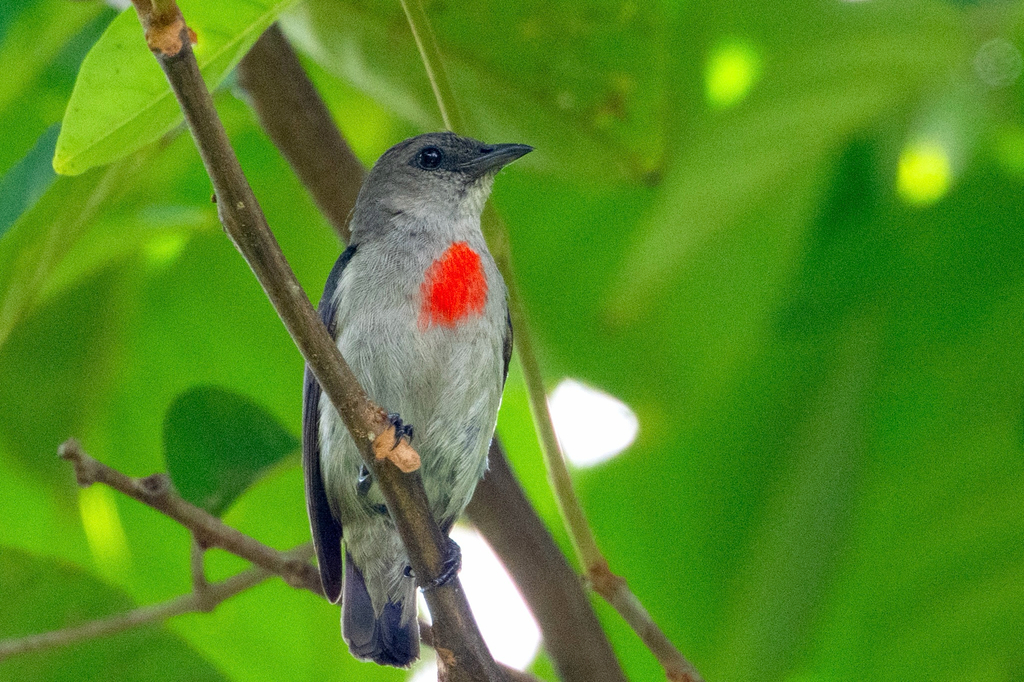
The ashy flowerpecker (Dicaeum vulneratum) is a species of bird in the family Dicaeidae. It is endemic to Indonesia where it occurs on Seram, Ambon and nearby islands in the Banda Arc. Its natural habitats are subtropical or tropical moist lowland forest and subtropical or tropical moist montane forest.
From the article Ashy flowerpecker on Wikipedia (CC BY-SA), quoted section by section
Description
Ashy flowerpeckers range between 8 and 8.5 cm in length. The species is dimorphic - both adult males and females have primarily brown upperparts and gray underparts with black legs and bill and a red patch on the rump (this patch is yellowish-green in juveniles), but males have a red patch on the breast, while females have a white throat and breast. Apart from rump color, juveniles are similar to females in coloration. The ashy flowerpecker's thin, high-pitched song varies throughout its range. On Ambon, it consists of three trisyllabic notes, while on Seram, it consists of three disyllabic notes.
Range & habitat
The ashy flowerpecker is found on the island of Seram, as well as the surrounding islands of Saparua, Boano, Ambon, and the islands of the Gorong archipelago. Within that range, it favors both forests and more degraded woody areas like gardens and farm edges. It can be found anywhere between sea level and 2100 meters in elevation but is most common between 300 and 600 meters.
Wikipedia: “Distribution and habitat”
What it does
Ashy flowerpeckers feed primarily on nectar, but might also consume mistletoe pollen and fruit. They forage both in the forest canopy and at lower levels, joining mixed-species flocks in addition to foraging individually.
Wikipedia: “Food and feeding”
Listen
Looking for field recordings…
Where it lives
Recorded sightings
—
geo-referenced records in GBIF, from museums, herbaria and field observers.
Drag the globe to turn it. Dots are where records exist, not a range map; darker means more records.
In the stacks
Searching the stacks…
Every page naming Dicaeum vulneratum in the Biodiversity Heritage Library →
This page is assembled live from iNaturalist, GBIF, Wikipedia, the Source Library and the Internet Archive. It is not yet part of the hand-edited codex. iNaturalist taxon 13390.