On eBird ↗
Olive-crowned Flowerpecker
Live sightings near you, the range map, bar charts of when it is seen, and Macaulay Library photos and recordings.
Olive-crowned Flowerpecker
Dicaeum pectorale
The olive-crowned flowerpecker (Dicaeum pectorale) is a small passerine bird in the flowerpecker family, Dicaeidae. It is found in far western New Guinea and on adjacent islands.
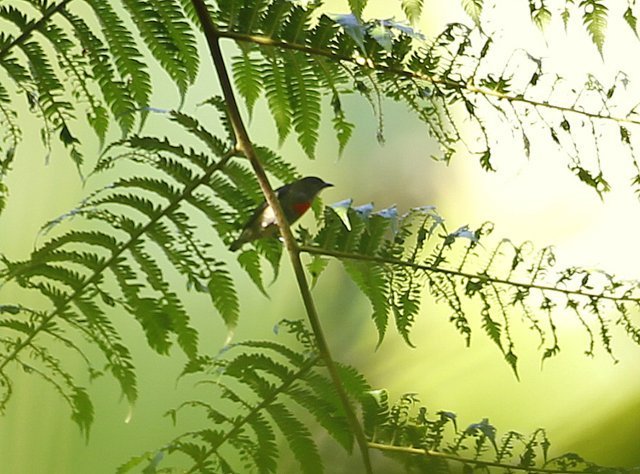
It is a small bird, with males having olive upperparts, greyish-green underparts, a white throat and a scarlet breast patch. Females are similar to males, but lack the scarlet breast patch. It is mainly frugivorous, also supplementally feeding on spiders.
From the article Olive-crowned flowerpecker on Wikipedia (CC BY-SA), quoted section by section
Description
The olive-crowned flowerpecker is a small bird, 9 cm (3.5 in) in length and weighing 7–7.8 g (0.25–0.28 oz). Nominate males have olive green upperparts and crown, yellowish rumps, grey-green underparts, yellowish-white central abdomen and undertail coverts, white throats, and a large scarlet patch on breast. Females are similar to males, but lack the scarlet throat patch and have yellower center of abdomen and undertail coverts. Juveniles are similar to females, but have more olive underparts. Vocalisations include a short, insect-like buzzing note, a single, high upslurred note, and a drawn-out chew, repeated at intervals.
Range & habitat
The olive-headed flowerpecker is found throughout lowlands in western New Guinea and on nearby islands. It inhabits forest canopy up to altitudes of 1,500 m (4,900 ft), although it can be found up to altitudes of 2,350 m (7,710 ft). It is common to uncommon throughout its range.
Wikipedia: “Distribution and habitat”
What it does
Like other flowerpeckers, the olive-headed flowerpecker feed mainly on fruit, especially figs and mistletoe. It also supplements its diet with spiders. Foraging is done in the canopy, either alone or in pairs.
== References ==
Wikipedia: “Diet”
Listen
Looking for field recordings…
Where it lives
Recorded sightings
—
geo-referenced records in GBIF, from museums, herbaria and field observers.
Drag the globe to turn it. Dots are where records exist, not a range map; darker means more records.
In the stacks
Searching the stacks…
Every page naming Dicaeum pectorale in the Biodiversity Heritage Library →
This page is assembled live from iNaturalist, GBIF, Wikipedia, the Source Library and the Internet Archive. It is not yet part of the hand-edited codex. iNaturalist taxon 13376.